Say the word Essex and people tend to picture nightclubs, fake tan and reality TV. Which is, frankly, a little unfair. The real Essex is far bigger, older, greener and more interesting than its reputation suggests. This is one of England’s oldest counties, where ancient forests rub shoulders with seaside resorts, Roman ruins sit quietly in market towns, and winding rivers cut through wide marshes.
Essex is a county full of odd contrasts. Just when you think you have it figured out, it offers something completely unexpected.
Romans, Saxons and the bits before the telly shows
Long before reality television discovered Essex, the Romans arrived at Colchester, or Camulodunum as they called it, and made it the first Roman capital of Britain. You can still wander the town’s Roman walls, admire ancient mosaics, and visit the excellent castle museum, which has been quietly doing history long before anyone invented the phrase ‘reality star’.
Further down the timeline, Essex became a stronghold of the East Saxons (from whom the county gets its name), and many of its ancient churches and villages can trace their roots back well over a thousand years.
Estuaries, marshes and rather a lot of birds
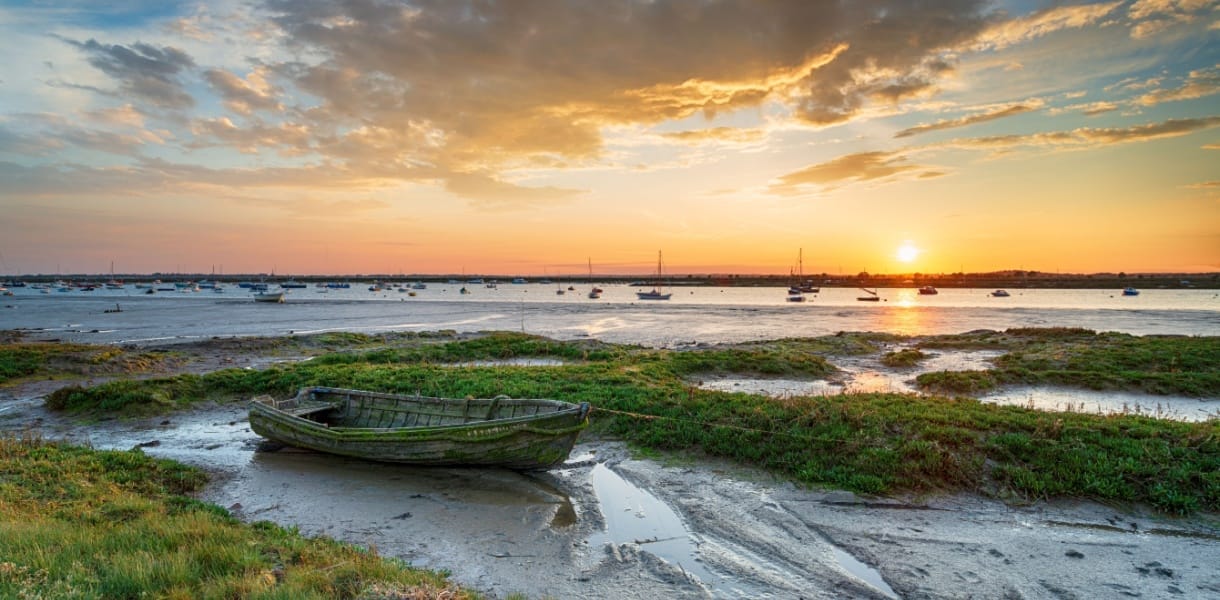
Much of Essex is defined by its relationship with the sea. The twisting coastline of estuaries, creeks and mudflats makes it one of the longest coastlines in England, even if much of it hides shyly behind marshes and reeds. The River Blackwater, Crouch and Thames wind through wide saltmarshes that attract thousands of birds, and rather fewer people, which is part of their charm.
Places like Maldon are famous for their sea salt, while the old Thames barges still gather at Hythe Quay, their red sails creating one of the county’s most quietly beautiful scenes.
Seaside towns, candyfloss and slot machines
Of course, Essex does have its louder side, and nowhere shows it better than Southend-on-Sea, home to the world’s longest pleasure pier. The pier stretches out into the Thames Estuary for over a mile and a third, which is far enough that many visitors sensibly take the little train rather than walk.
Further up the coast, Clacton and Walton-on-the-Naze offer traditional British seaside fun: arcades, fish and chips, and just enough wind to make you wish you had brought a warmer jacket.
Villages, market towns and ancient woods
Inland, Essex reveals a far more rural face. Villages like Finchingfield, Coggeshall and Thaxted offer duck ponds, half-timbered cottages and medieval churches that look like they belong on a postcard. Market towns such as Saffron Walden and Great Dunmow retain their old-world charm, complete with crooked streets, independent shops and weekly markets that have been running for centuries.
Epping Forest, once a royal hunting ground, still sprawls across thousands of acres on the edge of London, offering walkers, cyclists and slightly lost dog owners plenty of space to explore.
Secret islands, oyster beds and the wild edge
Essex even has islands, though they rarely shout about themselves. Mersea Island remains a wonderfully sleepy spot, known for its oysters and its causeway that disappears at high tide, temporarily turning it into a proper island again.
Nearby, the Dengie Peninsula and the remote chapel of St Peter-on-the-Wall feel like the end of the world — lonely, windswept and oddly peaceful.
Where reputation and reality part company
Essex has managed to gather a reputation that only tells one small part of the story. The real county is far older, greener, quieter and more varied than most people realise. It is a place of ancient roots, secret marshes, pretty villages and long stretches of sky where nothing much happens — and that, quite often, is exactly the point.
10 of the best reasons to visit Essex
Essex is one of those places that everyone thinks they know, but usually don’t. Say the word and people picture TV shows, spray tans and an awful lot of white Range Rovers. But step away from the clichés and you’ll find a county that is, in turns, ancient, surprising, and occasionally delightfully eccentric. From medieval market towns and fossil-filled cliffs to jam that has travelled further than most of us ever will, Essex has plenty to boast about.
Here are ten reasons why you should give it a proper look.
1. Colchester Castle
Britain’s oldest recorded town comes with bragging rights, and Colchester Castle is the centrepiece. This is no dainty turreted thing — it’s the largest Norman keep in Europe, built on the foundations of a Roman temple. Inside, you’ll find everything from medieval armour to stories about Boudicca’s rebellion, proving that Colchester has been causing trouble for two millennia.
2. Dedham Vale (Constable Country)
Some landscapes just look like paintings, and in this case they literally are. John Constable set up his easel here, turning Essex meadows and rivers into works that now hang in the world’s grandest galleries. Dedham Vale, part of the Stour Valley, is a patchwork of fields, slow-moving water, and villages where nothing appears to have changed for centuries — apart from the odd café serving flat whites.
3. Southend Pier
Essex doesn’t do things by halves, so of course it has the world’s longest pleasure pier. Southend’s stretches 1.34 miles into the Thames Estuary, so long that a small train runs along it in case the walk feels a bit much. At the far end, you’re rewarded with bracing sea air, gulls eyeing your chips, and the satisfying knowledge that you’ve just walked into the sea without getting your shoes wet.
4. Mersea Island
Oysters are the star of the show on Mersea Island, where seafood has been pulled from the water for centuries. At low tide you can wander the creeks and shoreline; at high tide you might just get stuck, as the road floods twice a day. A proper island, then, with salty air, beach huts, and shellfish so fresh they’ve probably only just been convinced to leave the sea.
5. Audley End House and Gardens
If you’ve ever wondered how the Jacobean elite lived, Audley End provides the answer: lavishly. The house is all grand staircases and opulent rooms, while the gardens were sculpted by Capability Brown, who had a knack for making the countryside look better than nature managed on its own. There’s also a working Victorian kitchen, so you can discover just how many people it once took to make a decent pudding.
6. Saffron Walden
One of the prettiest towns in Essex, Saffron Walden is all wonky timber-framed houses, medieval streets and a church that looks more like a cathedral. Once famous for growing saffron, it now thrives on its markets, independent shops, and the sort of old-fashioned charm that makes you feel like you’ve stepped into a period drama — minus the horses.
7. Maldon’s Hythe Quay
Down at Maldon’s quayside, historic Thames sailing barges bob at their moorings, looking like they’ve sailed straight out of a sepia photograph. The town is also home to Maldon sea salt, a pantry essential used by chefs across the globe. It’s hard not to feel a bit of pride as you sprinkle a pinch on your chips, knowing it was harvested just down the road.
8. Leigh-on-Sea
Part fishing village, part arty enclave, Leigh-on-Sea has managed to hold onto its working cockle sheds while filling its lanes with galleries, pubs and quirky shops. On a summer’s evening it feels like half of Essex has descended here for seafood, a pint, and views across the estuary. If you want a spot that sums up the county’s character — traditional but with a creative streak — this is it.
9. Walton-on-the-Naze
Head for the cliffs of Walton-on-the-Naze and you’ll find two things: spectacular coastal views and fossils galore. Children (and plenty of adults) spend happy hours hunting ancient shark teeth and shells along the beach. The Naze Tower, an 18th-century brick lighthouse, adds to the drama, while the sense of history underfoot stretches far further back than most of us can comprehend.
10. Tiptree Jam Museum and Tea Room
Essex isn’t shy about celebrating its food, and the Tiptree Jam Museum is a delight. Wilkin & Sons have been making preserves here since 1885, and their jams have travelled everywhere from Buckingham Palace to British embassies abroad. The museum tells the story, but the real highlight is the tea room, where you can smother scones in jam that’s quite possibly more famous than the village it comes from.
The final word
Forget the stereotypes. Essex is a county of deep history, inventive food, lively coastlines, and quiet countryside that has inspired great art. Visit with an open mind, and you’ll soon find yourself defending it to anyone who dares dismiss it.