There are cities that whisper their history politely and there are cities like Cambridge that hurl it at you with a sense of giddy academic mischief. Walk five paces and you’ve stumbled upon Newton’s old digs. Turn a corner and you’re retracing the footsteps of Darwin, Wordsworth, or Stephen Hawking. It’s the sort of place where every stone seems to have passed an exam.
Cambridge, that dreamy cluster of colleges and cobbles in Cambridgeshire, is more than just the sum of its scholars. It’s a place of gentle anarchy and pleasant contradictions. It’s grand without being grandiose, clever without being smug, and, on a sunny weekend, just about the finest spot you could hope to find yourself in.
Cambridge, first impressions and accidental genius
The first thing that strikes you is how walkable it is. Everything seems reassuringly close and gently jumbled. The streets wind as if designed by a distracted mathematician who was late for a lecture. You’re never more than a few minutes from something marvellous: a chapel that looks like it was hand-delivered from another century, a bookshop you could accidentally live in, or a man in a straw hat selling strawberries from a bicycle cart.
Even the road signs are oddly charming. Trinity Street, King’s Parade, Silver Street. They sound less like directions and more like characters in a Jane Austen novella.
The backs and the art of being agreeably idle
No visit to Cambridge is complete without ambling along the Backs, the elegantly dishevelled green ribbons behind the colleges that run beside the River Cam. The name comes not from some elaborate Latin etymology, but simply because these are the backs of the colleges. That’s the kind of place Cambridge is. Grand buildings with no need to show off.
You wander past immaculately mown lawns, spindly trees doing their best to lean photogenically, and bridges with names that sound like settings for historical duels. The Bridge of Sighs (no relation to Venice’s) arches delicately over the river like it’s in on a secret. The Mathematical Bridge, rumoured to have been built without nails (spoiler: it wasn’t), looks like something a geometry teacher might dream about after a particularly strong pot of tea.
There’s something pleasantly timeless about the whole stretch. You feel as if you could lie down on the grass with a copy of The Wind in the Willows and wake up in 1923.
Punting and the great riverside shuffle
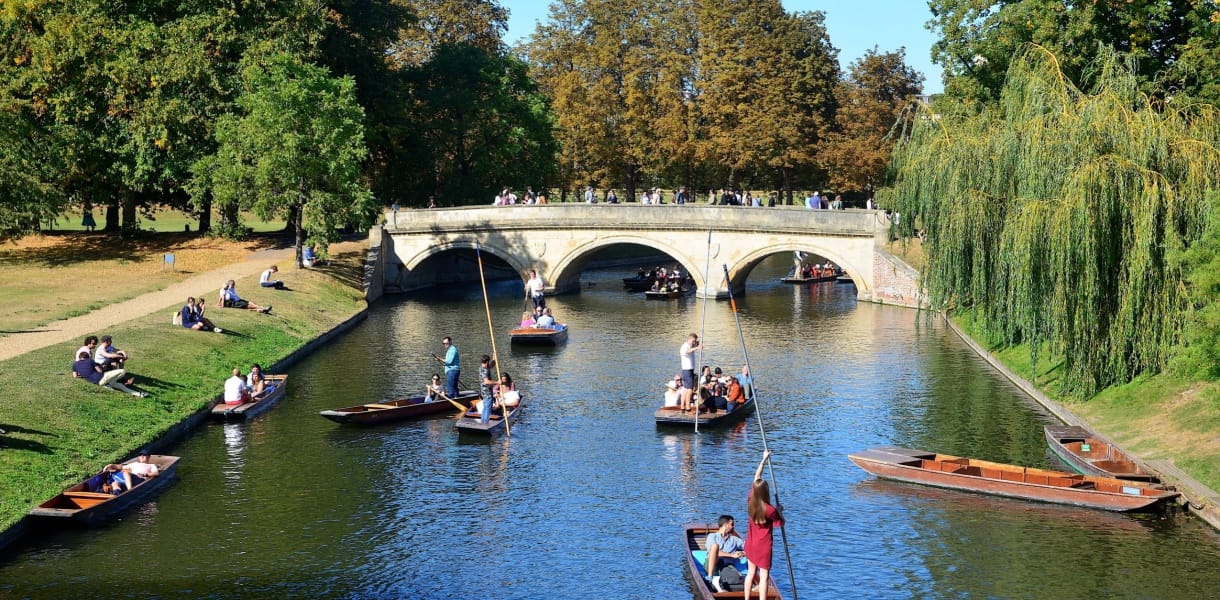
Of course, no one can properly say they’ve been to Cambridge without going punting. This is boating for those who like their leisure with a touch of gentle peril and occasional confusion.
You can hire a punt yourself or pay someone in a waistcoat to do it for you. The latter is highly recommended unless you enjoy the sensation of slowly rotating in place while people on bridges take photos of your failure.
Gliding along the Cam, propelled by a polite teenager named Josh who can quote Milton while steering around swans, is oddly hypnotic. The colleges float past like participants in a historical pageant. King’s Chapel looms in solemn splendour. Clare Bridge, the oldest in town, offers up its deliberately damaged globe (a mystery no one’s quite cracked). There are willows trailing their fingers in the water, ducks playing chicken with punts, and the occasional rogue football bobbing along like a forgotten thought.
A picnic that beats any formal dining
Around lunchtime, when your punt is threatening to become a sun trap, it’s time to moor up and enjoy the time-honoured Cambridge tradition of the riverside picnic.
Find a patch of grass near Jesus Green or along the Backs and unpack your modest feast. A few sandwiches, a punnet of cherries, something cold and fizzy. It doesn’t need to be complicated. The view does all the heavy lifting. You get the sound of lapping water, the thud of punting poles, and the occasional cry of “Sorry!” as another amateur mariner careers into a bush.
Even the pigeons seem erudite here. One eyed my flapjack with what can only be described as a scholarly air.
Wandering among the wonders
Post-picnic, there’s more to explore. King’s College Chapel, naturally, is the showstopper. It’s Gothic with a capital G and then some. The fan-vaulted ceiling is so intricate it looks like it’s showing off. And when the choir starts practising, you could almost believe in angels.
There’s the Fitzwilliam Museum, which does that wonderfully British thing of being enormous and free. Inside you’ll find everything from Roman coins to French impressionists. It’s the sort of place where you go in for ten minutes and emerge three hours later wondering why your legs no longer work.
Or pop into the University Library, which is more fortress than building, housing millions of books and the kind of hush that feels morally improving.
Cafes, bicycles and a touch of eccentricity
The joy of Cambridge isn’t just in the showpieces. It’s in the details. The café that sells both Ethiopian coffee and second-hand poetry books. The blackboard outside the pub declaring “Dogs welcome, humans tolerated.” The bicycle with a basket overflowing with violas and possibly a thesis.
This is a city that has long nurtured eccentricity like a prized orchid. You’ll spot professors in rainbow socks arguing about Chaucer, and students wearing tuxedos at 2pm, apparently en route to exams. Nobody bats an eyelid. In fact, it would be more shocking to see someone behaving normally.
Evenings by the river and the world’s best closing act
As the day winds down, the river becomes even lovelier. The sunlight gets syrupy, the punts fewer, and everything takes on that golden, slightly unreal glow that makes you want to say things like “Isn’t this just splendid?”
There are riverside pubs where you can sit with a pint and reflect on the fact that Isaac Newton probably once stood not far from where your crisps are now resting. The Anchor and the Mill are fine choices. You can gaze at the Cam, still and perfect, and feel quietly superior to anyone not currently in Cambridge.
And if you’re very lucky, there’ll be music drifting across the water from some unseen student gathering, probably involving a cello and at least one ukulele. It’s oddly moving. The perfect soundtrack to a perfect weekend.
Leaving with more than you came with
Cambridge does something to you. It gently rearranges your expectations of a city. It makes you want to learn things, wear linen, and keep a notebook just in case a brilliant thought lands uninvited.
It’s a place of ideas, of playfulness, of beauty so matter-of-fact it doesn’t even need to announce itself. And for a weekend, that’s more than enough. You arrive with a backpack and leave with a head full of stories, a phone full of terrible punting photos, and the quiet certainty that you’ll be back.
Because once you’ve seen the world from the back of a punt, there’s really no going back. And truth be told, you won’t want to.
Cambridge quick guide
Getting here
- Fast trains run from London King’s Cross and Liverpool Street in about an hour
- Direct services also connect with Norwich, Birmingham, and Stansted Airport
- The city centre is a 15-minute walk or short bus ride from the station
Where to stay
- Boutique boltholes in converted townhouses around Regent Street
- Traditional inns and pubs with rooms near the river
- University college rooms available to book outside of term time for a unique stay
Where to eat
- Riverside picnics are a must, but you’ll also find cosy pubs serving hearty classics
- Independent cafés around King’s Parade and Mill Road offer excellent coffee and pastries
- The market square has street food stalls with plenty of local flavour
What to do
- Punt along the River Cam past King’s College and the Bridge of Sighs
- Visit King’s College Chapel and the Fitzwilliam Museum
- Wander the Backs, explore bookshops, and take in the lively café culture
Nearby gems
- Ely, with its soaring cathedral, is a 20-minute train ride away
- Grantchester Meadows, made famous by poets, are perfect for a riverside walk
- The Imperial War Museum at Duxford showcases historic aircraft and wartime stories
Best time to visit
- Spring brings blossom along the river and a lively student buzz
- Summer is ideal for punting and outdoor picnics
- Autumn offers crisp walks and quieter colleges once term begins