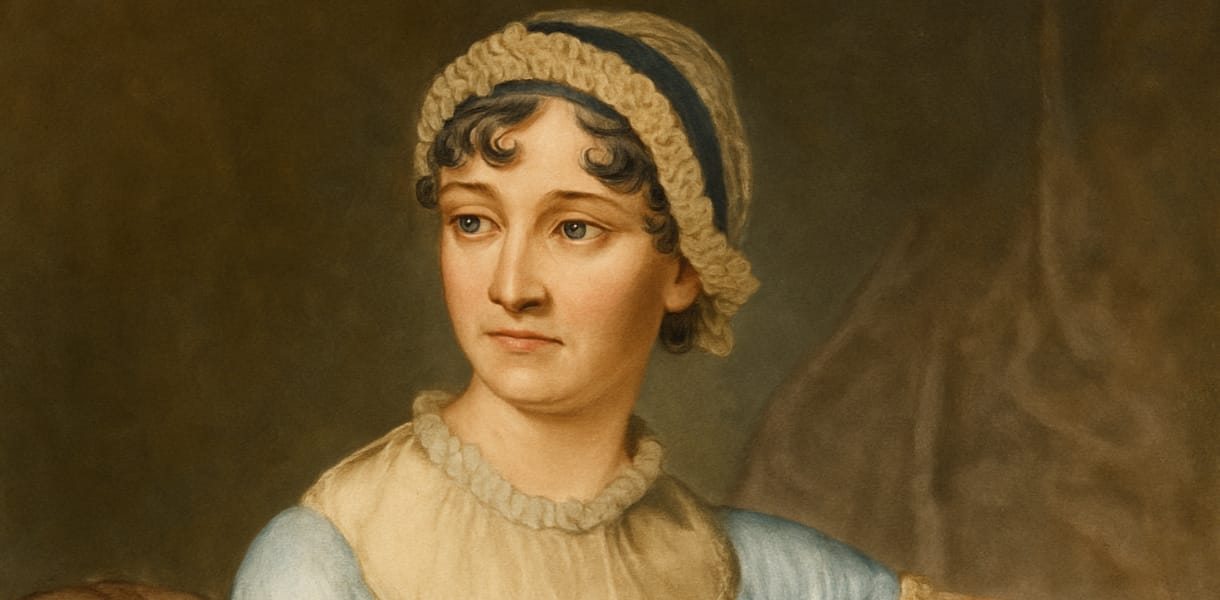
Few writers have managed to capture the delicate dance of human manners, love, and ambition with the wit and precision of Jane Austen. Living a life that, at first glance, seemed quiet and provincial, Austen nevertheless became one of the sharpest chroniclers of Georgian England. Her novels, written from the parsonage drawing room, continue to sparkle with irony, humour, and insight into the timeless workings of the human heart.
Early life in Hampshire
Jane Austen was born on 16 December 1775 in the village of Steventon, Hampshire, the seventh of eight children in a lively and affectionate family. Her father, George Austen, was the rector of Steventon, and her mother Cassandra was known for her wit and stories. It was a household where books were treasured and theatricals staged in the barn, where children were encouraged to read, write, and make jokes at one another’s expense.
Jane and her beloved sister Cassandra were educated partly at school and partly at home, but Jane’s true education came from devouring the family library and observing the world around her. Even as a teenager she began to write spirited stories and parodies, collected in her youthful notebooks now known as the Juvenilia. These early works showed the same sharp eye and irreverent humour that would later make her novels so distinctive.
A writer at work
By her twenties Austen was shaping her craft with more ambitious works. She drafted Sense and Sensibility, Pride and Prejudice, and Northanger Abbey in the 1790s, though all would undergo revision before eventual publication. Her daily life in Hampshire might have seemed uneventful, family visits, walks in the countryside, dances at local assemblies, but Austen was quietly dissecting the social rituals and expectations that defined her world.
Her writing desk was famously small, a modest table without even a lid, but from this perch she produced sentences so finely balanced they still glitter two centuries later. Her genius lay not in sweeping epics or melodramatic plots, but in rendering the nuances of conversation, the subtlest flicker of pride or folly, and the unspoken tensions of courtship.
Publication and recognition
Austen’s path to publication was neither smooth nor swift. Northanger Abbey, a playful parody of Gothic novels, was sold to a publisher in 1803 but languished unpublished for years. It was not until 1811 that her first novel, Sense and Sensibility, appeared, published anonymously as “By a Lady.”
The book was a success, and it was followed by Pride and Prejudice in 1813, which Austen herself called her “own darling child.” Its sparkling dialogue and the slow-burn romance of Elizabeth Bennet and Mr Darcy made it an instant favourite, and it remains one of the most beloved novels in English literature.
She went on to publish Mansfield Park (1814) and Emma (1815), each pushing her exploration of social mores, personal integrity, and the pursuit of happiness. Her final works, Persuasion and Northanger Abbey, were published posthumously in 1817.
Themes and legacy
What makes Austen’s novels endure is their combination of romance with razor-sharp social commentary. She wrote at a time when women’s choices were often constrained by wealth and marriage, yet her heroines are not passive figures. Elizabeth Bennet, Anne Elliot, and Elinor Dashwood all navigate a world that seeks to limit them, asserting their intelligence, moral clarity, and independence.
Austen’s humour is equally enduring. She delights in skewering vanity, pomposity, and pretension – whether it is the ridiculous Mr Collins, the garrulous Mrs Bennet, or the officious Lady Catherine de Bourgh. Her novels remind us that human absurdity is timeless, and that laughter is often the sharpest form of truth.
Her style,ironic, concise, and observant, has influenced generations of writers. From George Eliot to modern romantic comedy, Austen’s DNA can be found everywhere. And her works continue to inspire films, television adaptations, and even modern retellings like Bridget Jones’s Diary and Clueless.
A life cut short
Jane Austen’s life was not a long one. In 1809 she moved with her mother and sister to a cottage at Chawton, Hampshire, on the estate of her brother Edward. It was there, in relative stability, that she revised and wrote the novels that would make her name.
But her health began to fail in 1816, and by July 1817 she was gone, aged just 41. The exact cause remains debated – Addison’s disease, Hodgkin’s lymphoma, or tuberculosis of the adrenal glands have all been suggested. She was buried in Winchester Cathedral, where her memorial tablet praises her personal virtues but makes no mention of her literary achievements, which were still only beginning to be recognised.
Rediscovery and fame
After her death, her novels never truly disappeared, but it was the later 19th century that saw a surge of admiration. The Victorians, particularly with the publication of her nephew James Edward Austen-Leigh’s Memoir of Jane Austen in 1870, began to view her as a national treasure. By the 20th century she had become one of Britain’s most celebrated authors, her works studied, adapted, and adored worldwide.
Today, Jane Austen is more than a novelist – she is a cultural touchstone. She appears on the ten-pound note, her birthplace and homes are literary shrines, and her words are quoted by readers who may never have cracked open a Regency novel before. Few writers could have predicted such a destiny for a clergyman’s daughter writing quietly in Hampshire.
Places to visit
For those wishing to follow in Austen’s footsteps, there are plenty of places across southern England that bring her story to life:
- Steventon, Hampshire – The village where Austen was born and spent her early years. The rectory is gone, but the church where her father preached remains.
- Chawton Cottage, Hampshire – Now the Jane Austen’s House Museum, this is where she lived for the last eight years of her life and wrote or revised her major works. The modest rooms and gardens offer an intimate glimpse into her world.
- Bath – Austen lived here from 1801 to 1806, and the city features prominently in Northanger Abbey and Persuasion. The annual Jane Austen Festival celebrates her life with costumes, talks, and lively events.
- Winchester Cathedral – Her final resting place, where admirers from around the world come to pay respects.
Why Jane Austen matters today
Austen’s genius lies in her ability to make the particular universal. The concerns of early 19th-century English society – inheritance laws, polite dances, the pressure to marry well – might seem distant. Yet her novels still speak to anyone who has struggled with pride, been misled by appearances, or longed for a love that is both tender and true.
She reminds us that ordinary life, the dinners, the conversations, the small misunderstandings, contains all the drama and comedy one could ever need. And she does so with sentences so elegant and sly that readers often find themselves smiling without quite realising why.
Jane Austen, the quiet revolutionary, wrote from the sidelines but changed the game. She captured not only her own world but something enduringly human. Over two hundred years on, her novels are still cherished, proving that wit, honesty, and empathy never go out of fashion.