Few places in Scotland carry the weight of history as heavily as Stirling. Once the key to controlling the north, it was the stage for two of Scotland’s most dramatic victories in the Wars of Independence. To walk the city’s cobbled streets today is to wander through a living monument to the legacies of William Wallace and Robert the Bruce. Castles, battlefields and towering memorials keep their stories alive, while the surrounding landscape still holds the echoes of swords, shouts and hard-won freedom.
The setting that shaped a nation
Stirling sits at the heart of Scotland where the River Forth narrows to a natural crossing point. Whoever held Stirling held the gateway between Highlands and Lowlands. It is no surprise that the city became the focus of fierce struggles in the late thirteenth and early fourteenth centuries. English kings saw Stirling as a prize to secure their authority in Scotland. Scottish leaders saw it as the key to resistance. This tension came to a head in two of the most famous battles in Scottish history, fought only miles apart.
William Wallace and the Battle of Stirling Bridge
In September 1297, William Wallace rose to prominence with a victory that stunned Europe. Alongside Andrew Moray, he led a Scottish force against the English army at Stirling Bridge. The English had marched north confident of an easy win. Instead they walked into a trap. Wallace and Moray allowed the enemy to cross the narrow wooden bridge in small numbers. Once half the force was over the river, the Scots charged. The bridge collapsed under the chaos and the English army was cut down.
The battlefield can still be explored today. A short walk from the modern city centre, the site is marked by a pair of stone monuments and quiet riverside paths. The air is calm now but it is easy to imagine the thunder of hooves and the cries of soldiers caught in the crush. The victory did not end the war but it sent a message that Scotland would fight for its freedom. Wallace became Guardian of Scotland, a national hero and a thorn in the side of Edward I of England.
The National Wallace Monument
To see how Wallace is remembered, visitors climb the steep hill of Abbey Craig. At the summit stands the National Wallace Monument, a Victorian tower that dominates the skyline. Completed in 1869 after a surge of romantic nationalism, it rises 67 metres high with turrets and crown-like stonework. Inside, exhibitions tell the story of Wallace’s life, from the ambush at Lanark to the triumph at Stirling Bridge and his brutal execution in London.
Climbing the spiral staircase rewards you with views across the Forth Valley, the Ochil Hills and the mountains beyond. The panorama explains why Stirling mattered so much in medieval times. It is a place where the land funnels together, forcing armies to meet. For many visitors, the sight of the battlefield from above is a highlight of the trip. It turns history into geography, connecting the deeds of Wallace with the ground beneath your feet.
Robert the Bruce and the Battle of Bannockburn
If Wallace lit the fire of resistance, it was Robert the Bruce who secured Scotland’s independence. In June 1314 he faced Edward II’s army at Bannockburn, two miles south of Stirling. Bruce had been crowned king in 1306 and spent years fighting a guerrilla campaign. Bannockburn was the moment of decision. Edward marched to relieve Stirling Castle, which was under siege by the Scots. Bruce blocked his path with a smaller force of disciplined soldiers, many armed with long spears.
The battle lasted two days. On the first day, Bruce himself fought in single combat against the English knight Henry de Bohun. With a well-timed blow of his axe, Bruce killed his challenger and lifted Scottish morale. On the second day, the Scottish schiltron formations held firm against repeated English cavalry charges. The English army panicked, retreating into the marshes and the River Forth. Thousands were killed and Edward fled south. The victory was decisive. Scotland’s independence was secured for a generation, sealed later by the Declaration of Arbroath.
The Bannockburn Visitor Centre
Today the battlefield is interpreted through the Bannockburn Visitor Centre, run by the National Trust for Scotland. It combines high-tech displays with outdoor trails. Inside, a 3D experience places you in the heart of the fight, surrounded by soldiers and horses. Interactive screens allow you to command your own battle, learning how terrain and tactics shaped the outcome. Outside, the statue of Robert the Bruce on horseback stands tall, looking out over the fields where the battle turned.
Walking the site reveals open meadows, wooded areas and quiet corners that invite reflection. Information boards guide you through key moments of the battle. Like Stirling Bridge, Bannockburn is no longer a place of blood and dust. It is a landscape of memory where Scotland’s identity was defined.
Stirling Castle, a prize worth fighting for
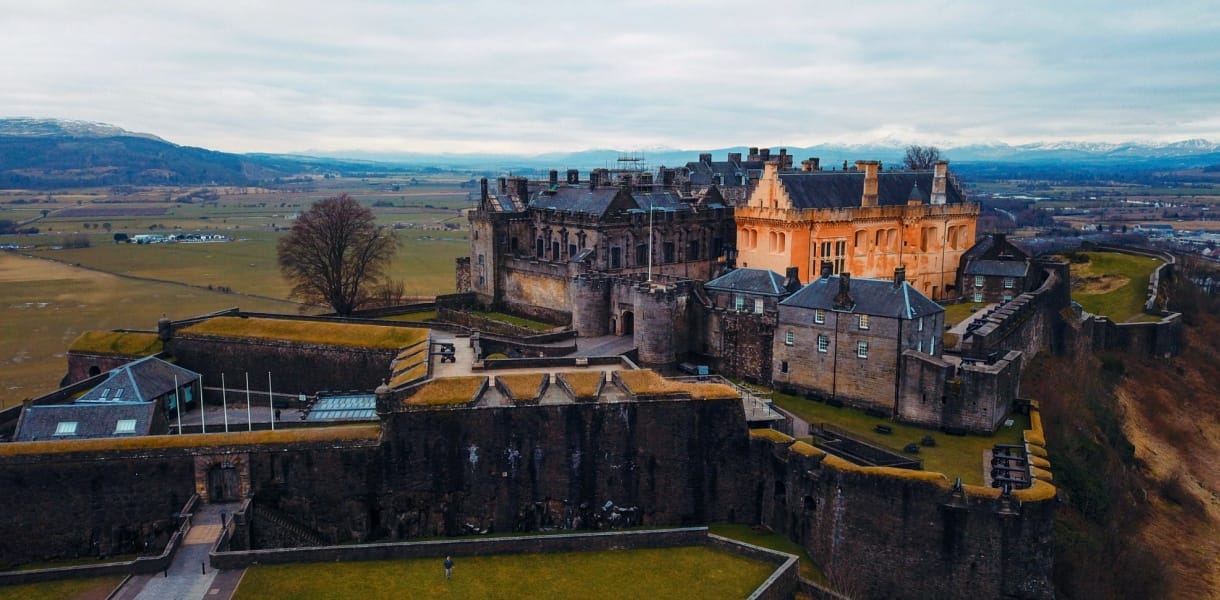
Between these two battles stands Stirling Castle, the fortress that drew armies from both sides. Perched high on a volcanic crag, it dominates the city and commands views for miles. The castle was besieged and exchanged hands multiple times during the Wars of Independence. For Edward I it was the gateway to Scotland. For Wallace and Bruce it was a prize that symbolised control of the kingdom.
Today the castle is one of Scotland’s top visitor attractions. Restored Renaissance palaces reveal the grandeur of the Stewart monarchs who later ruled here. The Great Hall glows with golden harling. The Royal Palace shows colourful recreated tapestries. The Chapel Royal, built for James VI, carries delicate painted decoration. Yet the military history is never far away. The outer defences, artillery batteries and sheer cliffside remind visitors why this was once the most fought-over castle in Scotland.
From the battlements you can see the Wallace Monument to the north and Bannockburn to the south. The view ties the stories together, a living map of Scotland’s fight for freedom.
A city layered with history
Beyond the great battles, Stirling offers quieter reminders of its past. The Old Town is lined with medieval and early modern buildings, including the atmospheric Holy Rude Church where James VI was crowned. The Argyll and Sutherland Highlanders Museum inside the castle grounds tells the story of later regiments that carried Stirling’s martial tradition across the world. The city centre mixes historic lanes with modern shops, cafes and restaurants, making it easy to blend heritage with everyday life.
For those who enjoy walking, the Back Walk path circles the old town walls with views over the surrounding countryside. Further afield, the Ochil Hills and the Trossachs National Park provide landscapes of lochs, forests and mountains that echo the wild country once roamed by Wallace’s men.
Remembering the heroes
Stirling’s power lies in how it makes history tangible. Wallace and Bruce are not just figures from dusty books here. They are present in towers, statues, stones and fields. The city invites visitors to reflect on the meaning of freedom and the price paid for it. While Scotland has changed enormously since the fourteenth century, the stories of Stirling Bridge and Bannockburn continue to inspire pride and debate.
The legacies of Wallace and Bruce also reach beyond politics. They are woven into art, literature and identity. From Blind Harry’s medieval poem about Wallace to modern films, their deeds have become symbols of courage against overwhelming odds. Stirling, with its castle and battlefields, is the stage where these legends feel most real.
Visiting today
Stirling is easy to reach by train from Glasgow and Edinburgh, each about forty-five minutes away. The compact city centre allows you to explore on foot, with buses and taxis linking the castle, the Wallace Monument and Bannockburn. Guided tours bring extra insight, but wandering at your own pace offers time to absorb the atmosphere. Many visitors combine Stirling with day trips into the Highlands or the nearby Trossachs, making it a natural gateway to wider adventures.
Hotels range from grand converted townhouses to cosy guesthouses. Food options include traditional pubs serving haggis and whisky alongside modern restaurants showcasing Scottish produce. With a little planning, it is possible to trace the stories of Wallace and Bruce in a single day, though most travellers find themselves lingering longer.
A legacy written in stone and soil
To stand in Stirling is to stand at the heart of Scotland’s story. Here Wallace turned the tide of resistance at a narrow bridge. Here Bruce secured independence on open fields. Here kings fought for a castle whose walls still rise above the city. These places are not just relics of the past but living landscapes that continue to shape how Scotland sees itself.
For visitors, Stirling offers the rare chance to connect heroes with places, legends with landmarks, and history with the present day. It is a city where battles became nationhood and where the legacies of Wallace and Bruce endure in every stone tower and every stretch of green field.
Places associated with Wallace and Bruce
Stirling Castle
One of Scotland’s most important strongholds and a prize in the Wars of Independence. Explore royal chambers, the Great Hall and sweeping views over the battlefields.
Getting here: A short uphill walk from Stirling city centre or local buses from the train station.
Facilities: Visitor centre, exhibitions, café, gift shop.
Special interest: The battlements provide direct sightlines to the Wallace Monument and Bannockburn.
Website: Stirling Castle
The Battle of Stirling Bridge site
Riverside ground where Wallace and Moray outwitted the English in 1297. Today it is marked by monuments and walking paths along the River Forth.
Getting here: Around 20 minutes on foot from Stirling centre. Parking nearby.
Facilities: Information boards, benches, riverside walks.
Special interest: Best appreciated by following the river path to see the narrow crossing point that shaped the battle.
The National Wallace Monument
Victorian tower built to honour Wallace, with exhibitions, artefacts and sweeping views across the Forth Valley.
Getting here: Shuttle bus from Stirling city centre or car park at the base with a steep climb to the tower.
Facilities: Visitor centre, café, shop, guided tours.
Special interest: Home to Wallace’s legendary sword, over five feet long.
Website: Wallace Monument
Bannockburn Battlefield and Visitor Centre
Site of Bruce’s great victory in 1314, now an immersive museum and outdoor landscape trail.
Getting here: Two miles south of Stirling, reached by local bus or short drive.
Facilities: Interactive visitor centre, café, shop, outdoor trails.
Special interest: The equestrian statue of Robert the Bruce is a modern icon of Scottish identity.
The Abbey Craig
Hill from which Wallace is said to have watched English troops gather before the battle of Stirling Bridge. Today crowned by the Wallace Monument.
Getting here: Accessible from the Wallace Monument visitor centre via a wooded trail.
Facilities: Woodland walks, viewpoints, benches.
Special interest: Offers the best natural vantage point for understanding the topography of the 1297 battlefield.