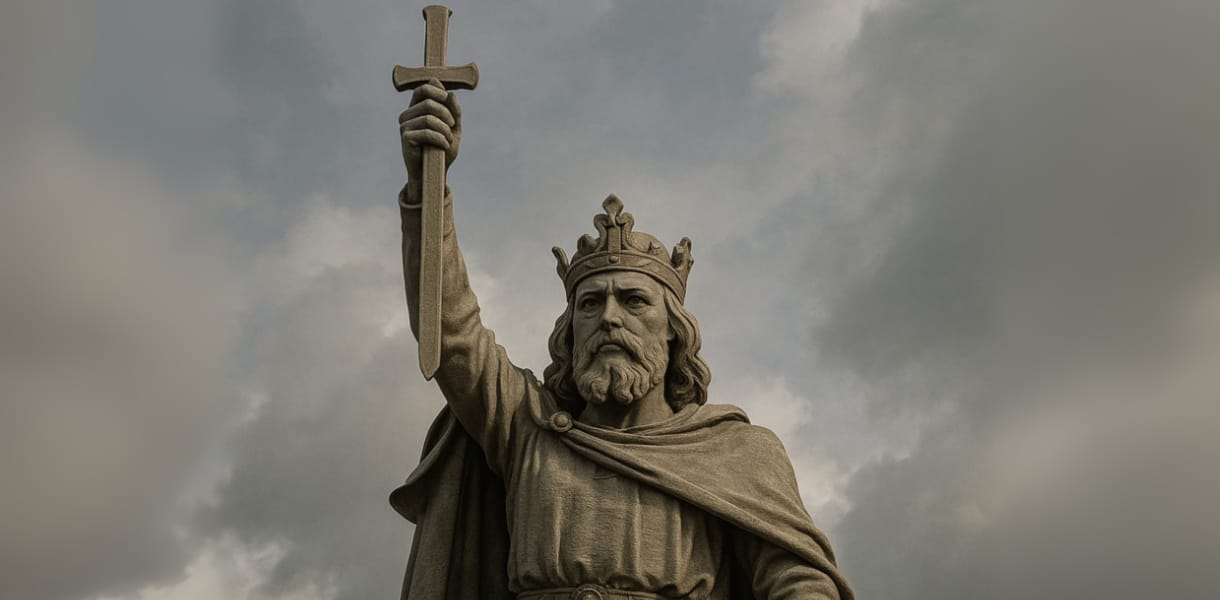
Few figures from the early Middle Ages have loomed quite so large in English history as Alfred the Great. Born in the ninth century, when the idea of a united England was still little more than a distant dream, Alfred became the unlikely king who stood against the Viking onslaught and gave shape to the foundations of the English nation. His story is a mixture of military resilience, political shrewdness, cultural vision, and personal struggle; the kind of tale that has secured him the unique title of “the Great,” the only English monarch to hold it.
Early life and unexpected kingship
Alfred was born in 849 at Wantage in Berkshire, the youngest son of King Æthelwulf of Wessex. In a crowded royal family, no one expected him to inherit the throne. His early years were spent in a land constantly threatened by Viking raids, with the great Scandinavian armies landing on English shores to pillage monasteries, towns, and kingdoms.
As a boy, Alfred was sent to Rome where he was received by Pope Leo IV. Chroniclers later seized on this journey as a moment of divine recognition, a sign that Alfred was destined for greatness. Yet the young prince returned to Wessex with no guarantee of power. Only after the deaths of his elder brothers – each ruling in turn – did Alfred find himself king in 871 at the age of 21, inheriting a realm under siege.
The struggle with the Vikings
Alfred’s reign was defined by one question: how to resist the Vikings, whose Great Heathen Army had already overrun much of Anglo-Saxon England. In his first year as king, Alfred fought nine battles, victories mixed with defeats, against an enemy that seemed inexhaustible. For a time it looked as though Wessex might go the way of Northumbria, Mercia, and East Anglia; kingdoms that had all fallen to Scandinavian power.
The crisis reached its peak in 878, when a Viking surprise attack forced Alfred into hiding. He fled into the marshes of Somerset, a fugitive in his own land. Later legend embroidered this dark period with the famous story of Alfred burning cakes he had been asked to watch while sheltering with a peasant woman, too distracted by thoughts of battle to keep an eye on the oven.
But it was from this low point that Alfred began his remarkable comeback. Rallying the men of Wessex, he emerged from the marshes to defeat the Vikings at the Battle of Edington. The victory forced the Viking leader Guthrum to accept baptism and retreat to East Anglia. Wessex had survived, and with it the possibility of a future England.
A kingdom secured
Alfred knew survival was not enough. To guard against future invasions, he set about transforming his kingdom. He reorganised the military, ensuring that part of the army was always on duty while the other half tended farms. He constructed a network of fortified towns, burhs, linked by roads and manned by local garrisons. These were not just military outposts but centres of trade and administration, strengthening the fabric of Wessex itself.
Alfred also turned his attention to the sea, recognising that the Vikings’ strength lay in their longships. He oversaw the building of a fleet of ships, described by chroniclers as longer, faster, and steadier than the enemy’s. Though not always victorious at sea, the very act of naval construction showed Alfred’s willingness to innovate.
Law, learning, and the making of England
Alfred’s greatness did not rest only on the battlefield. He was also a lawmaker and a patron of learning. He issued a code that combined Mosaic law, Christian teaching, and traditional customs, aiming to give his kingdom a sense of moral as well as political unity.
Alarmed by the decline of learning caused by decades of war, Alfred championed education. He invited scholars from across Europe to his court, established schools for young nobles, and personally took part in translating key works into Old English. Among these were Gregory the Great’s Pastoral Care and Boethius’s Consolation of Philosophy. Alfred believed that wisdom was as essential to rulership as swords and shields, and he sought to make learning accessible beyond the Latin-trained clergy.
Through these efforts, Alfred helped to nurture an English identity that was more than a patchwork of kingdoms. He forged a vision of a people united by law, language, and culture – a vision his successors would expand into the kingdom of England.
Family, faith, and the private king
Behind the crown was a man of deep personal faith and constant ill health. Chroniclers note that Alfred suffered from some mysterious ailment for much of his life, perhaps Crohn’s disease or piles, though we cannot be certain. Despite this, he remained active in governance and war for nearly three decades.
He married Ealhswith, a noblewoman of Mercian lineage, strengthening ties between Wessex and its neighbour. Their children would carry on his legacy, most notably Edward the Elder, who extended Alfred’s policies of defence and unification. His daughter Æthelflæd, later known as the “Lady of the Mercians,” would become one of the most formidable rulers of the age, continuing her father’s fight against the Danes.
Death and legacy
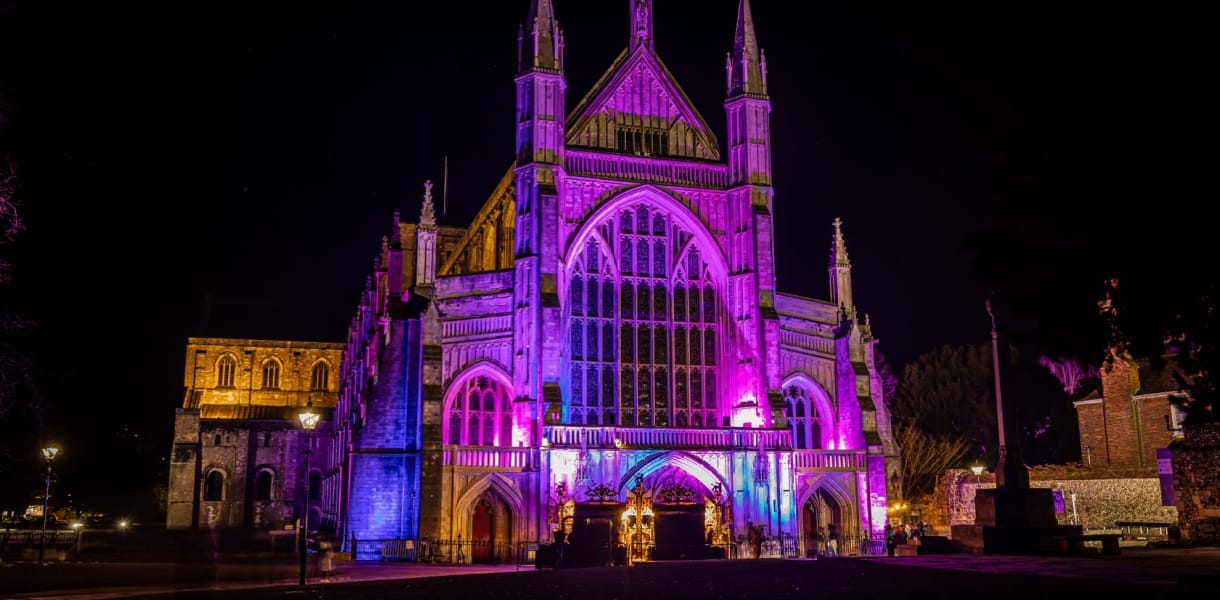
Alfred died in 899 at the age of fifty, leaving behind a kingdom that was not yet England but was well on its way. He was buried in Winchester, his chosen capital, though his bones have been moved several times since, and their final resting place remains uncertain.
His legacy, however, is not in doubt. Alfred was remembered not simply as a warrior king but as a builder, a scholar, and a lawgiver. He preserved Wessex when it seemed doomed to collapse, and in doing so laid the foundations for a united English state.
No other English monarch has been called “the Great,” and that singular honour reflects not just his victories but the balance of his achievements – military, political, cultural, and moral. For later generations, Alfred became a symbol of resilience and nationhood, the king who saved England from being swallowed by the Viking tide.
Places to connect with Alfred today
- Wantage, Oxfordshire – Alfred’s birthplace, marked by a statue in the market square.
- Athelney, Somerset – the marshy island where Alfred hid during the Viking crisis; a monument now stands there.
- Edington, Wiltshire – site of his decisive victory over Guthrum.
- Winchester, Hampshire – Alfred’s capital and burial place, where a great Victorian statue of the king still dominates the city.
- London – though not his capital, Alfred captured and refortified the city, beginning its rise as a centre of English power.
Why Alfred still matters
More than eleven centuries after his death, Alfred’s reputation endures. He was a leader who understood that survival required not only swords but schools, not only walls but words. He gave his people the tools to resist invasion and the cultural framework to imagine themselves as one nation.
In turbulent times, Alfred’s story is a reminder that greatness can be found not just in victory but in vision – in the ability to turn crisis into opportunity, to see beyond the immediate battle to the longer work of building a society. That is why, when we look back across the long gallery of English rulers, Alfred alone bears the simple, remarkable title of “the Great.”