
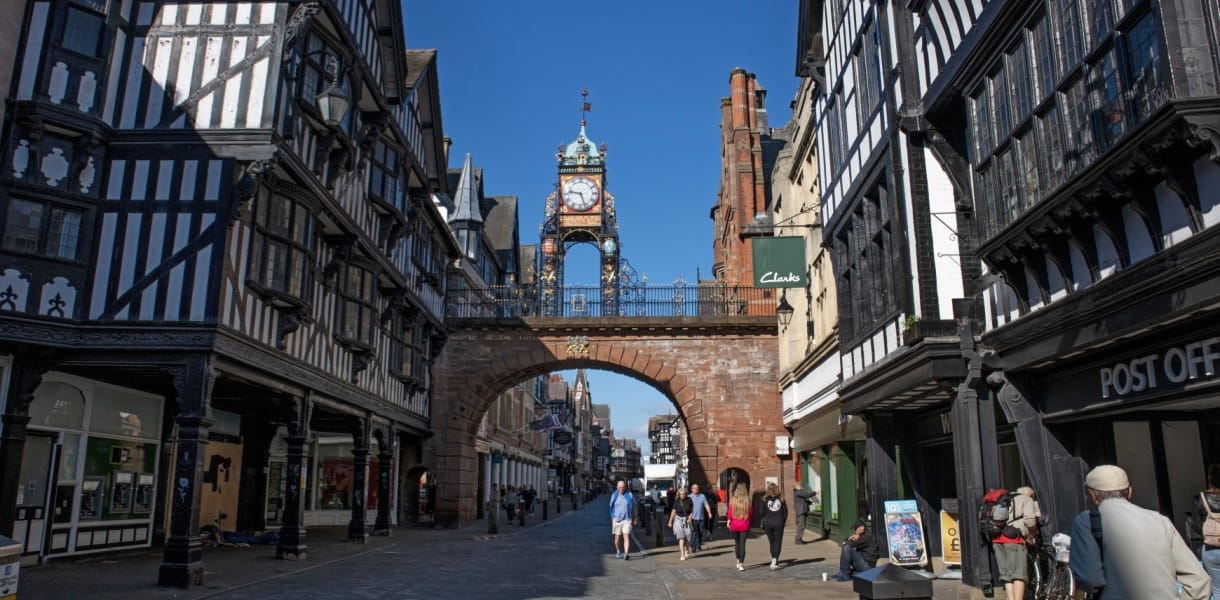
With Roman walls, medieval Rows, a grand cathedral and a river that softens all that old stone, Chester is one of England’s most handsome historic cities. Compact, walkable and gloriously layered, it offers the rare pleasure of feeling both deeply ancient and extremely easy to enjoy over a weekend.
Quick takeaways
- Best for history lovers, couples, weekend breakers and anyone who enjoys a city with proper atmosphere
- Famous for its Roman walls, medieval Rows, black and white timbered buildings and Chester Cathedral
- Easy to explore on foot, with most major sights close together in the city centre
- Great for a one or two night break, though it also works well as a day trip
- Best visited in spring, early summer or autumn for the loveliest walking weather
There are cities that impress you with one or two grand gestures, then quietly run out of things to say. Chester is not one of them. Chester arrives like an overachieving period drama extra who has somehow wandered into the modern world still fully dressed for the part and looking annoyingly magnificent. It has Roman walls, medieval Rows, black and white timbered buildings, a cathedral, a racecourse, a river, and enough ancient atmosphere to make your average market town look as if it was assembled last Tuesday.
It is, in short, absurdly pleasing.
Chester sits in the Cheshire, close enough to Wales to feel a little bit borderland and just different enough from nearby cities to have its own slightly self-satisfied air. You can understand why. This is a place that has been fortified, traded through, prayed in, paraded around, and generally admired for the better part of two millennia. It has the sort of history that most places would divide into several separate towns for convenience.
And yet it does not feel stuffy. That is the trick of Chester. For all its old stones and solemn credentials, it remains deeply walkable, oddly intimate, and pleasantly alive. It is not a museum piece under glass. It is a city where people buy coffee beneath medieval galleries, stroll along Roman walls on a Tuesday afternoon, and behave as though all cities come with this much architectural theatre.
A city built by people in sandals
Chester began, like a surprising number of good British places, with the Romans. They founded Deva Victrix here in the first century AD as a fortress for the Twentieth Legion, which sounds less like a military posting and more like the title of an ambitious pub quiz team. They chose the site for sensible Roman reasons, namely strategy, transport, and the ability to dominate the surrounding area in an organised imperial fashion.
What the Romans left behind was not just a faint historical shrug, but something substantial. Chester still has the most complete city walls in Britain, originally Roman in origin and later rebuilt and extended, and they remain one of the city’s great pleasures. Walking them is one of those rare tourist activities that feels both worthy and genuinely enjoyable. You get views into gardens, glimpses of cathedral stonework, peeks at crooked rooftops, and the steady satisfaction of knowing you are tracing a route laid out by people who took straight lines very seriously.
There is also the Roman amphitheatre, the largest known in Britain, which gives Chester that extra little flourish of ancient swagger. Most cities would have been quite pleased with a surviving wall. Chester, clearly not one for modesty, also kept the entertainment complex.
The Rows and other architectural showing off
If Chester’s walls are impressive, its Rows are downright peculiar in the best possible way. These medieval two level galleries line the main shopping streets and are unlike anything else in Britain. At street level there are shops and entrances and the ordinary bustle of a city centre. Then, above them, another layer of walkways and storefronts runs along the buildings like a secret city suspended in mid air.
To wander through them is to feel that someone got bored with the usual arrangement of streets and decided to add an upper floor for variety. They give Chester an almost theatrical quality. You are not just shopping or strolling. You are making an entrance, emerging from staircases, gliding along timber framed galleries, and unexpectedly finding yourself eye level with carved beams that have been in place longer than many countries.
The black and white buildings help, of course. Chester has enough timber framed charm to make even the most determined cynic soften slightly around the edges. Some of it is genuinely old, some of it is Victorian revival, but together it creates a cityscape that feels cohesive, decorative, and just faintly unreal. On a grey day it looks dramatic. On a sunny day it looks almost indecently pretty.
A cathedral with the good manners not to overwhelm you
Chester Cathedral is one of those places that manages to be grand without becoming pompous. Built from warm red sandstone, it has a softness to it that changes beautifully with the light. Some cathedrals loom. Chester’s seems to settle into the city with calm confidence, as if entirely aware of its own importance and therefore under no pressure to bang on about it.
Inside, it offers the usual rewards of English cathedral life. There are soaring arches, worn stone, stained glass, carved details, and that particular hush that seems to absorb both noise and time. But there is also something unusually approachable about it. It does not feel remote from the city around it. It feels woven into daily life, part spiritual centre, part architectural anchor, part reminder that people have been gathering on this patch of ground for a very long while.
Step outside again and Chester resumes its rhythm at once. Shops, cafés, buses, school groups, couples with tote bags, someone carrying an ice cream despite the weather. The cathedral does not interrupt the city. It deepens it.
The gentle art of wandering
Chester is one of Britain’s great cities for ambling without purpose. This is not faint praise. Many places claim to reward wandering when what they really offer is a branch of Boots and a roundabout. Chester genuinely does reward it. The streets fold and narrow. Courtyards appear unexpectedly. The walls call you back for another section. Little alleys hint at older routes. The river curves past with serene determination, as if trying to calm everyone down.
The River Dee gives the city a softer edge. Down by the water there are footpaths, boat trips, green spaces, and the sort of scenes that make perfectly grown adults consider whether they should become the kind of person who owns a striped deckchair. The views are lovely in that understated British way. Trees lean over the bank, bridges carry you between one pleasant prospect and another, and rowers move past looking energetic enough to make everyone on land feel vaguely inadequate.
Then there is Grosvenor Park, neat and civilised and very much in keeping with Chester’s gift for elegant presentation. Even the greenery here seems well brought up.
Layers of history with a decent lunch nearby
What makes Chester so satisfying is not just that it is old, but that its history sits in layers you can actually sense. Roman foundations, medieval streets, Tudor fantasies, Georgian confidence, Victorian restoration, modern city life. It is all there, not arranged tidily in separate zones but muddled together in the way real places tend to be. You can pass from Roman masonry to a designer shop window in under a minute and somehow not resent either.
That mixture gives Chester substance. It is easy on the eye, certainly, but it is not merely decorative. There is depth behind the prettiness. The buildings do not just look historical, they are historical, or at least in lively conversation with history. The city wears its past not as a burden but as a series of useful accessories.
And crucially, it does all this while remaining enjoyable on a very practical level. There are good places to eat, welcoming pubs, smart hotels, independent shops, and enough small pleasures to fill a weekend without effort. Chester understands the importance of atmosphere, but it also understands cake, which is the mark of a truly civilised destination.
Why Chester lingers in the mind
Some historic cities dazzle briefly, then blur into a collection of attractive facades and educational plaques. Chester tends to stick. Perhaps it is the completeness of it, the way the walls still ring the centre and the Rows still shape the streets. Perhaps it is the scale, large enough to feel substantial, small enough to remain companionable. Or perhaps it is simply that Chester has the confidence to be exactly what it is, which is a city of uncommon charm and considerable polish.
It feels old without feeling tired, elegant without being aloof, and impressive without becoming exhausting. It is the sort of place that makes you slow down a little, look up more often, and briefly entertain the notion that modern town planning took a wrong turn somewhere around 1963.
Chester does not shout for attention. It barely needs to. It simply stands there in sandstone and timber, with its walls intact and its galleries perched above the streets, looking like the answer to a question nobody else quite understood. And after a day or two in its company, you may find yourself thinking that cities really ought to make more effort.
Know before you go
Getting here
- Chester is one of the easiest historic cities in north west England to reach without losing your temper.
- By train, it has direct services from London, Manchester, Liverpool, Birmingham and North Wales.
- Chester railway station is around a 10 to 15 minute walk from the city centre.
- By car, the city is well connected via the M56, M53 and A55.
- Parking in the centre can be busy at weekends, so park and ride services are often the more civilised option.
- It makes an especially easy cross border day trip or short break from North Wales.
Where to stay
- For full historic charm, look for a hotel within the old city walls.
- Boutique hotels and Georgian townhouses suit Chester especially well.
- Larger chain hotels on the edge of the centre and near the station are useful for short stays.
- Couples will find plenty of stylish weekend break options.
- Families may prefer self catering apartments or hotels just outside the busiest core.
Where to eat
- Chester is very good at the business of eating pleasantly in attractive surroundings.
- The city centre has cosy cafés, polished bistros, traditional pubs and modern restaurants tucked into historic buildings.
- A proper pub lunch works particularly well here.
- Afternoon tea is another strong Chester tradition.
- For evening meals, there is a good mix of British, Italian and gastropub fare.
- The river area is a good bet for relaxed dining with a view.
What to do
- Walk the city walls for one of Chester’s best and most atmospheric experiences.
- Wander the Rows and enjoy the city’s wonderfully odd two level shopping streets.
- Visit Chester Cathedral for red sandstone grandeur and a welcome sense of calm.
- Stop by the Roman amphitheatre for a reminder of the city’s ancient origins.
- Stroll along the River Dee and through Grosvenor Park.
- Spend time drifting through Chester’s lanes, courtyards and historic side streets.
- If you are visiting in season, Chester Racecourse adds another layer to the city’s long story.
Nearby gems
- Llangollen makes an excellent day trip with canals, hills and splendid scenery.
- The Wirral Peninsula offers coastal walks and quieter towns.
- Cheshire country estates such as Tatton Park are within easy reach by car.
- Delamere Forest is ideal if you fancy woodland trails instead of Roman walls.
- Liverpool is an easy train ride away if you want a complete contrast.
Best time to visit
- Spring and early summer are excellent, when the walls, river and parks all look especially cheerful.
- Autumn suits Chester beautifully, with crisp air and rich tones in the sandstone.
- Winter can be wonderfully atmospheric, especially during the festive season.
Summer is extremely busy, particularly at weekends, but Chester usually remains manageable.