Salisbury is one of those cities that can make you wonder whether some committee in the 13th century was simply showing off. It has a cathedral with Britain’s tallest spire, a Magna Carta that is not a replica or a theatrical suggestion of one but an actual surviving 1215 copy, a close of such calm and scale that it feels faintly aristocratic, and a city centre still laid out with enough medieval order to make wandering about seem like a very respectable use of an afternoon. Then, just outside town, there is Old Sarum, where the earlier city sat on its great windswept hill before everyone sensibly moved downhill and started again. Salisbury is handsome, historic and deeply English, but it also has a refreshing clarity to it. You can see how the place works, how it grew, and why it still charms people so thoroughly.
Quick takeaways
Best for
Cathedral lovers, medieval city breaks, history-heavy day trips, literary and heritage fans, and anyone who likes old England in a particularly polished form
Why visit Salisbury
It combines one of England’s great cathedrals, Magna Carta, a beautifully coherent historic centre, and the dramatic hilltop remains of Old Sarum all in one manageable small city
Don’t miss
Salisbury Cathedral, the Chapter House and Magna Carta, Cathedral Close, Mompesson House, Salisbury Museum, the Market Square, and Old Sarum
Time needed
A full day works well, but an overnight stay gives you time for both the city and Old Sarum without rushing
Best bit
The contrast between the serene beauty of the cathedral close and the exposed drama of Old Sarum on the hill
Worth it if
You like small historic cities that feel genuinely old rather than merely tastefully styled to look that way
Salisbury at a glance
Salisbury is one of the most satisfying small cities in southern England, not because it tries very hard, but because it already has an unfair advantage. The cathedral dominates the skyline with extraordinary confidence, the streets around it still retain a strong medieval structure, and the city as a whole feels compact, coherent and unusually easy to understand on foot. The modern city dates from the early 13th century, when people moved down from Old Sarum and established a new settlement on the plain below. That means Salisbury has the useful distinction of offering not one historic city story, but two, one on the hill and one beneath the spire.
Why Salisbury matters
Some places are old in a vague, decorative sort of way. Salisbury is old in a much more satisfying structural sense. You can feel the logic of it. Old Sarum began as an Iron Age hillfort, was later occupied by the Romans, and then developed further under the Saxons and Normans. It was a strong, strategic place, which was all very well for defence, but less ideal if you wanted somewhere more spacious, accessible and generally pleasant to live. By the early 13th century, the focus had shifted downhill to the site of modern Salisbury, where the new cathedral and city could be laid out more deliberately.
That move matters because it gives Salisbury an unusual clarity. This is not a city that grew in a thousand accidental directions and hopes you will forgive the confusion. It feels planned, or at least more planned than most medieval places had the decency to be. The result is a city that still feels legible. You can grasp it quickly, which is one reason it makes such a rewarding short break.
What makes Salisbury special today
The clever thing about Salisbury is that it manages to feel both grand and gentle. The cathedral is one of the great landmarks of England and carries enough historical and architectural importance to dominate most visits entirely on its own. Yet the city around it remains calm, compact and very easy to like. You can spend a morning looking at one of the most significant documents in constitutional history, then have lunch, browse old streets, wander into a townhouse in the close, and still have energy left for a hillfort by late afternoon.
There is also something unusually elegant about Salisbury. Not grand in the overbearing sense, but composed. Cathedral Close in particular has that rare English quality of looking as if it has been tidied by several centuries of responsible people with decent taste. The city centre beyond it is busier and more everyday, which is exactly as it should be. Salisbury works because it combines serenity with normal life. It is not a set piece. It is a real city that happens to have a truly excessive amount of medieval charm.
The cathedral that settles the matter at once
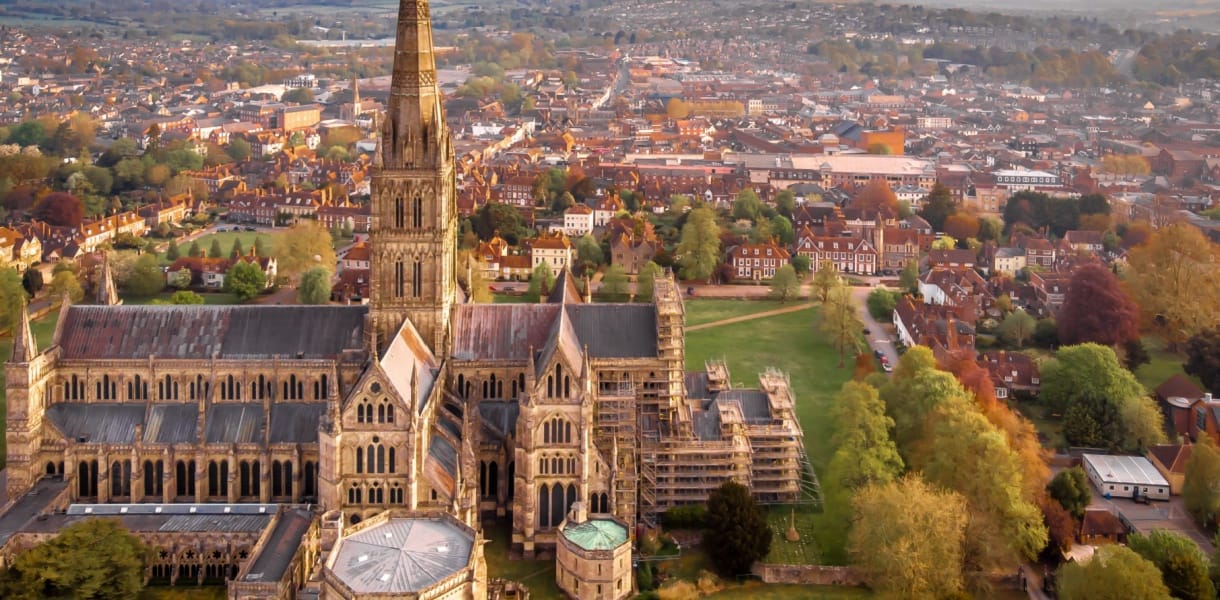
Salisbury Cathedral is one of those buildings that rather ends the argument. You arrive, look up at the spire, and accept that the city knew exactly what it was doing. The cathedral describes itself as a medieval masterpiece with Britain’s tallest spire, the largest cloisters and the biggest cathedral close in the country, which is the sort of statistical overachievement that sounds made up until you stand in front of it.
What makes it especially satisfying is its unity. Unlike some great cathedrals that have grown by fits and starts over centuries, Salisbury has a remarkable architectural consistency. It feels composed rather than patched together. Inside, there is space, light and that particular kind of stone-built confidence medieval England did so well when it was in the mood. Even if you are not especially cathedral-minded, this one has a way of winning you over by sheer force of grace and scale.
Then there is the Chapter House, where Salisbury keeps the best preserved of the four surviving 1215 Magna Carta copies. This is not just an interesting extra, nor a worthy side exhibit you feel obliged to nod at. It is one of the defining reasons Salisbury matters. Seeing it here gives the city a direct line into the story of rights, law and state power, which is a surprisingly serious thing to find folded into such a manageable and attractive place.
A city that knows the value of a proper close
Cathedral closes can sometimes feel a little too refined, as though you ought to lower your voice and develop opinions about stone tracery. Salisbury’s close is certainly beautiful, but it is also one of the city’s most enjoyable spaces simply to be in. It is broad, calm and lined with handsome buildings that reinforce the impression that this part of the city has had a long time to practise looking distinguished.
Mompesson House sits here very nicely indeed. The National Trust describes it as a homely and welcoming 18th-century townhouse in the heart of the close, which is exactly right. It offers a different side of Salisbury from the soaring cathedral and constitutional drama. Here the pleasure is domestic, architectural and quietly civilised. It is the sort of place that reminds you not all history has to arrive with a trumpet fanfare. Sometimes it can simply be a lovely house with a good setting and a rather satisfying sense of permanence.
Old Sarum and the business of moving a city
If Salisbury Cathedral represents elegance and order, Old Sarum provides the windswept, strategic prequel. It is one of the most historically important sites in southern England, with origins as an Iron Age hillfort around 400 BC, later Roman occupation, then Saxon and Norman use, including a great Norman inner mound and castle. This is not merely an old ruin outside town. It is the former Salisbury, or at least the place from which modern Salisbury emerged.
Old Sarum has that rare quality of being both archaeologically significant and genuinely enjoyable to visit. You can walk the mighty outer ramparts, stand on the mound, trace the shape of what once mattered intensely to a great many people, and enjoy the wide views across Wiltshire into the bargain. It also helps explain why modern Salisbury feels the way it does. Without Old Sarum’s exposed hilltop history, the lower city’s relative calm and order would not be nearly so satisfying.
There is also something inherently pleasing about a city that more or less admits it tried one location, found it a bit blustery and inconvenient, and sensibly moved downhill for a better arrangement. It shows a practical streak that deserves admiration.
Streets, market life and the smaller pleasures
The cathedral is the star, clearly, but Salisbury would be less enjoyable if it were only that. Fortunately the city centre has enough independent life and ordinary charm to stop everything feeling ceremonial. Medieval street patterns, old buildings, market activity and day-to-day bustle all give the place a lived-in quality that matters. You are not merely orbiting a famous church. You are spending time in a city.
This is one of Salisbury’s quieter strengths. It does not overwhelm you with scale or force you into an exhausting tick-list of major sights. It allows room for browsing, loafing and the sort of unhurried wander that often produces the best bits of a city break. A street here, a view there, a sudden glimpse of the spire between buildings, a pause in the market square, a cup of tea in the close. Salisbury is very good at these smaller rewards.
Why Salisbury works so well as a short break
Some historic cities feel better in theory than in practice. Salisbury is the opposite. On paper it has obvious appeal, but in person what really stands out is how easy it is to enjoy. The main sights are close enough together to make the day feel relaxed. The city centre is attractive without becoming exhausting. The big-ticket history is balanced by domestic detail, open space and the calm grandeur of the close.
It also suits different kinds of visitor rather well. If you like architecture, the cathedral more or less settles that. If you like English history, Old Sarum and Magna Carta give you two excellent reasons to come. If you prefer atmosphere to scholarship, Salisbury still works beautifully because it is simply pleasant to be in. This is often the mark of a really good small city. It does not demand a particular kind of enthusiasm. It offers several and lets you choose.
How to plan a trip to Salisbury
Salisbury works well as either a day trip or a one-night stay, but the overnight version is better. That gives you time to do the cathedral and Magna Carta properly, enjoy Cathedral Close without hurrying, and fit in Old Sarum without making the whole day feel like a race against your own itinerary.
A sensible first visit would start with the cathedral and Chapter House, then continue around the close with Mompesson House or Salisbury Museum if you want more context. After lunch, spend time in the city centre and market area, then head to Old Sarum later in the day when the wide views and wind on the hill feel especially dramatic. If you are staying overnight, keep some unstructured time for simply wandering. Salisbury rewards that.
Final verdict
Salisbury is one of England’s most rewarding small cities because it has both star quality and shape. The star quality is obvious enough. There is the cathedral, the spire, the Magna Carta, the close, the hilltop predecessor waiting just beyond town. But the shape is what makes it especially satisfying. The city makes sense. It feels coherent. It offers grandeur without bluster and history without heaviness.
For first-time visitors, it is a superb introduction to historic southern England. For returning travellers, it has the sort of composure and atmosphere that hold up very well on a second visit. Some cities impress you mainly because they are famous. Salisbury is better than that. It impresses you because it is beautiful, legible, old and quietly full of substance. Which, in city terms, is a very strong combination indeed.
City info box
Getting here
- Salisbury is in Wiltshire and has direct rail connections from London Waterloo, as well as links with Southampton, Bath and Bristol routes
- The station is within walking distance of the city centre
- By car, Salisbury is straightforward to reach from much of southern England, though the centre is best explored on foot
- Old Sarum is just outside the city and is easy to combine with the main centre in one trip
Where to stay
- Stay near the city centre or Cathedral Close area for the strongest sense of place
- Salisbury suits boutique hotels, traditional inns and comfortable guesthouses particularly well
- An overnight stay is worth it if you want both the city and Old Sarum without rushing
Where to eat
- Salisbury works well for cafés, bakery stops, long lunches and traditional pub dinners
- The city centre is compact enough that you can stop often without straying far from the main sights
- This is a city that rewards gentle grazing rather than over-planned dining logistics
What to do
- Visit Salisbury Cathedral
- See the 1215 Magna Carta in the Chapter House
- Walk around Cathedral Close
- Visit Mompesson House
- Explore Salisbury Museum
- Spend time in the Market Square and old centre
- Head up to Old Sarum for the earlier city story and wide views
Nearby gems
- Old Sarum is the essential add-on and should be part of almost any first visit
- Stonehenge is not far away if you are building a wider Wiltshire heritage trip
- Wilton House makes a strong companion stop for grand house and estate appeal
- The wider Wiltshire landscape gives you plenty of options for combining Salisbury with villages, chalk downs and other historic sites
Best time to visit
- Spring and early autumn are ideal for walking the city and Old Sarum comfortably
- Summer is lively and attractive, though busier
- Winter can suit Salisbury surprisingly well, especially for cathedral atmosphere and clear views of the spire
- A bright day with a bit of cloud and moving light does this city particular favours