There are towns where you feel the centuries in the cobblestones, and then there is Bath, where history practically runs a hot tap and invites you to stay awhile. Nestled in a green Somerset bowl and famously good at staying on brand since the Romans popped by with togas and thermal ambitions, Bath manages to be both a living museum and a place you might actually want to live. Or at the very least linger over tea and cake.
This is not a town that hides its assets. Bath parades its golden stone like a self-satisfied cat stretching in the sun. The crescents curve just so, the pillars are poised, and even the post boxes feel as if they were designed with an eye for harmony. And that’s before you get to the bits that made it famous. The waters. The writers. The grand old buildings with names that sound like minor aristocrats.
The Romans had a soak, and so can you
The story of Bath begins long before Austen or Abbeys. Back around AD 60, the Romans arrived and immediately set to work doing what they did best – building things. Temples. Baths. Underfloor heating. They named the settlement Aquae Sulis, dedicated it to a Celtic-Roman hybrid goddess, and constructed a rather impressive bathing complex around the natural hot springs.
You can still visit the Roman Baths today, and you really should. The Great Bath glows with steam and greenish water, watched over by a gaggle of carved stone faces that haven’t seen a decent toga in quite some time. There’s an excellent museum with glass walkways over ancient pavements, flickering projections of toga-clad bathers, and a working tap where you can sample the mineral-rich spring water. Be warned. It tastes like a challenge.
If you want to do as the Romans did but with fewer ghosts and more spa menu options, head to the modern Thermae Bath Spa. You can float in the warm rooftop pool while looking out over the Abbey towers, preferably at dusk, when the whole city takes on a soft amber glow and you can pretend you’re starring in your own Georgian drama.
Jane Austen’s Bath and the business of society
No deep dive into Bath would be complete without its literary leading lady. Jane Austen lived here from 1801 to 1806, and while she wasn’t always enamoured of the city (her letters are full of sharp little jabs at social life and damp lodgings), it still inspired some of her best work. Northanger Abbey and Persuasion both feature Bath in all its gossiping, promenading glory.
You can visit the Jane Austen Centre on Gay Street, which offers bonnets, mannequins, a waxwork Jane and a rather passionate team of guides. There’s also the annual Jane Austen Festival each September, where you’ll find hundreds of people in empire-line dresses and cravats doing everything from dance workshops to Regency sword fighting.
For the full Austen effect, take a walk along the Royal Crescent and the Circus, imagining yourself late for an invitation to tea with an eligible colonel.
Georgian splendour and the fine art of facade
It’s impossible to walk around Bath without noticing how deliberately lovely it all looks. That’s because much of the city was built during the 18th century Georgian boom, when wealthy folk were pouring into town to take the waters, show off their wealth and complain about their gout.
Architects like John Wood the Elder and his son (creatively named John Wood the Younger) created some of the city’s most famous landmarks. The Circus is a circular arrangement of grand terraced houses with carved stone acorns and theatrical ambition. The Royal Crescent is even grander – a sweeping arc of honeyed Bath stone facing a green lawn and ideal for photo opportunities involving parasols.
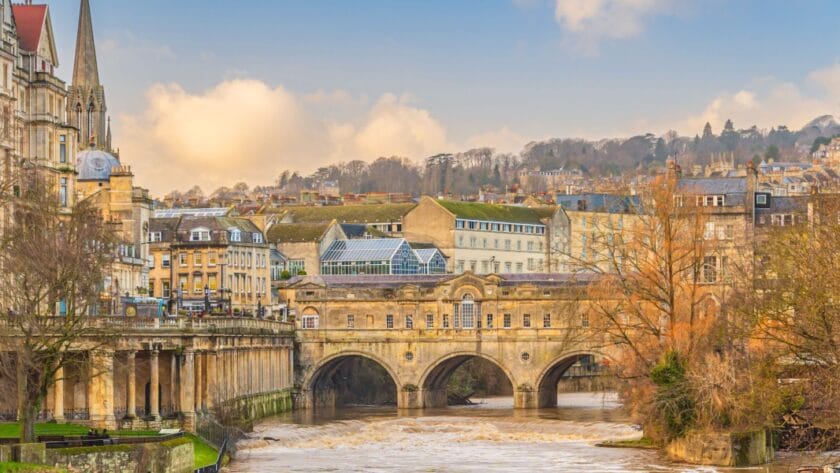
Pulteney Bridge is another Georgian gem, and one of the few bridges in the world with shops running along both sides. Cross it, and you may briefly wonder if you’ve wandered into a doll’s house version of Florence.
Abbey, museums and other forms of enrichment
Right in the centre of town, Bath Abbey rises up with its ladders of angels and fan-vaulted ceilings. There’s been a place of worship here for over a thousand years, and today’s Abbey is a mix of medieval roots and Victorian flourishes. Climb the tower if you’re feeling energetic. You’ll get a bell’s-eye view of the rooftops and river bends.
Bath also has a fine collection of museums for a city of its size. The Fashion Museum, the Holburne Museum, and the Victoria Art Gallery all offer excellent diversions on a rainy day. The Herschel Museum of Astronomy is a small but wonderful spot celebrating the man who discovered Uranus from his back garden (which must have caused quite a stir in the Georgian press).
Then there’s No.1 Royal Crescent, a painstakingly recreated Georgian home that smells convincingly of beeswax and boiled carrots. You’ll find yourself whispering in reverence as if the original residents might come back from their card game at any moment.
Cafes, shops and places to loiter
Bath has moved on from being a place where people came to get better. These days, it’s a place people come to feel better. Possibly after a flat white and a cinnamon bun.
Wander through the lanes and alleys and you’ll find independent bookshops, vintage clothes, places selling organic honey made by monks, and more than one establishment promising ‘artisan’ something-or-other. The food scene is excellent too, with everything from fine dining to very good pies.
Kingsmead Square is ideal for people watching. Milsom Street remains the grand old dame of shopping. And if you’re after a quiet corner, head for the botanical calm of the Parade Gardens or climb up to Alexandra Park on Beechen Cliff for one of the best views in town.
The hills are very much alive
Bath is not flat. This may come as a surprise to anyone who imagines it as a polite little place for gentle strolls. The hills here are determined and scenic. But they’re worth it.
Walk a stretch of the Bath Skyline trail and you’ll see the city laid out below like something from a miniature railway set. Larkhall and Widcombe offer village vibes within city limits. And if you fancy making a day of it, the Two Tunnels Greenway takes you on a traffic-free cycle route through old railway tunnels all the way to Midford and beyond.
You might even spot a hot air balloon rising slowly above the rooftops, just to remind you that some cities really are built to be admired from every angle.
Bath quick guide
Getting here
- Bath is well connected by train, with regular services from London Paddington taking around 1 hour 20 minutes
- The city is just off the M4 and accessible by coach or car from Bristol, which is only 12 miles away
- There’s a Park and Ride system for visitors driving into town
Where to stay
- The Royal Crescent Hotel offers Georgian grandeur and a peaceful garden spa
- Harington’s Hotel is quirky and central with a cosy feel
- For budget stays, Bath YHA sits near the canal and offers private rooms and dorms
Where to eat
- Sally Lunn’s is famous for its historic buns and cream teas
- Oak serves inventive plant-based dishes in a stylish setting
- The Scallop Shell does top-notch fish and chips with sea views in spirit if not geography
What to do
- Tour the Roman Baths and take the waters at the Thermae Spa
- Visit Bath Abbey and climb the tower
- Explore No.1 Royal Crescent and the Fashion Museum
- Take a walking tour with a costumed guide for theatrical history
Nearby gems
- Bradford-on-Avon is a charming canal town just 20 minutes away
- Lacock village offers old stone cottages and Harry Potter filming spots
- The American Museum and Gardens has sweeping views and an unexpected collection
Best time to visit
- Spring and early autumn are ideal for walking and sightseeing without the peak summer crowds
- Christmas sees Bath dressed in lights with a popular festive market
- The Jane Austen Festival in September is a unique way to see the city in character
Let Bath surprise you. Behind all the elegance and fine manners, there’s a city with a twinkle in its eye and warm water underfoot. Bring good shoes. Bring an appetite. And maybe pack a bonnet, just in case.