Birmingham doesn’t always shout about itself. That’s one big reason why I like it so much. While London blares and Manchester struts, Brum gets on with things in its own quietly confident way. The city is large, yes, sprawling even, but it’s also layered, quirky, and unexpectedly green. It’s a place where steam-powered Victorian ambition meets street art, where curry is practically a local language, and where canals outnumber Venice (allegedly).
If you think Birmingham is just shopping centres and motorways, you’re in for a surprise.
A city built on cogs, coal and character
At first glance, Birmingham might not look like a city of superlatives, but that’s only if you squint too hard at the concrete and miss what’s hiding behind it. This was once the workshop of the world, powered by a population of inventive types who seemed to create something useful every other Tuesday. From the first steam engines to pens, whistles and buttons, the city made it all.
James Watt gave the Industrial Revolution a proper engine room here. The Lunar Society, a kind of 18th-century TED Talk dinner club, gathered the likes of Erasmus Darwin and Joseph Priestley to discuss everything from chemistry to abolition. You could argue the modern world started in Birmingham, though Birmingham wouldn’t be so immodest as to say so.
Much of the old industry has gone, but the warehouses remain, now repurposed as hipster bars, loft apartments or galleries. Digbeth, once home to metal bashers and welders, is now a hotbed of creativity with street art as high as the rooftops and independent venues bursting out of every corner.
Canals, cubes and concrete
Here’s a fun fact to throw into conversation – Birmingham has more miles of canal than Venice. It’s one of those facts Brummies love, partly because it confounds expectations. These aren’t just leftovers from a time of barges and beer deliveries either. They’ve had a facelift.
Start at Brindleyplace where the once grimy towpaths now host office workers sipping lattes and weekend cyclists negotiating geese. The iconic Cube building squats nearby like a glass Rubik’s cube with delusions of grandeur. It’s part hotel, part restaurant, part architectural dare.
From here, the canals ripple outwards. Some lead to quiet corners like the Edgbaston Reservoir, others to Gas Street Basin where you’ll find colourful narrowboats moored beneath converted warehouses that are now full of cocktails and conversation.
Curries, culture and culinary surprises
Birmingham’s curry scene is legendary, and rightly so. The Balti was born here, and while you can still find old-school BYOB curry houses with strip lighting and plastic tablecloths, you’ll also find inventive modern South Asian cuisine served with a side of style. Head to the Balti Triangle where a handful of the original and authentic balti houses are still left, however they are well worth seeking out in their original setting for the classics, or try Opheem for Michelin-starred masala with a twist.
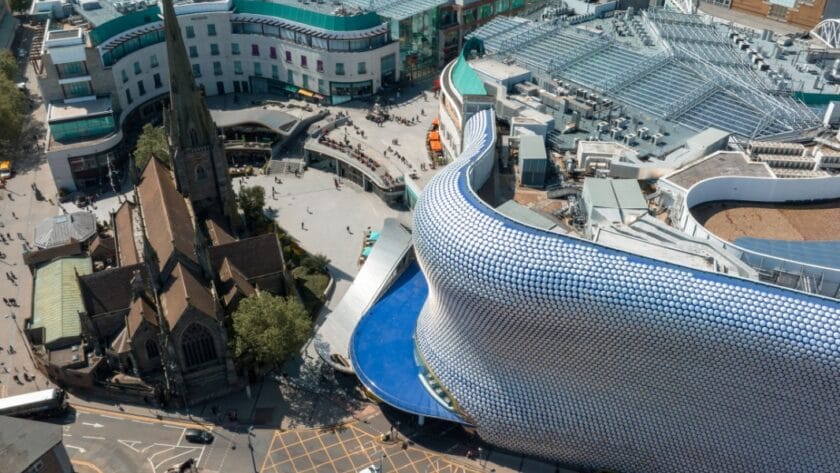
Beyond curry, the city’s food scene is flourishing. Digbeth Dining Club turns street food into an event, with vendors competing to outdo each other in flavour and flair. Fancy restaurants like Purnell’s and Simpsons have put Brum on the fine dining map, while the city’s markets – especially the Bull Ring indoor market – are a treasure trove for lovers of Caribbean patties, Polish pierogi or Vietnamese pho.
Don’t miss the custard factory either. Yes, it once made actual custard, but now it’s an arts and culture complex where the scent of dessert has been replaced by the buzz of creatives, craft beers and vintage clothes.
A city of sounds and stories
Music is stitched into Birmingham’s DNA. This is the home of Black Sabbath, UB40, Duran Duran and The Streets. The city gave us heavy metal, ska-pop, new romantic synths and council estate hip hop, all within a few postcodes of each other. The Symphony Hall offers something more orchestral if your ears need a cleanse.
On stage, Birmingham has a flair for the dramatic. The Hippodrome is one of the busiest theatres in the UK, hosting everything from West End musicals to the Birmingham Royal Ballet. There’s also the Rep, which punches well above its weight in new writing, and the mac (Midlands Arts Centre) which balances experimental theatre with family-friendly shows and art exhibitions.
Green spaces and surprising escapes
For a city that looms large on the map, Birmingham has a lot of places where you can forget you’re in a city at all. Cannon Hill Park is a fine example – part flower-filled Victorian pleasure ground, part cricket ground and part duck-dodging pedal boat circuit.
Sutton Park is even more ambitious, a 2,400-acre sprawl of heathland, woodland and wetlands where cows roam freely and the silence can be startling. It’s one of the largest urban parks in Europe and a blissful antidote to city noise.
Then there’s the Jewellery Quarter. A little chunk of living history, its Georgian streets are still home to dozens of working jewellers. It’s a place to watch craftsmen at work, rummage for one-of-a-kind pieces and perhaps fall down a rabbit hole of heritage. The Museum of the Jewellery Quarter is a hidden gem in every sense.
People, pride and proper Brummie welcome
Birmingham’s biggest asset isn’t its past or its architecture, it’s its people. This is one of the youngest, most diverse cities in Europe, and it shows. Walk down any high street and you’ll hear a dozen languages, see every shade of culture and fashion, and probably be offered a samosa by someone’s nan.
The Brummie accent is often misunderstood, perhaps because it sounds a little modest. But listen properly and you’ll hear the humour, the warmth, the melodic ups and downs that reflect a city full of good-hearted pragmatists with a dry wit and a no-nonsense approach to life.
Visitors often arrive unsure of what to expect. They usually leave with a full belly, an appreciation for the canal network and a mild addiction to cheesy chips with curry sauce.
Birmingham is a city that reveals itself slowly. It doesn’t boast or beckon – it simply invites you in and lets you discover why locals are quietly but deeply in love with it.
Birmingham quick guide
Getting here
- Trains from London Euston take around 1 hour 20 minutes to Birmingham New Street
- Birmingham Airport connects to Europe, North America and beyond
- Easy motorway access via the M6, M5 and M42
Where to stay
- Malmaison in the Mailbox offers stylish rooms with canal views
- The Grand Hotel combines heritage with high-end comfort in the city centre
- Budget options include Premier Inn and easyHotel, both centrally located
Where to eat
- Opheem for modern Indian fine dining
- Original Lahore in Sparkbrook for classic Balti
- Digbeth Dining Club for street food with a party atmosphere
What to do
- Walk the canals from Brindleyplace to Gas Street Basin
- Explore the street art and indie shops of Digbeth
- Visit the Birmingham Museum and Art Gallery (when reopened)
- Catch a show at the Hippodrome or Symphony Hall
Nearby gems
- Sutton Park for nature walks and birdwatching
- The Black Country Living Museum for industrial history
- Cadbury World in Bournville for a sweet family outing
Best time to visit
- Spring and early autumn are ideal for walking and canal strolls
- Summer brings outdoor festivals and lively street markets
- December is festive with the Frankfurt Christmas Market filling the city centre