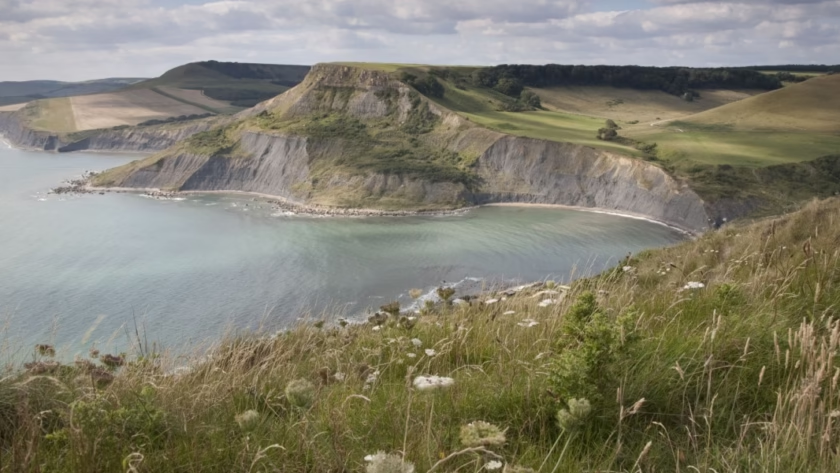
If you ever feel like your usual seaside outing is lacking in geological drama, try driving the Jurassic Coast. It is a road trip where the scenery goes back millions of years, the beaches are sprinkled with ammonites, and the cliffs look like something from a palaeontologist’s fever dream. Stretching from Exmouth in Devon to Studland Bay in Dorset, this coastline is not just scenic, it is ancient, layered, and wonderfully unpredictable.
And the best part? You can do the lot in a few days with a flask, a fossil hammer, and a working sense of wonder.
Day one: Red cliffs and Regency charm
The journey begins in Exmouth, where the cheerful buzz of beachgoers mingles with the low murmur of geological significance. Just above the beach is Orcombe Point, marked by the rather excellent Geoneedle, which quietly signals the start of the Jurassic Coast World Heritage Site. If ever there were a more modest beginning to such a grand journey, we have yet to find it.
Just a few miles east lies Budleigh Salterton, where the cliffs are rust-red and the beach is made entirely of perfectly smooth pebbles. No sand, no fuss, just pebbles stretching out like nature’s own version of a massage bed.
From there, the road winds towards Sidmouth, a Regency town with a flair for dramatic headlands and comfortable tearooms. Salcombe Hill offers a short walk with a long view and the kind of sea air that clears your brain out completely.
Day two: Fossils, trams and smugglers’ tales
The second day kicks off with a detour worth taking. Branscombe and Beer (yes, that really is the village name) sit tucked into green folds of countryside like smugglers’ secrets. Branscombe has cob cottages that lean gently sideways and a beach café that does a strong line in crab sandwiches. Beer, meanwhile, offers boat rides and tales of smuggling that are almost certainly true, or at least convincingly exaggerated.
Next is Seaton, a town with a certain utilitarian honesty, but redeemed entirely by its vintage tramway. Hop aboard and trundle through reed beds like a Victorian trainspotter on holiday.
But the day’s real treasure lies ahead in Charmouth. Here, the Heritage Coast Centre will arm you with enough knowledge to confidently shout “that’s a belemnite” at a piece of sea-worn stone. With luck, the sea will yield a fossil or two. Failing that, it is still a very good beach for picnics and staring thoughtfully at the horizon.
Then comes Lyme Regis, the town that Mary Anning made famous long before Hollywood noticed. Its winding streets and fossil shops are pleasingly unmodern. The Cobb curves protectively around the harbour, and the museum tells the story of a girl who changed science by walking along the beach with a sharp eye and a small hammer.
Day three: Big cliffs and pebbles that go on forever
Leaving Lyme, the landscape gets bolder. A quick hop inland brings you to Golden Cap, the highest point on the south coast and a brief but energetic climb. The view, when not obscured by weather or sheep, is quite something.
Further east, West Bay appears like a film set built for cliff-based existential crises. These sheer golden cliffs starred in a certain moody television drama and now attract photographers and drone pilots with impressive camera kits.
Beyond lies Chesil Beach, a shingle bank so vast it looks like it was built by giants with time on their hands. It stretches for miles, linking Portland to the mainland with quiet determination. You don’t walk Chesil so much as commit to it.
Lunch, and a break from geology, awaits in Abbotsbury, a village that seems to exist just slightly out of time. It has a swannery that is exactly what it sounds like and a subtropical garden that is, frankly, an overachiever in the Dorset climate.
The day finishes at Lulworth Cove, which curls into the land like a question mark. A gentle place, perfect for a paddle or a postcard. A short walk away, Durdle Door appears from the cliff path like a stone invitation to swim. People take photos, swim beneath it, and occasionally propose in front of it. Nature, quite clearly, knows how to stage a scene.
Day four: Snorkels, castles and sandy farewells
With your legs likely protesting slightly, day four begins gently. The path to Kimmeridge Bay is a meander, not a march. This is a place where rock pooling is practically a competitive sport and snorkelling feels almost tropical on a good day. The rocks here contain the remains of creatures older than the dinosaurs, though the only things likely to nibble your toes now are inquisitive crabs.
Next is Corfe Castle, which rises from the Purbeck hills like a storybook ruin. It was blown up during the Civil War and has been crumbling photogenically ever since. The village at its feet does excellent pasties, which can be eaten on the train if you take the steam railway to Swanage.
Finally, the trip ends at Studland Bay, where the beaches stretch wide and the sea feels just a bit softer. The heath behind the dunes is a nature reserve and the ferry to Sandbanks bobs in the distance. You could press on into Bournemouth and beyond, but it is hard to beat the feeling of finishing here, toes in the sand, thinking about all the cliffs and creatures you have just driven past.
Jurassic Coast road trip essentials
Getting here
- Start at Exmouth, reachable by train from Exeter
- End at Studland, with links to Poole via chain ferry
Where to stay
- Sidmouth for regency charm
- Lyme Regis for seafront character
- Lulworth for cliff-top cottages
Where to eat
- Crab sandwiches in Beer
- Dorset pasties in Corfe
- Ice cream anywhere with a sea view
What to do
- Fossil hunting in Charmouth
- Walk Golden Cap
- Kayak through Durdle Door
- Ride the tram at Seaton
Nearby gems
- Abbotsbury’s subtropical garden
- Portland’s lighthouse and castle
- Swanage steam railway
Best time to visit
- Late spring to early autumn for the best weather and fossil-finding tides
This is not a road trip you rush. It is one you absorb slowly, layer by layer, like the cliffs themselves. A coastal journey stitched together by fossil beds, thatched villages, and just the right amount of wind in your hair. If you listen closely, you might even hear the ancient waves still whispering to the rocks.