Cornwall is the bit of England that seems to have wandered off on its own and decided it preferred the company of cliffs, sea spray, fishing boats, and people who know exactly how a pasty should be crimped. It is dramatic, battered, beautiful, faintly stubborn, and full of places that make you stop mid-sentence just to stare.
Quick takeaways
- Cornwall offers some of the most striking coastal scenery in Britain, with cliffs, coves, long beaches, and old harbour towns
- Its identity feels distinct, with traces of Celtic heritage, mining history, and a strong local pride
- You can come for surf, art, food, gardens, fishing villages, or long windswept walks and leave wondering why you do not live nearer the sea
- Highlights include St Ives, Padstow, Falmouth, Tintagel, the Minack Theatre, Land’s End, and the old mining landscapes around St Austell and west Cornwall
- It works equally well for family holidays, romantic breaks, food-led trips, and slow off-season escapes
Cornwall feels like another country, only with better chips
There are parts of Britain that seem content to be exactly where they are, and then there is Cornwall, which feels as if it has spent centuries edging away from the rest of England in the hope that one day it might snap free and float south towards warmer weather. It has its own pace, its own symbols, its own saints, its own fiercely defended bakery traditions, and a landscape so theatrical it can make perfectly sensible adults start speaking in hushed tones about light.
You notice the shift long before you reach the far end of the peninsula. The roads begin to curl and narrow as if they are losing patience with modern life. The hedges rise high on either side, thick with greenery and mystery, making every journey feel like a mildly competitive treasure hunt. Then the sea appears. Sometimes it glitters politely in the distance. More often it arrives like a revelation, all blue muscle and white spray, reminding you that Cornwall is a place shaped not by tidy human intention but by wind, salt, and rock.
This is what gives Cornwall its strange hold over people. It is not merely pretty. Large parts of Britain are pretty. Cornwall is something more unruly than that. It feels elemental. The coast does not just sit there looking decorative. It lunges, crashes, twists, and towers. Beaches appear at the bottom of steep paths like hidden prizes. Headlands jut into the Atlantic with the self-importance of old admirals. Inland, the moors brood quietly, as if trying not to get involved.
A county built from sea, stone, and stubbornness
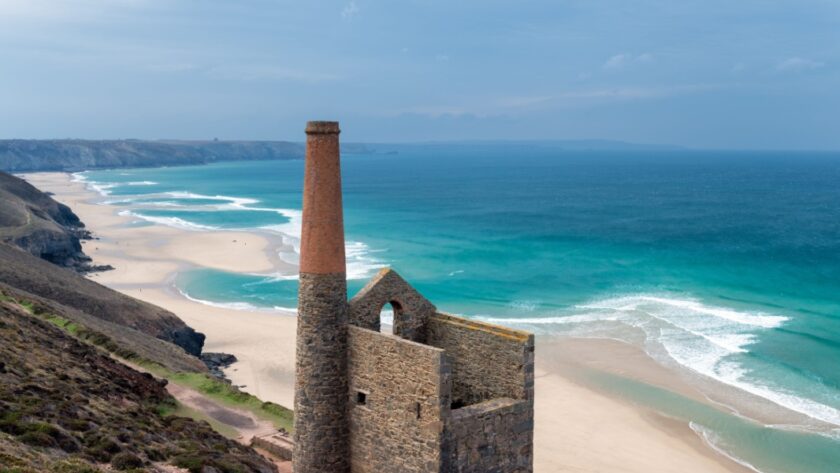
Cornwall’s character was shaped by geography and necessity, which is often the case in places where the land looks lovely but has historically made life difficult. For centuries this was a working landscape, not a postcard one. Fishing mattered. Mining mattered even more. Cornwall once helped power the industrial world through its vast tin and copper industries, and traces of that age still cling to the cliffs and hillsides in the form of engine houses, ruined stacks, and villages with a tough, practical air beneath their holiday polish.
These reminders of the past are part of what stops Cornwall becoming merely scenic. Around places such as St Agnes, Botallack, and the old mining country near Camborne and Redruth, the land still bears the marks of labour. Great stone buildings perch above crashing waves in places so absurdly dramatic that they look less like workplaces and more like sets from an opera about hardship. Yet they were real, and they tell you something essential about Cornwall. This is a county with beauty, yes, but also graft.
That sense of rootedness survives in its culture. Cornwall does not feel like a generic seaside region draped in bunting. It has a distinct identity, shaped by its Celtic past, its language, its patron saints, and its long habit of being slightly apart. Even the place names sound different, all Zennor, Lelant, Mousehole, and Porthcurno, as though the map itself has slipped into poetry.
Harbour towns, art colonies, and places that understand weather
Then there are the towns, many of which look as if they were arranged by someone with a weakness for whitewashed cottages, bobbing boats, and steep lanes. St Ives is perhaps the best example of Cornwall’s ability to charm people into irrational property fantasies. You arrive thinking you will have a look around and half an hour later you are pricing fishing cottages you cannot afford. Its narrow streets, sandy beaches, and quality of light have drawn artists for generations, and quite understandably. The place seems to have been designed for painters, photographers, and anyone who has ever felt improved by staring at the sea with a coffee in hand.
Falmouth, by contrast, has a bit more swagger. It is a proper harbour town, full of maritime history, sea-going energy, and the kind of pubs where you feel a waterproof jacket is not only acceptable but somehow correct. Padstow has become polished and food-famous, though beneath the restaurant bookings and glossy shop fronts it still has the bones of a working port. Mousehole, meanwhile, is so compact and picturesque that it can feel almost fictional, like somewhere invented to sell calendars.
What these places share is a close relationship with weather. Cornwall is not a county that pretends the elements are a minor inconvenience. Weather is part of the experience here. A Cornish beach on a blazing summer day can feel almost indecently cheerful, all turquoise water and children hurling themselves at waves. The same beach in a winter gale becomes something entirely different, thrilling and slightly alarming, with the sea performing as though it has a personal grievance.
The coast does most of the showing off
Cornwall’s coastline is its great masterpiece, and it knows it. There are long family beaches where buckets and bodyboards reign, hidden coves that require a determined scramble, surfing beaches with names spoken reverently by people in wetsuits, and cliff paths that make even a short walk feel cinematic. The South West Coast Path is especially good at making ordinary walkers feel briefly profound. One minute you are adjusting a boot lace, the next you are standing above a sweep of sea and rock thinking large thoughts about time, erosion, and whether there is a pub at the end.
The north coast tends to be the louder, wilder one, with Atlantic surf and dramatic cliffs. Places like Newquay, Bedruthan Steps, and Holywell Bay have a swaggering, open-to-the-elements quality. The south coast often feels gentler, with wooded creeks, calmer waters, and old harbours tucked into folds of the shoreline. Then, at the far west, Cornwall becomes something almost mythic. Land’s End may be touristy, but the surrounding landscape is undeniably stirring. Nearby Porthcurno, with its absurdly clear water and the extraordinary Minack Theatre carved into the cliffs, feels like a place dreamt up by someone unwilling to accept the limitations of geography.
And then there is Tintagel, where history and legend have entered a long-term relationship and nobody now seems especially interested in separating them. The cliffs are magnificent, the ruins atmospheric, and the whole place has the useful sense of being haunted by stories whether you believe in them or not.
Cornwall is also very good at pleasures
It would be unfair to suggest Cornwall survives on scenery alone. It also understands pleasure in a deeply practical way. It knows the value of a harbour-side pint, an ice cream in a windbreak, a paper bag of hot chips, and a bakery that opens just when morale is fading. The county has become a serious food destination, but wisely it has not abandoned simpler delights in the process. You can eat very well here, from polished seafood restaurants to beach cafés and farm shops, but some of Cornwall’s most satisfying meals are still the ones eaten outdoors while trying to stop a napkin escaping.
This, perhaps, is the secret of Cornwall. It offers grandeur without demanding formality. You can admire extraordinary landscapes in sandy shoes. You can encounter history while carrying fudge. You can spend the morning in an art gallery, the afternoon in the surf, and the evening eating something excellent while looking at a harbour that has seen far harder days than yours.
Cornwall is not subtle. It is too weather-beaten, too romantic, too full of cliffs and legends and fiercely defended local habits for that. But subtlety is overrated. Cornwall gives you beauty with force, character with edges, and the distinct impression that life might be better if it involved more sea air and fewer emails. Which, when you think about it, is hard to argue with.
Know before you go
Getting here
- Cornwall is reachable by road via the M5 and A30, though summer traffic can test both patience and character
- Trains run to major Cornish stops including Truro, St Austell, Penzance, Falmouth, Newquay, and St Ives
- Newquay Airport offers flights from selected UK locations
- A car is useful for exploring smaller villages, beaches, and rural areas, though some branch rail lines and local buses are scenic and surprisingly handy
Where to stay
- St Ives for art, beaches, and handsome seaside atmosphere
- Falmouth for maritime character, food, and a lively town feel
- Padstow or nearby north coast villages for foodie breaks and access to beaches
- Penzance or Mousehole for west Cornwall and easy access to Land’s End, St Michael’s Mount, and the far west
- Bodmin or the countryside around mid Cornwall for a quieter base with easier driving access
Where to eat
- Fresh seafood is the obvious star, especially in coastal towns
- Padstow, Falmouth, and St Ives have strong dining scenes ranging from casual to celebratory
- Cornwall is also excellent for bakeries, farm shops, cream teas, and beach cafés
- Try a proper Cornish pasty from a respected local bakery rather than somewhere that appears to regard pastry as an afterthought
What to do
- Walk sections of the South West Coast Path
- Visit St Ives and the Tate St Ives
- Explore the Minack Theatre and Porthcurno
- Discover Tintagel and the north coast cliffs
- Spend time on the beaches around Newquay, Padstow, and west Cornwall
- Visit the Eden Project or the Lost Gardens of Heligan
- Explore the historic mining landscapes in west Cornwall
Nearby gems
- St Michael’s Mount for castle drama and tidal causeway magic
- Helford River for calmer waters and wooded creeks
- Boscastle for a striking harbour and storybook setting
- Port Isaac for a characterful fishing village with steep lanes and sea views
- Bodmin Moor for a wilder inland contrast to the coast
Best time to visit
- Late spring and early autumn are often ideal, with good light, milder crowds, and plenty open
- Summer brings the classic beach holiday atmosphere, along with higher prices and busy roads
- Winter can be wonderfully dramatic on the coast, especially for walkers, storm-watchers, and anyone who likes their beauty with a bit of menace