
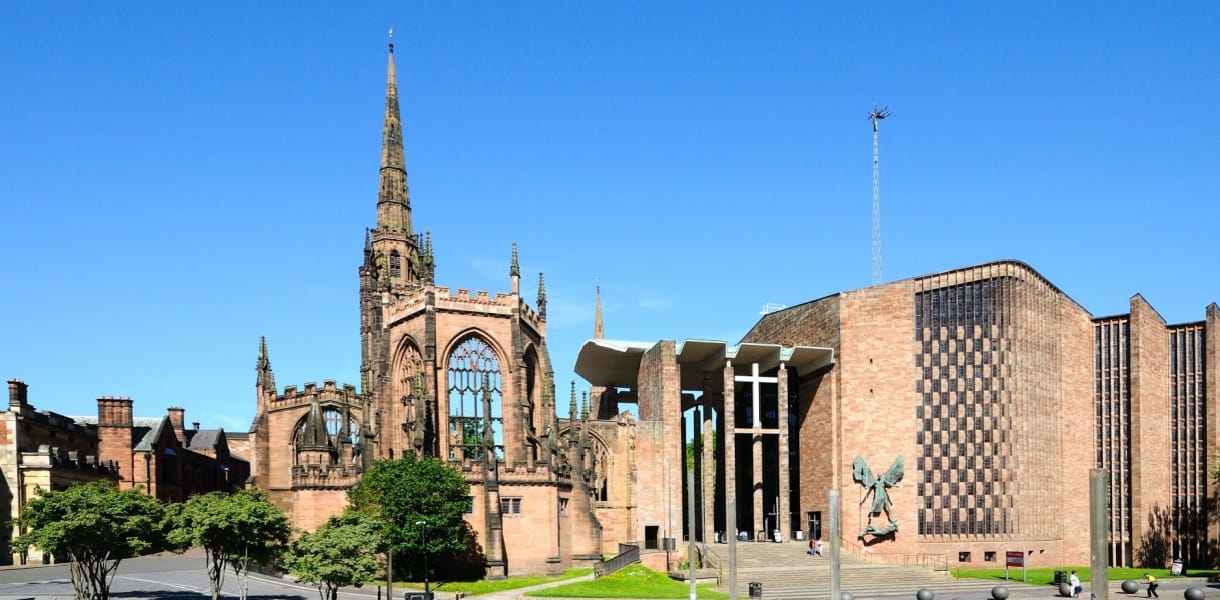
Coventry is one of those places that has had the sort of history that would have sent a lesser city quietly off for a lie down. It has been prosperous, pious, battered, rebuilt, mocked unfairly, and quietly transformed into somewhere far more interesting than many people expect. Come for the cathedral, stay for the layers of grit, invention, medieval fragments and modern confidence that make Coventry one of England’s most quietly fascinating cities.
Quick takeaways
- Coventry blends medieval history, post-war reinvention, and modern culture better than almost anywhere in England
- The cathedral ruins and new cathedral are among the most moving sights in the country
- The city has deep links to transport, engineering, and British industry
- You will find timber-framed streets, inventive museums, lively student energy, and plenty of green space
- It makes an excellent weekend break and an easy day trip from Birmingham, Warwick, Stratford-upon-Avon, and the wider Midlands
A city with a bit of a reputation and a lot to prove
Coventry has spent years suffering from the kind of faintly patronising tone usually reserved for school dinners and sensible footwear. It is one of those cities people think they know without having visited properly, which is always a risky business. In practice, Coventry is far more compelling than its reputation suggests. It is a city of broken edges and beautiful survivals, of old stone and post-war concrete, of sacred spaces and engineering swagger.
It does not charm in the easy, polished way of somewhere like Bath or York. Coventry is not interested in fluttering its eyelashes. It wins you over by degrees, with small surprises and larger revelations. A medieval gateway here, a cathedral ruin there, a street that suddenly looks as though Shakespeare might wander past in search of a decent sandwich. Spend a little time here and the city begins to feel less like a place people pass judgement on and more like somewhere with genuine depth and character.
The medieval city that once rivalled the greats
Long before Coventry became associated with cars, ring roads and post-war reconstruction, it was one of the most important cities in England. In the Middle Ages it was a centre of trade, religion and civic pride, rich from cloth and influential enough to matter on the national stage. This was not some sleepy provincial settlement with a market and the occasional goat. Coventry was a serious place, prosperous and confident.
Hints of that medieval power still survive, though you have to look for them in fragments. St Mary’s Guildhall is one of the city’s great treasures, a magnificent reminder that Coventry once had money, ambition and a taste for impressive interiors. Inside, you get the kind of atmosphere that makes you instinctively lower your voice, even if you were only about to comment on the price of coffee. Its great hall, tapestries and sense of age have a solidity that many heritage sites can only dream of.
Nearby, parts of old Coventry still peek through the modern city. Spon Street is the most famous example, a row of timber-framed buildings that looks delightfully improbable amid the twentieth-century rebuilding. It feels like a surviving sentence from a manuscript otherwise lost to fire and upheaval. You stand there and realise Coventry did not lose all of its past. It just had more than its fair share taken from it.
The night that changed everything
No understanding of Coventry makes sense without the Blitz. On the night of 14 November 1940, German bombing devastated the city centre, killing hundreds of people and destroying large swathes of the medieval city. The old St Michael’s Cathedral was left as a ruin, its tower and spire still standing above the shattered shell. That moment remains central to Coventry’s identity, not simply as a tragedy, but as the point from which the modern city had to imagine itself again.
The cathedral ruins are still one of the most powerful places in England. They are not tidy or decorative in the manner of some ancient ruins that now look as though they have settled into retirement. These ruins still feel raw. The roof is gone, the sky presses in, and the burnt sandstone walls seem to hold their silence with real effort. It is not merely picturesque. It is moving.
Beside the ruins stands the new Coventry Cathedral, completed in 1962. It could have been a stern and self-important bit of post-war architecture, but instead it is astonishingly humane. The building manages to feel modern, sacred and hopeful all at once. Basil Spence’s design, the immense tapestry of Christ in Glory, the great stained glass, the sense of light after destruction, all of it works together beautifully. Even people with no particular interest in architecture or religion often come away affected by it. Coventry chose not just to rebuild, but to say something generous about peace and reconciliation. That is no small thing.
Engines, bicycles and the business of moving people
Coventry also helped shape the modern world in a less spiritual but no less significant way. This is a city of industry, invention and mobility. It was central to Britain’s cycle and motor industries, and for a long time the city hummed with manufacturing confidence. If Birmingham often gets the louder billing when people talk about industrial might, Coventry deserves far more credit than it usually receives.
The Coventry Transport Museum is one of the best ways to understand this side of the city. Mercifully, it is not just a warehouse full of old machinery that appeals only to men named Dennis who enjoy explaining carburettors. It is lively, engaging and full of stories about design, speed, ambition and everyday life. The museum holds the largest publicly owned collection of British road transport in the world, and it turns what might have been a niche subject into a vivid portrait of a city built on movement.
There is something wonderfully British about the whole story. Coventry made bicycles, then motorcars, then its peace with change, then itself useful again. It is a city that kept adapting, even when the economic weather turned foul. The industries may have shifted, but the spirit of practical ingenuity remains stitched into the place.
A city of reinvention
Post-war rebuilding has not always been kind to Coventry’s image. Like many British cities reconstructed in the mid twentieth century, it acquired stretches of architecture that can appear a little stern. Some of it is much better than critics admit, some of it is exactly as clunky as feared, and all of it forms part of the story. Coventry is a city best appreciated not as a perfect visual composition but as an ongoing argument between eras.
That is also what makes it interesting. There is now a fresh confidence here, helped by cultural investment, university life, and a growing sense that Coventry no longer needs to apologise for itself. The city’s year as UK City of Culture gave it a welcome push, but the deeper point is that Coventry had the substance all along. The label merely encouraged more people to notice.
The modern city centre is easy to explore on foot, and that matters. You can move from old pubs to contemporary public art, from shopping streets to historic corners, from cathedral precincts to museums without much trouble. The experience is less about ticking off postcard icons and more about letting the city reveal itself gradually. Coventry is very good at the gradual reveal.
More than a cathedral city
There is plenty beyond the obvious highlights. Herbert Art Gallery and Museum offers a useful sweep through local history, art and culture, helping to tie together the medieval city, the Blitz, and the industrial years. FarGo Village, meanwhile, brings a more modern Coventry into view, with independent shops, creative businesses, street food and events. It adds a dose of informal energy that stops the city from feeling trapped in its own history.
Then there are the parks and quieter corners that soften the urban landscape. War Memorial Park is especially good for a stroll when you need a break from stone, glass and historical reflection. Like many Coventry pleasures, it does not shout about itself. It just gets on with being rather good.
And of course Coventry sits in a particularly rich part of England. Warwick, Kenilworth, Stratford-upon-Avon and Birmingham are all close by, which makes the city a strong base as well as a destination in its own right. But it would be a mistake to treat it merely as the practical option while prettier places get the glory. Coventry deserves time on its own terms.
Why Coventry lingers
What stays with you about Coventry is not one single landmark, though the cathedral comes close. It is the feeling of a city that has endured, adapted and emerged with its dignity intact. There is something deeply appealing about that. Coventry does not pretend its losses never happened. It incorporates them into its identity, then carries on.
In an age when many places are polished to within an inch of their personality, Coventry feels refreshingly real. It has scars, yes, but also humour, intelligence and substance. It is historically significant without becoming pompous, modern without becoming soulless, and moving without putting on a performance. That is a difficult balance to strike.
Coventry may never be England’s most showy city. Frankly, it has better things to do. What it offers instead is depth, resilience and the quiet satisfaction of discovering that a place dismissed by the careless is, in fact, full of stories worth hearing. Which is often the best sort of city there is.
Coventry at a glance
Getting here
- Coventry is well connected by train, with direct services from London, Birmingham, and other major cities
- By car, it sits close to the M6, M69 and A45, making it straightforward from much of the Midlands
- The city centre is compact enough to explore on foot once you arrive
Where to stay
- Stay in the city centre for easy access to the cathedral, museums, shops and restaurants
- There are reliable chain hotels for convenience and a handful of smarter options for a more comfortable weekend break
- Nearby Warwick and Kenilworth also make attractive bases if you want a broader trip around the area
Where to eat
- Coventry has a varied food scene with independent cafés, modern British dining, casual street food and strong South Asian options
- Fargo Village is a good bet for informal eating and local flavour
- The city centre has plenty of practical choices for lunch and pre-theatre dinners
What to do
- Visit the ruins of the old cathedral and the striking modern Coventry Cathedral
- Explore St Mary’s Guildhall for a dose of medieval grandeur
- Spend time at Coventry Transport Museum and the Herbert Art Gallery and Museum
- Wander Spon Street for one of the city’s most atmospheric historic corners
- Browse Fargo Village for independent shops, food and events
Nearby gems
- Warwick for its castle and handsome town centre
- Kenilworth for abbey ruins and one of England’s great ruined castles
- Stratford-upon-Avon for literary heritage and Tudor charm
- Birmingham for big-city culture, canals and excellent dining
Best time to visit
- Spring and early autumn are ideal for walking and sightseeing without peak crowds
- Summer brings events and a livelier atmosphere around the city
Winter can actually suit Coventry rather well, especially if you want the cathedral quarter at its most reflective