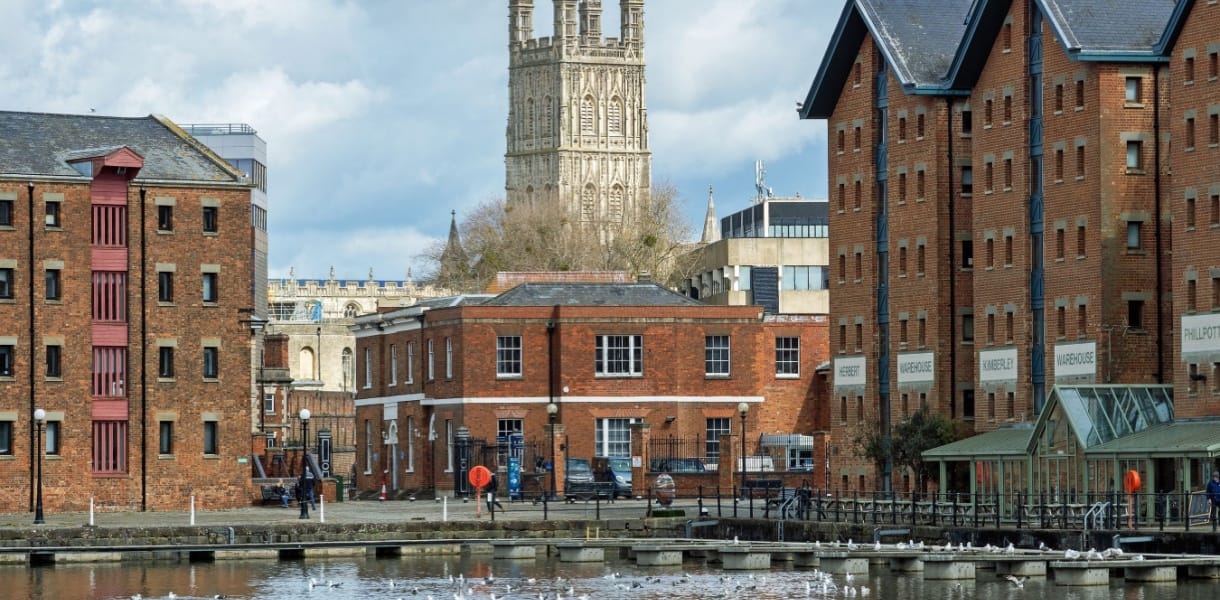
Gloucester is one of those cities that can seem oddly modest at first, as if it has no intention of showing off, and then suddenly produces a Roman wall, a vast medieval cathedral, a king’s tomb and a set of docks grand enough to make you reconsider the whole matter. It is ancient, handsome in places, scruffy in others, and all the more likeable for it.
Quick takeaways
- Best for history lovers, cathedral enthusiasts, waterside wandering and short city breaks
- Don’t miss Gloucester Cathedral, Gloucester Docks and the Museum of Gloucester
- Time needed One full day at a rush, two days if you want to do it properly
- Good for kids Yes, especially around the docks and museums
- Best time to visit Spring to early autumn, though the cathedral is excellent in any weather
A city with Roman roots and a talent for understatement
Some British cities fling themselves at you with immediate theatricality. Bath arrives powdered and polished. York seems permanently lit for a historical drama. Gloucester, by contrast, takes a slightly different approach. It lets you notice things gradually. A medieval lane here. A glimpse of old brick there. A sudden cathedral tower above the rooftops, as if history has quietly stood up in the back row.
That is part of its charm. Gloucester has been around for a very long time and does not feel the need to shout about it every five minutes. The city’s visitor offer today still revolves around that long story, with Gloucester Cathedral, Gloucester Docks and the Museum of Gloucester among its standout attractions.
What makes the place appealing is that it still feels like a proper working city rather than a heritage display cabinet. There are moments of grandeur, yes, but also a welcome lack of preciousness. Gloucester has not been polished to the point of losing its character. It feels lived in, which is often much more interesting.
The cathedral that rather settles the matter
Sooner or later, every visit ends up at Gloucester Cathedral, because ignoring it would be like trying not to notice a mountain. The site has seen Christian worship since the late seventh century, while the present abbey church began in 1089 under Abbot Serlo and still preserves major Norman fabric. The cathedral also highlights its cloisters, Great East Window and the tomb of Edward II as key features of the building.
This is the sort of building that makes modern architecture look faintly undercommitted. The nave has that thick-set Norman confidence that seems designed to outlast not only centuries but also criticism. Then come the cloisters, airy and intricate, with fan vaulting that manages to look both delicate and impossibly solid. Even if you know very little about church architecture, the place has a way of making you stand still and look up.
There is also the slightly surreal pleasure of recognising parts of it from film and television. The cathedral is now familiar to many visitors through screen appearances as well as its religious and historical importance. It is an odd but effective combination. Medieval splendour, royal tombs and a nagging sense that you have seen this corridor somewhere before.
The docks that give Gloucester its swagger
If the cathedral is Gloucester’s solemn masterpiece, the docks are where the city loosens its collar a bit. Gloucester Docks preserve one of the country’s most striking inland dock landscapes, with historic warehouses, waterside spaces, shops, food spots and visitor attractions gathered in a walkable area close to the city centre. Visit Gloucester also notes that this is the most inland port in the country and highlights the concentration of surviving Victorian warehouse buildings.
This part of the city has real atmosphere. Brick warehouses line the water with stern Victorian seriousness, as though trade were once a branch of moral philosophy. Yet the area does not feel frozen in time. You can wander between old industrial buildings and modern places to eat, browse the quayside, watch the boats, and feel the city’s commercial past still humming quietly underneath it all.
It is one of Gloucester’s best qualities that the docks do not feel separated from the rest of the city’s identity. They deepen it. Gloucester was never just a cathedral city contemplating eternity. It was also a place of movement, trade and practical ambition. The docks remind you that history here came in work boots as well as choir robes.
A city of layers rather than one big showpiece
What makes Gloucester rewarding is the way different eras sit side by side without too much ceremony. A Roman past, a medieval powerhouse, a Victorian port, a modern compact city break destination. You do not get just one version of Gloucester. You get several, all nudging one another in the ribs.
That is where the Museum of Gloucester earns its keep. It helps join up the story, covering the city’s past from prehistoric and Roman material through later periods, and gives welcome context to what you are seeing out on the streets.
There are prettier cities. There are grander cities. But Gloucester has something more durable than polish. It has weight, texture and a refreshing refusal to become too tidy for its own good. The rougher edges are part of the appeal. They stop the place from feeling stage-managed.
Why Gloucester works so well for a short break
For visitors, Gloucester is pleasingly manageable. The headline sights are close enough together that a short trip still feels full. You can spend the morning at the cathedral, drift down to the docks in the afternoon, dip into the museum, and still have time for dinner without feeling as though you have marched across half a county. The cathedral sits in the historic heart of the city, while the docks and quays are within easy reach.
It also suits different kinds of trip. History weekend, architecture wander, easy family outing, one-night stop with good food and a bit of atmosphere. Gloucester is flexible like that. It does not demand a solemn appreciation of its importance. It is quite happy for you to admire a medieval masterpiece, then go and eat something near the water.
And that is probably why it lingers in the memory. Gloucester is not trying to be fashionable, and it does not need to be. It is simply old, substantial, adaptable and full of stories. In Britain, that is often the beginning of affection.
Know before you go
Getting here
- Gloucester Railway Station and Gloucester Transport Hub are opposite each other and both are a short walk from the city centre, cathedral and main attractions.
- Buses run frequently from the Transport Hub, with links across the city and to places including Cheltenham and Stroud.
- If you are driving, check city centre and docks parking options in advance, especially on busy weekends.
- Once you arrive, Gloucester is compact enough to explore easily on foot.
Where to stay
- Hotel Indigo Gloucester – The Forum
Stylish central option with 129 rooms, on-site dining and a city-centre location close to Gloucester’s main sights. Good pick for a smart weekend break. - SULA Lightship
One for people who like their accommodation with a story. This restored historic lightship is moored in Gloucester Docks and offers a genuinely unusual stay. - The New Inn
A historic inn near the cathedral area and a good choice if you want somewhere with more old-world character in the middle of town.
Where to eat
- Greek on the Docks
Modern Greek and Mediterranean cooking right at Gloucester Docks. A strong choice for a meal with atmosphere and waterside views. - Sebz
Friendly Portuguese and Mediterranean restaurant in the city centre, known for tapas and a relaxed feel. Good for an informal evening meal. - Dr Foster
Docks pub and restaurant with all-day dining and waterside setting. Useful if you want something easy and atmospheric after a wander around the quays.
What to do
- Visit Gloucester Cathedral, one of the city’s great landmarks and one of the main reasons to come.
- Wander Gloucester Docks for waterside history, warehouse architecture and modern food and shopping.
- Drop into the Museum of Gloucester to get the city’s story in proper order.
Nearby gems
- The wider Gloucestershire area makes it easy to combine Gloucester with countryside or Cotswolds stops if you are planning a longer break.
- Cheltenham is close enough for a twin-centre trip if you want a contrast between Gloucester’s grit and Cheltenham’s polish.
Best time to visit
- Late spring to early autumn is ideal for enjoying the docks and city wandering at an easy pace.
- Winter still works well for cathedral visits and a shorter cultural break, particularly if you are more interested in heritage than lingering outdoors.