 kenroe61@gmail.com
 Northumberland does not rush to impress. It reveals itself in stages, through empty beaches, moorland roads, ruined priories, Roman stones, market towns and castles planted in absurdly handsome positions. A deeper look at one of Britain’s most rewarding regions shows why this northern county lingers in the mind long after the trip is over.
Quick takeaways
- Northumberland is one of Britain’s most rewarding regions for visitors who like coast, castles, history and open space in equal measure
- The county’s great strengths are its contrast and depth, from Lindisfarne and Bamburgh to Hadrian’s Wall, the Cheviots and Kielder
- It suits travellers looking for a slower, richer kind of trip rather than a rushed tick-list break
- The coast is among the finest in Britain, with huge beaches, dramatic castles and far less fuss than many better-known destinations
- Inland Northumberland offers one of England’s best combinations of walking country, dark skies, Roman history and peaceful market towns
- This is a region that rewards staying longer, driving slowly and allowing time for the unexpected
A deeper look at one of Britain’s most rewarding regions
There are parts of Britain that seem determined to impress you at once. They fling a castle into your line of sight, add a photogenic harbour, perhaps a field of obliging sheep, and wait for applause. Northumberland takes a different approach. It does not hurry. It reveals itself in stages, as if slightly sceptical about whether you are worth the effort. First you notice the space. Then the silence. Then the castle on the hill, the empty beach, the long view over moorland, the Roman stones lying calmly across the land as if the empire only just left. Somewhere around that point, you begin to suspect that this may be one of the most rewarding regions in Britain.
It is certainly one of the least showy. Northumberland does not swagger in the manner of some more famous places. It does not have the polished confidence of the Cotswolds, the theatrical grandeur of the Highlands, or the all-round overachievement of the Lake District. What it has instead is depth. Real depth. Historical depth, landscape depth, sky depth, and that pleasingly rare sense that whole chunks of the modern world have simply failed to elbow their way in.
This is the county where England starts to thin out and grow thoughtful. It stretches from Newcastle’s northern fringe to the Scottish border, and from the North Sea westwards into hills, forests and upland country that feel half forgotten in the best possible way. You come here expecting castles and coast and, to be fair, there is no shortage of either. But the deeper look is where Northumberland earns its place among Britain’s most memorable regions. This is not just somewhere to tick off beauty spots. It is somewhere to sink into.
A county built on space and weather
The first thing Northumberland gives you is room. Room to breathe, room to walk, room to stand on a headland and feel pleasantly unimportant. There is an awful lot of landscape here and, importantly, much of it has been left alone to get on with being landscape. Roads run on for miles through open country. Villages arrive modestly, with sturdy stone houses, a pub if you are lucky, and a church that looks as though it has seen several invasions and is not especially impressed by modern inconveniences.
The skies are part of the drama. In Northumberland, weather is not background decoration. It is a cast member. Sunlight can move across the Cheviots in great bands of silver and green. Sea mist drifts in and turns ruined castles into something out of legend. A windy afternoon on the coast can make the whole region feel vast and stern and magnificent, while a clear evening inland has a stillness that borders on the magical.
That sense of openness is one reason the place lingers in the mind. So many parts of Britain have been tidied, crowded, over-signposted or overexplained. Northumberland still allows for discovery. It does not place a helpful hand on your shoulder every five minutes and say here is the official viewpoint. You have to do some noticing of your own, which is an increasingly rare pleasure.
The coast that quietly outclasses most others
Northumberland’s coastline is one of those things Britain ought to brag about more, but somehow does not. Perhaps it is because the county itself seems too self-contained to bother with showmanship. Whatever the reason, the coast remains a glorious surprise to those who know it only by reputation.
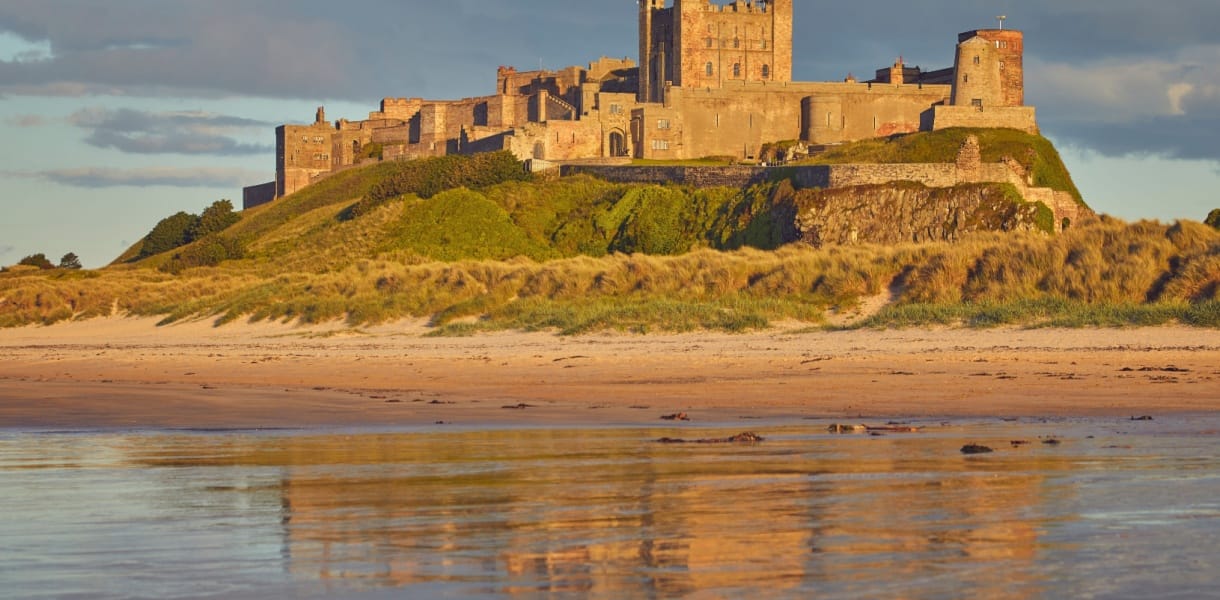
There are beaches here that seem to go on forever, pale and clean and almost absurdly empty outside the busiest days of summer. Bamburgh Beach spreads out beneath its great castle in a manner so handsome it almost feels unfair on the rest of the country. Druridge Bay offers long, uninterrupted sweeps of sand and sea where you can walk for ages with only gulls, wind and your own thoughts for company. Further north, places like Seahouses and Beadnell bring a more lived-in coastal charm, with harbours, boats and all the useful signs of actual human life.
Then there is Lindisfarne, which has a habit of making visitors go quiet. Holy Island is one of those rare places where landscape, history and atmosphere all pull in the same direction. Crossing the causeway already feels faintly ceremonial. Once there, you find a place of huge skies, low dunes, old priory stones and a kind of weathered holiness that survives centuries of tourism with surprising dignity. It is beautiful, certainly, but it is also more than that. It feels storied. Layered. A place where time has accumulated rather than simply passed.
What makes this coastline so rewarding is not just its beauty but its variety of mood. One moment it can seem almost playful, with bright boats and village cafés and children charging into the surf with more confidence than wisdom. The next it becomes austere, elemental and nearly primeval. You do not simply look at Northumberland’s coast. You feel your way along it.
Castles everywhere, and none of them apologising
If Northumberland has an architectural habit, it is building castles in places of maximum dramatic effect. It appears to have been a regional hobby for several centuries. Hilltops, tidal islands, cliff edges, riverbanks, they are all pressed into service. The result is a county that occasionally feels like it has more castles than ordinary buildings.
Bamburgh is the great scene-stealer, of course, rearing up above the dunes with the confidence of something that knows it has been on postcards for generations. It is vast, muscular, and just a little theatrical, which is exactly what one wants from a proper castle. Alnwick, by contrast, has a more polished grandeur, part fortress, part stately fantasy, and perfectly comfortable in its role as one of Britain’s best known historic houses. Warkworth sits beautifully above the River Coquet, full of melancholy grace and just enough ruin to keep things romantic.
But what is so striking in Northumberland is how these castles feel like part of the county’s natural fabric rather than isolated attractions. They belong here. This was a borderland, frequently fought over, nervy and strategic, and the architecture reflects that history in stone. These are not decorative follies built to flatter some landowner’s ego. They were answers to a difficult landscape and a difficult political reality.
Even the smaller pele towers and fortified manor houses tell the same story. This was a region shaped by conflict, by vigilance, by the need to keep watch. Yet today those same structures lend the county an almost mythic texture. You drive through an ordinary-looking village and find a medieval tower planted beside the houses as casually as if every community keeps one for emergencies.
The Roman frontier that still feels alive
Plenty of places in Britain have Roman remains. Northumberland has Hadrian’s Wall, which is rather like saying plenty of people have a garden wall but one person has the Great Wall of China. It is one of the country’s most extraordinary landscapes, not only because of the history but because of the way the wall sits in the land.
Across the central section especially, it runs over crags and ridges with an almost artistic flair, as though the Romans consulted a painter before starting work. The remains at Housesteads, Vindolanda and Chesters are among the most evocative anywhere in Britain, and not merely because they are old. They still feel purposeful. You can stand on the high ground and understand exactly why this frontier mattered. The views stretch, the wind cuts through, and the whole business of empire suddenly seems much less abstract.
What makes Hadrian’s Wall so rewarding is that it operates on several levels at once. It is a major historic monument, certainly. It is also a superb walking landscape, a vast open-air lesson in geography and military logic, and one of the best places in England to think about scale. Human ambition, imperial reach, the stubbornness of stone, the great indifference of weather, it is all there on the ridge.
And then there is Vindolanda, with its writing tablets and everyday fragments of life, reminding you that history is not only about emperors and generals. It is also about cold feet, shopping lists, complaints, routines, and the eternal human tendency to grumble when posted somewhere damp and remote. In this regard, the Romans in Northumberland were plainly becoming local.
Inland Northumberland and the pleasures of going further
Many visitors hug the coast or make for the famous stretches of Hadrian’s Wall, and fair enough. But inland Northumberland is where the county becomes even more interesting. This is a land of rolling hills, remote valleys, wide reservoirs, dark forests and villages that feel as though they have been sensibly ignoring trends for decades.
Northumberland National Park is one of the least visited national parks in Britain, which in practical terms means you get more space, fewer queues and a significantly lower chance of someone blocking the footpath while taking seven hundred photographs of a gate. The Cheviots rise softly but impressively along the border, all broad backs and changing light. The Simonside Hills have a rougher, moodier beauty, full of heather and folklore and the sort of views that make a flask of tea seem like a profound achievement.
Kielder adds another dimension to the county. The forest and water create a huge, almost northern wilderness feel, made all the more striking by the sense that you are still in England, yet in a version of it many people barely imagine. By day there are trails, bike routes and a feeling of rural scale on grand terms. By night there is darkness, the proper sort, with stars thrown across the sky in indecent abundance. Northumberland does darkness well. In an age when most of the country glows faintly all the time, that is no small thing.
There is a quiet richness to these inland landscapes. They do not fling themselves at you. They ask for a slower kind of attention. Walk a little, stop often, look around. Northumberland rewards patience more than speed.
Towns and villages with just enough rough edges
It would be possible to paint Northumberland as nothing but ancient ruins, empty beaches and noble scenery, but that would miss the fact that it is also full of places with character. Real character, too, not the aggressively curated kind with twelve gift shops and an artisan marshmallow emporium.
Alnwick has substance. It may be known for its castle, but it also has proper market town bones, handsome streets, and the feeling of somewhere that works as a town rather than existing purely as a backdrop. Hexham is one of the county’s great pleasures, elegant but grounded, with its abbey, market place and easy gateway position between town and upland country. Morpeth has charm in quieter doses, while places such as Wooler, Rothbury and Amble each bring their own local flavour, whether through walking culture, riverside setting or maritime revival.
What Northumberland does well in its settlements is resist becoming too polished. There are still useful shops, ordinary pubs, bits of weathered stone, practical people, and that sense that life here is not entirely arranged for outsiders. This matters. A region becomes more rewarding when it remains itself.
Why Northumberland stays with you
Some places delight in the moment and then fade. Northumberland is not like that. It has a way of settling into the memory and growing larger there. Perhaps it is the contrasts. The austere coast and the soft inland hills. The holy calm of Lindisfarne and the hard military logic of Hadrian’s Wall. The grandeur of Bamburgh and the plain friendliness of a market town café. The county feels varied without ever losing its own identity.
But more than that, Northumberland offers a rarer pleasure. It makes you feel that there is still room in Britain for surprise. Still room for silence, distance, weather, darkness, and history that is not fenced off from the present but woven through it. It is a region that rewards looking beyond the obvious and staying a little longer than planned.
A deeper look at Northumberland reveals more than a beautiful county. It reveals one of Britain’s most complete regions, where coast, castles, hills, ruins, villages and long empty roads all seem to belong to the same large and satisfying idea. It is England at its northernmost and, in many ways, at its most hauntingly memorable.
If much of modern travel encourages us to consume places quickly, Northumberland stands there, calm as an old tower, and suggests that we might instead take our time. Sensible advice, really. The county has been waiting a very long while.
Northumberland quick guide
Getting here
- Newcastle is the main gateway, with rail links from London, Edinburgh and other major cities
- The East Coast Main Line serves places including Morpeth, Alnmouth for Alnwick, and Berwick-upon-Tweed
- A car is very useful for exploring the county properly, especially inland areas, castles, beaches and smaller villages
- Driving distances can look modest on the map but this is a large county, so allow more time than you think
Where to stay
- Bamburgh or Seahouses for coast, castles and sea views
- Alnwick for a central base with heritage, restaurants and easier access to several highlights
- Hexham for Hadrian’s Wall, market town atmosphere and western Northumberland
- Rothbury or Wooler for walking, scenery and a quieter countryside stay
- Kielder or nearby for dark skies, forest stays and a more remote feel
Where to eat
- Expect a good mix of market town cafés, country pubs, seafood spots and hotel restaurants
- Coastal areas are ideal for fish and chips, crab sandwiches and harbour-side lunches
- Alnwick, Hexham and Morpeth are among the best bets for choice and variety
- Northumberland suits travellers who like proper tearooms, sturdy pub lunches and the occasional excellent surprise
What to do
- Walk the beach beneath Bamburgh Castle
- Time your visit to Holy Island carefully and soak up Lindisfarne’s remarkable atmosphere
- Explore Hadrian’s Wall sites including Housesteads and Vindolanda
- Spend time in Alnwick, including the castle and gardens
- Head into Northumberland National Park for big views and quieter walking country
- Stay out late or book a stargazing experience around Kielder
Nearby gems
- Berwick-upon-Tweed for walls, bridges and Anglo-Scottish border history
- Amble and Warkworth for a fine coastal pairing of harbour town and castle village
- Craster and Dunstanburgh for one of the county’s great short walks
- Ford and Etal for a gentler, less obvious corner of north Northumberland
- The Tyne Valley for abbeys, country estates and easy scenic detours
Best time to visit
- Late spring and early summer bring fresh green landscapes, longer days and excellent walking weather
- September can be superb, with softer light, fewer crowds and often very good coastal conditions
- Winter suits visitors who like dramatic skies, empty beaches and dark-sky experiences
- Even in peak summer, Northumberland generally feels calmer than many equally beautiful parts of Britain