With a Norman cathedral, a crooked medieval street plan, a market that has been trading for centuries and a quietly rebellious streak, Norwich is one of England’s most distinctive small cities. It is handsome without being smug, historic without feeling embalmed, and full of the sort of odd little details that make a place stick in the mind.
Quick takeaways
- Best for history lovers, independent minded weekend breakers, bookish travellers and anyone who likes a city with character
- Famous for its cathedral, castle, medieval streets, covered lanes and one of the oldest and largest open air markets in the country
- Compact enough to explore on foot, with plenty packed into a manageable city centre
- Great for a one or two night break, with enough museums, food spots and atmosphere to fill a weekend
- Best visited in spring, summer and early autumn when the lanes, gardens and market are at their liveliest
There are cities that make a great deal of noise about themselves, puffing out their civic chests and behaving as though the mere existence of a cathedral and a shopping street ought to bring visitors to tears. Norwich is cleverer than that. Norwich simply gets on with being excellent in a calm, faintly self amused sort of way, as though it has known for centuries that it is one of England’s best small cities and sees no reason to make a fuss.
This is very much in keeping with the place. Norwich has long had the air of somewhere that prefers to do things its own way. It is tucked away in East Anglia, which for many people still sounds less like a real region and more like a slightly wistful shipping forecast. It is not on the route to somewhere else. You go to Norwich because you mean to. That, somehow, feels important. It gives the city a sense of self possession. People who come here have made an effort, and Norwich seems quietly pleased about it.
It is also gloriously old. At one time it was England’s second city, which is not something modern Norwich shouts about much, but it explains the confidence of the place. Wealth from wool, trade and religion left behind a city rich in churches, lanes, houses, gateways and stonework, all packed into a centre that still feels satisfyingly human in scale. The result is a place with the texture of history and the practical convenience of somewhere you can cross on foot without needing rations.
A city of lanes, alleys and mild architectural showing off
Norwich is one of those cities that rewards looking up, turning corners and changing your mind halfway down a street. The medieval street pattern still curls through the centre in a way that feels almost mischievous. Nothing unfolds too neatly. Streets narrow when you expect them to widen. Hidden passages appear where a sensible city would have put a blank wall. Timber framed buildings lean companionably towards one another as if sharing gossip across the centuries.
Elm Hill is the bit everyone remembers, and quite right too. It is one of the loveliest historic streets in England, all cobbles, crooked houses and old shopfronts, with enough atmosphere to make you half expect a monk or a candlemaker to come hurrying past. It could easily have tipped into stage set territory, but somehow it remains charming rather than ridiculous. That is another of Norwich’s talents. It knows how to be picturesque without becoming unbearable.
Then there is the market, bright and bustling in the city centre, with its striped stalls and long history of people coming here to buy, sell, gossip, complain about the weather and inspect vegetables. Markets are among the best proofs that a city is alive rather than merely admired, and Norwich Market performs this duty magnificently. It is not a quaint historical relic sitting politely for photographs. It is a proper market, full of smells, chatter and the urgent business of lunch.
Cathedral country with a taste for grandeur
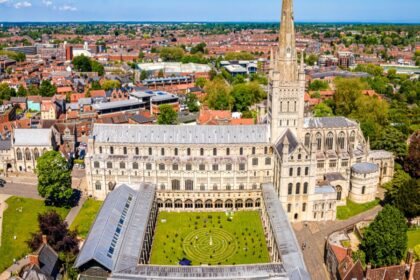
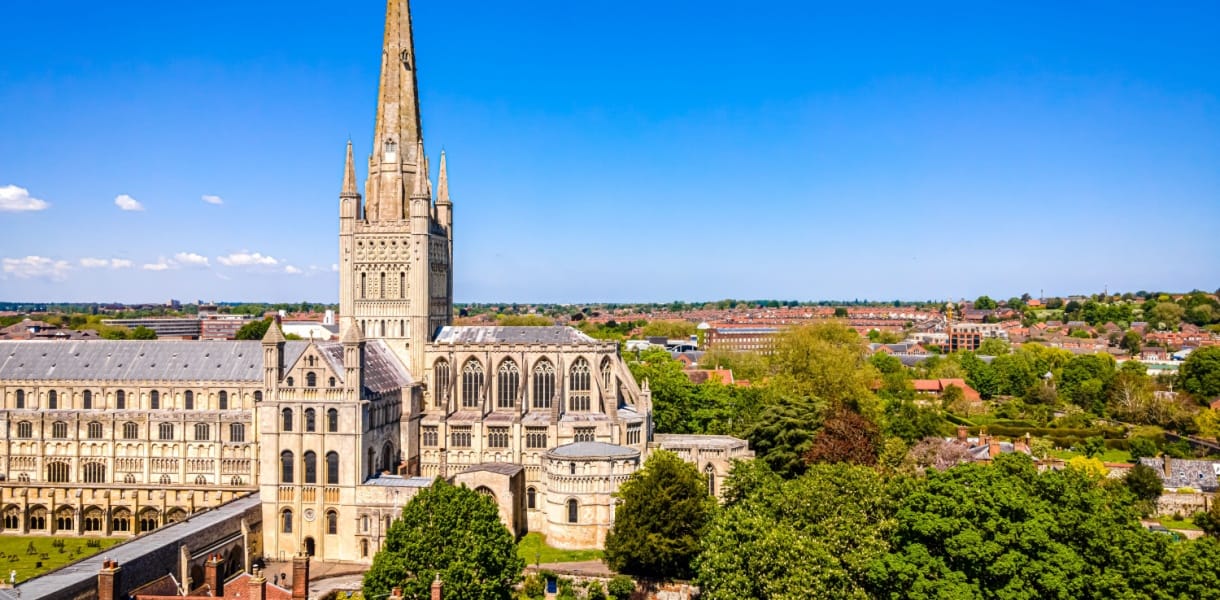
Norwich Cathedral is one of those buildings that has no need whatsoever to show off and yet cannot help being impressive. Its spire rises over the city with serene confidence, and its great Romanesque bulk has the sort of authority that makes modern architecture look a little overexcited. Approaching it through the cathedral close only improves matters. Suddenly the city noise falls away, the space opens out, and there it is, vast and honey coloured and entirely sure of itself.
Inside, it is magnificent in the way cathedrals are supposed to be but surprisingly often are not. The nave stretches on with proper Norman swagger, the cloisters are dreamy enough to make you reconsider your life choices, and the whole place has an immense calm that seems to settle on your shoulders the moment you step in. There are cathedrals that feel grand but chilly, all scale and no soul. Norwich Cathedral manages warmth as well as grandeur. It feels lived with.
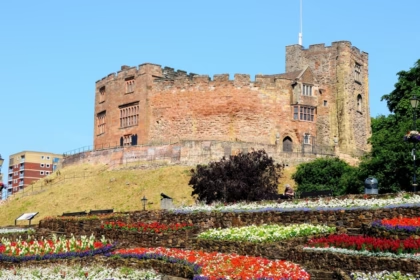
Norwich Castle offers a different flavour of power. Sitting high above the city, bold and square and unmistakably Norman, it looks exactly like the sort of building erected by people keen to establish who was in charge. Which, to be fair, was largely the point. It has been many things over the centuries, including a prison, and now serves as a museum, but it still has that wonderfully blunt fortress quality. Some buildings invite you in. Norwich Castle seems to dare you.
Churches, books and old money in sensible shoes
One of the great pleasures of Norwich is that the city is full of riches beyond the headline sights. It famously once had a church for every week of the year and a pub for every day, which is a ratio that suggests a very balanced approach to community life. Not all of those churches remain, but enough survive to give the place a remarkable ecclesiastical density. You stumble across towers and flint facades in the middle of shopping streets, on back lanes, beside gardens and tucked into corners where another city might have put a car park.
There is a seriousness to Norwich too, but not an off putting one. This is a city of books, learning, art and thought, a place with a literary streak running through it like a watermark. It feels independent minded in a deep, settled way. Not trendy, not trying too hard, not loudly alternative in the exhausting modern sense. Just quietly itself. The independent shops help. So do the cafés tucked into old buildings, the second hand bookshops, the theatres and galleries, and the general impression that Norwich would be perfectly capable of entertaining itself even if tourists stopped turning up altogether.
That confidence is attractive. Norwich does not seem desperate to please, which is perhaps why it does.
The river, the lanes and the business of lingering
Like all civilised places, Norwich has a river to soften its edges. The Wensum loops through the city, sometimes grandly visible, sometimes glimpsed between buildings like a private thought. It gives the place breathing space. Walk along it and the city changes character slightly. The stone and flint remain, but there is more greenery, more stillness, more room for the mind to wander off.
And Norwich is very good for wandering. Not just in the sense of moving from attraction to attraction, but in the more rewarding sense of drifting aimlessly and seeing what happens. A lane with a handsome doorway. A hidden courtyard. A pub that looks as though it has seen several centuries and is in no rush to discuss them. A view of the cathedral spire appearing unexpectedly between rooftops. These are the things Norwich does well. Not dramatic spectacle, perhaps, but accumulation. One pleasing detail after another until, before you know it, the whole place has worked its way under your skin.
There is also a practical pleasure to Norwich. It is very walkable. It has enough shops, food spots, museums and corners of interest to keep a weekend happily occupied, but not so many that the whole thing turns into a frantic checklist. You can pause here. Sit down. Have another coffee. Inspect a lane. Reinspect it. Very often the best thing to do in Norwich is simply allow Norwich to happen to you.
Why Norwich lingers in the mind
Some cities are exciting in a loud, immediate sort of way. Norwich is more subtle than that. It wins by charm, by intelligence, by texture, by the sheer quantity of lovely and slightly odd things packed into its streets. It is old, but not dusty. Beautiful, but not preening. Cultured, but not smug. Historic, but still plainly lived in.
It also has that most valuable of urban qualities, a sense of personality. Norwich does not feel interchangeable with anywhere else. It feels shaped by centuries of trade, religion, isolation, prosperity, stubbornness and taste. It feels like somewhere people belong to, and somewhere that knows exactly what it is.
Which, in the end, may be why it is so memorable. Norwich is not trying to overwhelm you. It is simply offering cathedral stone, medieval lanes, market lunches, hidden churches and a city centre full of agreeable surprises, then standing back with a faintly knowing expression while you realise how much you like it. By the time you leave, you may find yourself wondering why more English cities are not this civilised, this atmospheric and this quietly sure of their own peculiar charm.
Norwich at a glance
Getting here
- Norwich is well connected by rail from London, with regular services from Liverpool Street making it an easy city break if you do not mind a couple of hours spent watching East Anglia go by.
- There are also rail links from Cambridge, Ely and other parts of the east of England.
- By car, Norwich is reached via the A11 from London and Cambridge, or the A47 from the Midlands and east coast.
- The city centre is compact, so once you arrive you can do most of the important wandering on foot.
- Parking is available in and around the centre, but walking and public transport make life simpler.
Where to stay
- Stay in the city centre if you want the cathedral, market and medieval lanes on your doorstep.
- Boutique hotels and guesthouses in old buildings suit Norwich particularly well.
- There are also reliable modern hotels for easy weekend stays and family breaks.
- If you prefer a quieter setting, look at places just outside the centre near the river or cathedral close.
- Norwich works especially well for a one or two night stay with plenty of time left for ambling.
Where to eat
- Norwich is very strong on independent cafés, bakeries and relaxed restaurants.
- The market is a fine place for a casual lunch and an excellent way to feel part of the city rather than merely passing through it.
- You will find traditional pubs, modern British menus and plenty of good brunch territory in the centre.
- The lanes and side streets are often the best places to look for somewhere with character.
- This is a city where a slow lunch and an equally slow coffee feel entirely appropriate.
What to do
- Visit Norwich Cathedral for one of the city’s great moments of calm and grandeur.
- Explore Norwich Castle and its museum collections.
- Wander Elm Hill and the surrounding medieval lanes for peak Norwich atmosphere.
- Spend time at Norwich Market for food, people watching and a sense of the city at work.
- Seek out the churches, old gateways and hidden courtyards that give the centre so much texture.
- Walk by the River Wensum and enjoy a slower, greener side of the city.
- Dip into the independent shops, bookshops, galleries and theatres that make Norwich feel so self assured.
Nearby gems
- The Norfolk Broads are within easy reach and offer a complete change of pace, with waterways, boats and wide skies.
- The Norfolk coast makes an excellent day trip, with places like Cromer, Wells-next-the-Sea and Blakeney all strong contenders.
- Wymondham is a handsome small town nearby with a fine abbey and plenty of old world charm.
- The surrounding Norfolk countryside is full of flint villages, quiet lanes and stately homes.
- If you want coast and city in one trip, Norwich makes an excellent base.
Best time to visit
- Spring and summer are especially lovely, when the market is lively, the river walks are greener and the city’s outdoor corners come into their own.
- Early autumn suits Norwich beautifully too, with mellow light and a more settled pace after the summer crowds.
- Winter has its own appeal, especially if you enjoy old buildings, cosy pubs and a city that looks very good in low light.
Norwich is a year round destination, but it is best appreciated when you have time to stroll rather than rush.