Wiltshire is one of those counties that feels like it has been quietly minding its own business for several thousand years. This is a place where the scenery seems to have absorbed all the major moments of British history and is still wearing them rather well. You will find prehistoric stone circles, rolling chalk hills, medieval market towns and an air of calm that suggests Wiltshire is in no hurry to give away all its secrets.
A landscape that remembers everything
Wiltshire’s landscape is one of its most striking features. The county is home to the Salisbury Plain, a great sweep of chalk downland that serves as both an important military training ground and one of the richest archaeological sites in the country. Beneath its grassy surface lie the remnants of countless ancient settlements and burial sites.
Then, of course, there is Stonehenge. Standing proudly on the plain, this prehistoric circle of stones is perhaps the most recognisable ancient monument in Britain. Its origins remain shrouded in mystery and its purpose the subject of endless theories. Whether you visit at sunrise on the summer solstice or in the quiet of a weekday afternoon, it has a presence that is difficult to put into words.
Not far away lies Avebury, another great stone circle and a World Heritage Site in its own right. Unlike Stonehenge, here you can walk right up to the stones and even picnic beside them, though it is hard to eat a sandwich while contemplating structures that have been standing for more than four thousand years.
Towns with character and a good sense of their place in history
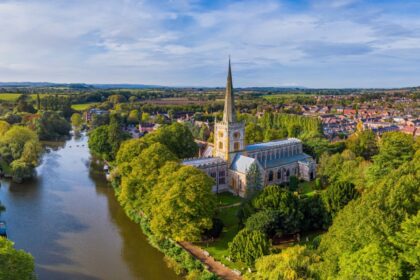
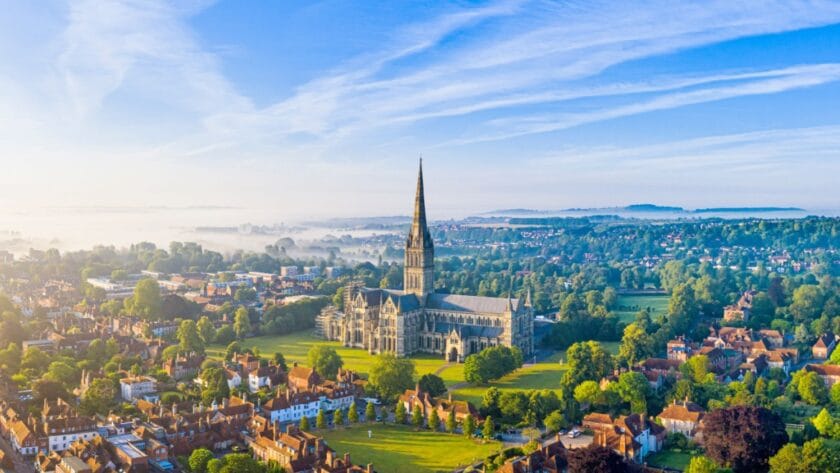
Wiltshire’s towns manage to combine charm with a strong sense of continuity. Salisbury, with its stunning cathedral, is a highlight. The cathedral spire reaches higher than any in England and can be seen for miles across the surrounding countryside. Inside, you will find one of the best preserved copies of the Magna Carta, as well as a peaceful cloister and a sense of history you can almost hear.
Marlborough is another gem, with one of the widest high streets in the country lined with handsome Georgian buildings, independent shops and old coaching inns. It has been a place of trade and travel for centuries and still feels like a market town that is genuinely used by the people who live there.
Devizes, with its historic market square, is known for the Kennet and Avon Canal and the impressive flight of locks at Caen Hill. Watching narrowboats make their slow, methodical way up or down the locks is oddly hypnotic and a reminder that Wiltshire is not a place that rushes.
The green heart of the county
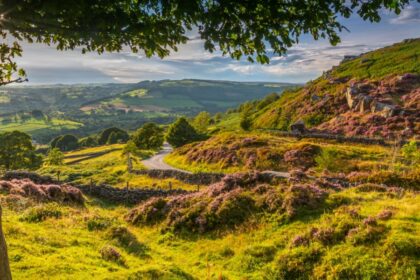
Wiltshire is blessed with plenty of space to breathe. The North Wessex Downs Area of Outstanding Natural Beauty stretches across part of the county, offering chalk hills, sweeping views and quiet footpaths that can take you to places where the only sound is the wind in the grass.
The Vale of Pewsey is a particularly lovely part of Wiltshire, dotted with villages that seem perfectly placed for walking or cycling breaks. Pewsey itself is a small but lively community, and the surrounding countryside is criss-crossed with trails that lead to white horses carved into the hillsides. These chalk figures, cut into the slopes, are a distinctive feature of Wiltshire and a nod to its long tradition of marking the landscape.
History in layers
Wiltshire has a knack for keeping history close at hand. You can wander from the Neolithic to the Norman in the space of an afternoon. Old Sarum, just outside Salisbury, was once a thriving settlement and the original site of the cathedral before it was moved to its current location. Today you can walk among its earthworks and imagine the bustling community that once stood there.
Lacock is one of Wiltshire’s best preserved villages, its honey-coloured stone cottages so unchanged that it is regularly used as a filming location for period dramas and films. The abbey here has seen many incarnations, from a medieval nunnery to the home of William Henry Fox Talbot, one of the pioneers of photography.
Why Wiltshire works so well for visitors
Part of Wiltshire’s appeal is that it feels both spacious and full of things to see. You can spend your morning exploring a prehistoric monument, your afternoon wandering through a medieval town and your evening in a pub with low beams and a fire that looks like it has been burning since the Civil War.
Its location also makes it easy to combine with other parts of southern England, but there is enough here to justify an entire trip. Whether you are here for the walking, the history, or simply the pleasure of driving through lanes edged with hedgerows and chalk banks, Wiltshire delivers without fuss.
Top 10 reasons to visit Wiltshire
- Stonehenge – the world’s most famous stone circle
Because nothing says “day out” quite like standing in a windswept field wondering how on earth people managed to shift 25-tonne stones 5,000 years ago. - Avebury – Stonehenge’s bigger, friendlier cousin
Here you can actually wander among the stones, touch them, and then pop into the pub that sits right in the middle of the circle. Very Wiltshire. - Salisbury Cathedral’s spire
At 123 metres, it’s the tallest in Britain. Climb up (if you’ve the legs for it) and you’ll be rewarded with views across the city rooftops to the chalk hills beyond. - The white horses on the hills
Gigantic chalk figures carved into the downlands, ranging from the elegant Westbury White Horse to the slightly lumpier ones that look like they were designed by committee. - Market towns with character
Marlborough, Devizes, Malmesbury and Corsham each have their own charms – Georgian squares, crooked lanes, independent shops, and an unnerving number of good tea rooms. - Canals and towpaths
The Kennet and Avon Canal snakes its way through the county, complete with swing bridges, narrowboats and the dizzying Caen Hill Locks, 29 in a row like watery dominoes. - Timeless countryside
Wiltshire’s rolling chalk downs, ancient woodlands and sleepy villages look like something out of a Constable painting – if Constable had remembered to add a few tractors. - Prehistoric oddities galore
Silbury Hill (Europe’s largest man-made mound) and Old Sarum (an Iron Age fort turned Norman stronghold) remind you this land has been lived on, dug up and fought over for millennia. - A taste of local life
Farmers’ markets, village pubs, and hearty Wiltshire ham sandwiches are as much a reason to come as the famous sites.
That feeling of stepping back in time
Whether you’re staring up at a medieval spire, strolling along an ancient ridgeway, or watching mist curl over a chalk hillside, Wiltshire has a way of making the present feel pleasantly irrelevant.