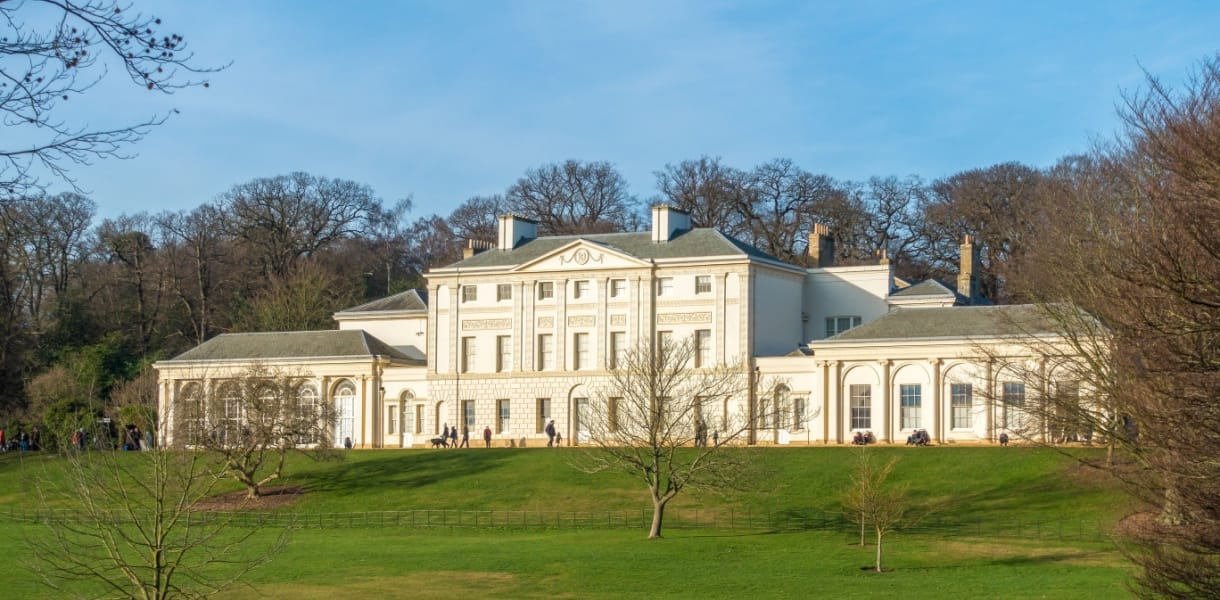
Perched at the edge of Hampstead Heath, with sweeping views that have tempted generations of painters, poets and daydreamers, Kenwood House is one of London’s quiet marvels. It is at once a grand 18th-century mansion, a treasure chest of art, and a place where city life gives way to green space and sky. To step inside its rooms is to wander through centuries of culture, wealth, taste and ambition, yet the house remains a place of open doors and easy welcomes, where everyone from local dog walkers to visiting art lovers can feel at home.
A Palladian dream
Kenwood’s story begins in the early 17th century, but it was the 18th century that gave it its present shape. The estate was bought by William Murray, later the first Earl of Mansfield, in 1754. A distinguished lawyer who became Lord Chief Justice, Murray wanted a country retreat within reach of Westminster. For the transformation of Kenwood he turned to the Scottish architect Robert Adam, a man at the height of his powers.
Adam’s redesign in the 1760s left an indelible mark. He extended the house and created the extraordinary library, still one of the finest surviving examples of his work. Step into the room today and you are greeted by a confection of delicate plasterwork, soft pastels and elegant proportions. It is not just a space for books but a theatre of learning, a stage set for Enlightenment thought. The library’s ceiling, with its flowing motifs and subtle colour palette, seems almost too refined for the business of reading, yet it epitomises Adam’s vision of architecture as harmony, balance and beauty.
The Mansfield legacy
Kenwood was not just a home of elegance but also of ideas. Lord Mansfield became famous for his rulings on cases that touched the abolition of slavery. The Somerset case of 1772, though more complex in legal detail than later retellings suggest, was widely interpreted as affirming that slavery could not be supported by English law. This gave Kenwood a place in the story of Britain’s long struggle towards abolition, and the house remains linked to that history.
The Mansfield household was also home to Dido Elizabeth Belle, the mixed-race daughter of Mansfield’s nephew. Raised alongside her cousin, Lady Elizabeth Murray, Dido’s story is a striking one: she grew up in a world of privilege but lived with the contradictions of race and status in 18th-century Britain. Her presence at Kenwood is remembered today as part of the house’s layered past.
A gallery of masterpieces
If the architecture enchants, the art collection makes Kenwood truly exceptional. The house holds one of the finest assemblages of paintings in London, thanks to the Iveagh Bequest. This was the gift of Edward Cecil Guinness, the first Earl of Iveagh, who left his collection to the nation in 1927. It is a roll call of great European art, displayed in an intimate domestic setting.
Here you will find Rembrandt’s self-portrait, painted when the artist was in his sixties, his face lined with the wisdom and fatigue of a turbulent life. There is Vermeer’s The Guitar Player, rare and luminous, one of only a handful of works by the Dutch master. Gainsborough is well represented, his portraits glowing with the soft, earthy tones of Georgian England. Reynolds, Romney, Turner, and Constable add further depth to the collection, while the Dutch landscapes and still lifes offer windows into other worlds.
Unlike a large city gallery, Kenwood’s rooms create the illusion that you are a guest wandering through someone’s private house, pausing before masterpieces casually hung in drawing rooms and corridors. The effect is both disarming and delightful. Art here is not just displayed, it is lived with.
A house in the landscape
Kenwood’s setting is as important as its interiors. The mansion looks out across a sweep of parkland that rolls down towards the lakes and woods of Hampstead Heath. The grounds were landscaped in the 18th century, influenced by the ideas of Capability Brown and his followers, though softened over time into the romantic wilderness that visitors love today.
From the terrace, the view towards the City of London is a reminder of Kenwood’s dual identity: country retreat and urban fringe. On clear days you can pick out the dome of St Paul’s or the jagged skyline of the modern city. At your feet, the lawns descend towards ancient oaks, rhododendron walks, and a lake that has mirrored countless sunsets. It is no wonder the heath has inspired generations of writers and artists, from Keats and Constable to modern photographers.
A place for everyone
Kenwood’s survival and accessibility owe much to the Iveagh Bequest and the stewardship of English Heritage. Admission to the house and its grounds is free, a fact that makes it one of the most democratic of London’s great houses. Families arrive with picnics, students sprawl with sketchbooks, and art lovers lose themselves in the paintings. In summer, concerts and open-air cinema bring the lawns to life. In winter, the house offers warmth, light and quiet contemplation.
There is also a café tucked into the old stables, where visitors can linger over coffee and cake before heading back onto the heath. The atmosphere is unpretentious, more village green than stately home. This, perhaps, is Kenwood’s greatest achievement: it is a place of grandeur that has never forgotten to be welcoming.
Conservation and care
Maintaining a building like Kenwood is no small feat. The house has undergone significant restoration projects in recent decades, including careful conservation of Robert Adam’s library and the cleaning of artworks. Each intervention is designed to balance historical accuracy with the needs of a living visitor attraction. The aim is to keep Kenwood vibrant without turning it into a museum piece.
Environmental challenges also loom large. The grounds are home to ancient trees and delicate habitats, and there is ongoing work to balance public enjoyment with conservation. Hampstead Heath itself is a patchwork of common land, managed to protect both wildlife and recreation. Kenwood, sitting on its northern edge, shares in that responsibility.
Kenwood in popular culture
Over the years Kenwood has appeared in novels, films and paintings. The lawns and lakes are familiar backdrops in costume dramas, while the house itself has been a setting for everything from historical biographies to modern detective stories. Its position on Hampstead Heath has given it a cameo in countless Londoners’ lives, whether as a place for childhood adventures, romantic walks, or simply the reward at the end of a long dog walk.
Constable painted the house, capturing it with the same eye that immortalised the Suffolk countryside. More recently, its connection to Dido Belle has inspired plays, films and exhibitions that explore themes of race, identity and history. In this sense, Kenwood is not frozen in the past but continues to speak to contemporary debates.
Why Kenwood matters
Kenwood House is more than the sum of its parts. It is an architectural gem, an art gallery of international standing, a landscape that offers some of the finest views in London, and a place woven into the social and cultural fabric of the city. It tells stories of law and justice, of family life, of artistic patronage and generosity. It is a house that reflects Britain’s complexities: grandeur and openness, tradition and change, privilege and public access.
For the casual visitor, it may be no more than a beautiful house on a hill. For the art lover, it is a chance to stand inches away from masterpieces. For the historian, it is a window into the Enlightenment and beyond. For the Londoner, it is part of the rhythm of the city’s green lungs. However you approach it, Kenwood has the knack of leaving you richer than when you arrived.
Practical information
- Location: Hampstead Lane, London NW3 7JR
- Admission: Free entry to the house and grounds
- Opening times: Check English Heritage website for seasonal variations
- Facilities: Café, shop, accessible routes, guided tours
Transport: Nearest underground stations are Archway, Golders Green and Hampstead, with bus connections and walking routes across the Heath