
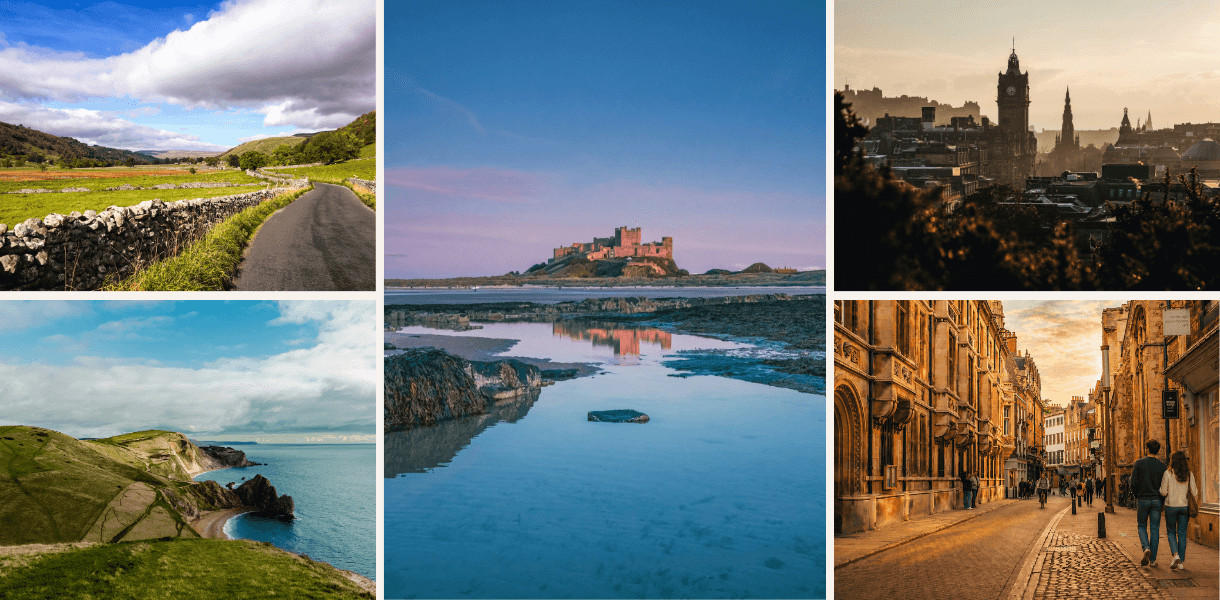
Britain can seem deceptively compact on the map. A small island, a few familiar landmarks, a lot of old buildings, and the vague impression that one can go from one end of it to the other while barely finishing a packet of train-station shortbread. In practice, though, the UK divides itself into distinct regional personalities with impressive enthusiasm. One part offers Roman walls and raw North Sea coast. Another does rolling hills, cathedral cities and villages that look as though they have spent centuries rehearsing for watercolour paintings. Another gives you former industrial giants, cultural swagger, and enough scenery to make you reconsider your life choices. For visitors, this is excellent news. It means Britain is not one trip but many.
Quick takeaways
- Best for first-time visitors
London, South East England, South West England, Scotland - Best for dramatic scenery
Scotland, Wales, South West England, North East England - Best for historic cities and classic heritage
Yorkshire and the Humber, South East England, East of England, North East England - Best for city breaks with regional character
London, North West England, West Midlands, Scotland, Northern Ireland - Best for touring holidays with lots of variety
South West England, Yorkshire and the Humber, East of England, Wales - Best for visitors who like places with strong identity
Yorkshire and the Humber, Wales, Scotland, Northern Ireland, North East England
Why the regions matter more than people sometimes realise
One of the easiest mistakes visitors can make with the UK is to think of it as a single travel experience with a few local variations. London for the icons, perhaps, then a bit of countryside, perhaps a castle, perhaps a seaside town, and job done. But the real pleasure of travelling around Britain is that the mood shifts so quickly and so completely from one region to the next.
The accents change. The architecture changes. The food changes. The pace changes. Even the light can feel different. The East of England has broad skies and a slow-revealing charm. The North East feels tougher, wider and closer to old frontiers. The South West seems to have decided that every trip should involve winding lanes and at least one excellent bakery. Scotland arrives with scenery and history turned up to a rather confident volume. Wales has mountains, coast and a distinct cultural identity that gives the whole place extra depth.
For visitors, thinking in regions is useful because it helps you plan more satisfying trips. Rather than seeing the UK as one long list of attractions, you start to see clusters of character. You understand why some places suit a first short break, why others are better for a scenic tour, and why some regions reward a week of slow wandering far more than a rushed day or two.
North East England
The North East has a highly agreeable lack of showing off. This is helpful, because if it did decide to boast, it would have plenty to work with. There are Roman ruins, mighty castles, glorious beaches, one of England’s finest cathedrals, a lively regional capital, and landscapes that often seem to have been given more sky than strictly necessary.
For visitors, the region offers one of the richest combinations in England. Newcastle gives you architecture, nightlife, bridges and urban energy. Durham delivers cathedral-and-castle magnificence in quantities that feel faintly unfair on lesser cities. Northumberland then stretches out into beaches, moorland, market towns, Hadrian’s Wall and castle ruins that look especially good in brooding weather, which is convenient because the region is perfectly capable of supplying some.
This is an excellent choice for visitors who like history and scenery but would rather experience them somewhere that still feels grounded and unspoilt.
Quick regional take
- Best for castles, Roman history and wild coast
- Strongest bases for visitors are Newcastle and Durham
- Ideal for scenic touring, heritage trips and atmospheric short breaks
North West England
The North West is several Englands bundled together in one region and getting on with it. It contains two major cities with completely different personalities, a famous national park, industrial heritage, football obsession, elegant corners, rough-edged corners, and enough regional identity to keep everyone usefully opinionated.
Manchester gives visitors big-city energy, music history, sport and a modern cultural scene. Liverpool has waterfront grandeur, humour, maritime history and the useful advantage of being both handsome and entertaining. Then, just when you think the region is mainly about cities, Cumbria appears with the Lake District and reminds you that some of Britain’s most admired scenery is also part of the package.
This makes the North West one of the easiest regions to recommend. It works for city-break people, walking people, literary-history people and anyone who likes a trip with variety and a little northern confidence.
Quick regional take
- Best for major cities and classic mountain-and-lake scenery
- Manchester, Liverpool and the Lake District make a powerful trio
- Great for mixed itineraries combining urban culture and landscape
Yorkshire and the Humber
Yorkshire has always had the good sense to behave less like a region and more like a nation-in-waiting. After travelling through it, one can understand the temptation. It is broad, self-assured, historically rich and packed with enough variety to keep a visitor happy for a very long time.
York is one of England’s greatest historic cities and hardly needs much help from me in making that case. The Yorkshire Dales and North York Moors provide some of the country’s finest countryside. The coast gives you Whitby, fishing-town drama, abbey ruins and sea air with a touch of gothic flair. Then there are handsome market towns, stately homes, industrial heritage and a general feeling that the place takes itself seriously enough to be impressive but not so seriously that it becomes dull.
If a visitor wanted one English region that offers a bit of almost everything, Yorkshire would make an extremely persuasive argument.
Quick regional take
- Best for all-round English variety
- Excellent for historic cities, national parks and seaside character
- A very strong choice for first-time visitors wanting depth beyond London
East Midlands
The East Midlands is one of those regions that can be quietly more appealing than its reputation suggests. It does not burst into the room waving famous landmarks about, but it has heritage cities, beautiful market towns, rolling countryside, country houses and very useful access to the Peak District. This is not a bad set of qualities for a region that is sometimes treated as though it only exists because the map needed filling in.
Lincoln is one of its great visitor stars, with a cathedral and historic uphill quarter that more than repay the effort of reaching them. Nottingham has folklore, history and a lively city feel. Derbyshire opens onto some of England’s most popular walking country. Elsewhere, towns such as Stamford and Southwell provide exactly the sort of mellow, old-English pleasure many visitors are hoping to find.
The East Midlands is especially good for people who like touring holidays, heritage, and places that feel attractive without becoming self-conscious about it.
Quick regional take
- Best for market towns, heritage cities and country house touring
- Good for visitors combining town breaks with Peak District scenery
- Particularly rewarding for slower, more exploratory trips
West Midlands
The West Midlands has been unfairly reduced in many imaginations to Birmingham, motorways and a vague sense of concrete. This is rough on Birmingham, which has improved itself enormously, and even rougher on the rest of the region, which contains Shakespeare, castles, canals, cathedrals, industrial history and some of England’s loveliest smaller towns.
Birmingham now makes a convincing city-break case with canals, food, shopping, museums and a more confident cultural identity than it used to get credit for. Stratford-upon-Avon remains a reliable pleasure, Warwick has a castle that approaches the whole medieval-business with admirable enthusiasm, and Shropshire adds market-town beauty and a quieter rural charm.
What makes the West Midlands interesting is that it feels both historic and lived-in. It is not a region arranged purely for visitors. It has depth, working cities, ordinary life and a lot of historical importance sitting right there among it all.
Quick regional take
- Best for Shakespeare, castles, canals and urban history
- Strong for visitors who like cultural city breaks mixed with classic heritage
- A more varied region than many people expect
East of England
The East of England is understated in a way that turns out to be very effective. It does not fling grand mountain scenery at you or demand immediate admiration. Instead, it wins you over with cathedral cities, elegant university architecture, medieval towns, wide skies, waterways, estuaries, big beaches and a general sense of spaciousness.
Cambridge is the obvious centrepiece and remains one of the UK’s most beautiful and rewarding small cities. Norfolk offers the Broads, stately homes, handsome villages and a coastline that can feel both serene and gloriously exposed. Suffolk contributes arty seaside towns, church towers, old market settlements and a gently cultivated beauty that sneaks up on you. Essex, meanwhile, is more interesting than lazy stereotypes allow, particularly once you leave the obvious commuter associations behind and start noticing estuaries, old towns and coastline.
This is a very good region for visitors who like subtle charm, slower travel and places that reveal themselves properly over a few days.
Quick regional take
- Best for elegant towns, broad landscapes and gentler touring
- Cambridge, Norfolk and Suffolk are especially rewarding for visitors
- Ideal for quieter trips with history, coast and countryside in balance
London
London is not merely a region so much as a world city that happens to be attached to the rest of the country. It is vast, layered, complicated, overqualified and occasionally exhausting, though usually in a way that leaves you wanting more rather than less. The place contains royal icons, museums, markets, neighbourhoods, parks, theatres, bridges, churches, towers and enough history to occupy several capitals.
For first-time visitors, it is obviously indispensable. The famous landmarks really are worth seeing, which is mildly inconvenient for anyone hoping to be superior about them. For repeat visitors, London becomes even better because you stop trying to conquer it and begin simply enjoying parts of it. Bloomsbury one day, Greenwich another, South Bank at dusk, a museum in the rain, a market on a Saturday, a side street that unexpectedly becomes the thing you remember most.
It is not the whole UK, and should not be mistaken for it, but it remains one of the great cities of the world and one of the country’s deepest visitor experiences.
Quick regional take
- Best for first-time UK visitors and major iconic sights
- Endless scope for repeat visits focused on districts and themes
- Works for history, culture, food, theatre and world-class museums
South East England
The South East is sometimes overshadowed by its proximity to London, which is a little unfair because it is one of the strongest regions in England for visitor appeal. It offers cathedral cities, castles, stately homes, seaside towns, chalk hills, attractive villages and short-break destinations that feel properly varied.
Canterbury and Winchester are both deeply satisfying historic cities. Oxford, depending on how you are drawing your practical travel plans, is often part of the wider South East travel picture and adds architecture and academic grandeur. Kent and Sussex supply coasts, gardens, vineyards, old towns and easy scenic escapes. The South Downs make walking feel civilised. There is history in abundance, but also softness and beauty, which is a very useful combination.
For many visitors, this is one of the easiest regions to enjoy because it is so accessible and so full of places that work well over one or two nights.
Quick regional take
- Best for easy classic English short breaks
- Excellent mix of heritage cities, coast and countryside
- Strong choice for visitors wanting memorable trips beyond London without too much faff
South West England
The South West has a dangerous tendency to make people fantasise about moving there after roughly forty-eight hours. This is because it combines beautiful coast, old towns, moorland, harbour scenery, handsome villages, excellent holiday atmosphere and winding roads that suggest life might be improved by driving more slowly and buying more local jam.
Bath is one of the region’s great stars and one of the finest short-break cities in Britain. Cornwall supplies dramatic cliffs, beaches, fishing villages and artistic corners. Devon gives you moorland, estuaries and family-holiday appeal. Dorset adds Jurassic Coast grandeur and old seaside character. Somerset contributes small cities, old towns and countryside that seems to have settled itself very comfortably indeed.
This is one of the UK’s strongest regions for scenic touring, coastal breaks and the sort of trip where almost every detour seems to improve things.
Quick regional take
- Best for coast, holiday atmosphere and scenic driving
- Bath, Cornwall, Devon and Dorset all have major visitor appeal
- Ideal for longer touring trips as well as classic weekend breaks
Wales
Wales has one of the strongest senses of national character anywhere in the UK, and visitors feel it quickly. The language, landscape, place names and sheer mountain-and-coast confidence all help. It is compact enough to tour surprisingly well, yet varied enough to feel much larger than it really is.
North Wales offers mountain scenery, castles and some of Britain’s most dramatic historic settings. Mid Wales becomes quieter and more spacious. West Wales is full of coastal beauty, little harbours and broad sea views. South Wales gives you Cardiff, the valleys, industrial history and gateways to the Brecon Beacons. What holds it all together is that Wales feels distinct. You are not just in another part of Britain. You are in a country with its own voice and rhythm.
For visitors, that gives the whole experience extra richness. You come for castles, peaks and coast. You leave remembering atmosphere, identity and a lot of impressive consonants.
Quick regional take
- Best for mountains, castles, coastline and strong cultural identity
- Excellent for scenic road trips and active holidays
- One of the most rewarding UK destinations for visitors wanting something distinct
Scotland
Scotland has a talent for making an entrance. It offers cities of great beauty and character, landscapes that appear to have been composed for maximum dramatic effect, and a national identity strong enough to give the whole visitor experience more shape and texture. It can be grand, witty, rugged, elegant and faintly overwhelming, often all in the same trip.
Edinburgh provides one of Europe’s great urban settings, while Glasgow offers creativity, humour and a more relaxed kind of cultural confidence. Beyond the cities lie the Highlands, lochs, glens, islands and castles that fuel so much of Scotland’s international appeal. Happily, the reality is not just postcard material. There are also harbour towns, local pubs, ordinary streets and a lived-in feel that stops the whole thing becoming too theatrical.
This is one of the UK’s most rewarding destinations for repeat visits because each part of the country feels so different from the next.
Quick regional take
- Best for dramatic scenery, iconic touring and major cities
- Strong appeal for first-time visitors and return travellers alike
- Excellent for road trips, scenic rail journeys and longer holidays
Northern Ireland
Northern Ireland is one of the UK’s most underestimated travel rewards. People who know it tend to speak about it with a certain proprietary satisfaction, as though they have discovered something that the wider travel world has been annoyingly slow to appreciate. They are not wrong.
Belfast makes a strong city-break base, with striking architecture, maritime history, changing neighbourhoods and real momentum. The north coast then supplies one of the most scenic touring routes in these islands, with clifftops, beaches, old castles and geological drama in highly respectable quantities. Inland areas bring quieter pleasures, lakelands and small towns, while the country’s history adds depth and seriousness beneath the beauty.
Because it is relatively compact, Northern Ireland works very well for shorter trips. You can see a great deal without constantly feeling that you are spending your holiday in transit.
Quick regional take
- Best for dramatic coastal touring and a compact but varied trip
- Belfast and the north coast make an especially strong combination
- Ideal for visitors who like scenery with real historical depth
Final verdict
The UK makes more sense, and becomes much more interesting, when you stop thinking of it as one destination and start thinking in regions. London may be the international headline act, but it is only one part of a deeply varied whole. The North East offers castles and coast with a fine absence of fuss. Yorkshire gives you one of England’s richest all-round travel experiences. The South West can make a weekend feel like a proper holiday. Wales and Scotland bring scenery and identity in wonderfully persuasive combinations. Northern Ireland quietly overdelivers.
For visitors, that is the real delight of travelling in Britain. You can return again and again and still find places that feel quite different in tone, pace and personality. It is a small country only if you insist on measuring it on a map. As a collection of travel experiences, it is considerably larger than it looks.