
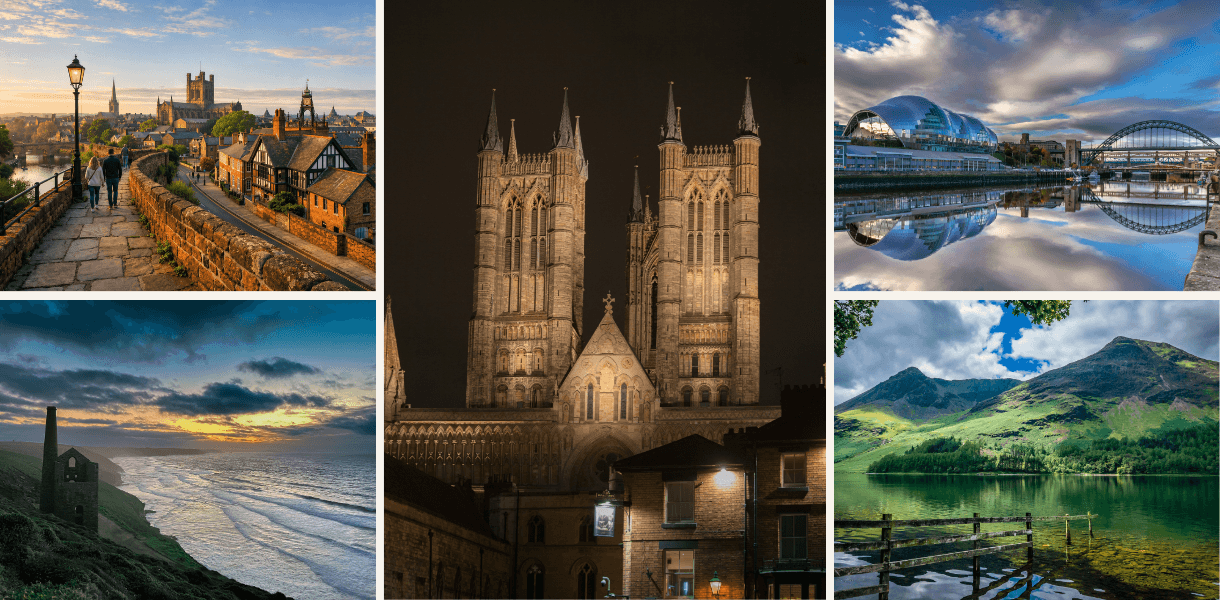
England is sometimes discussed as though it were one long, uninterrupted stretch of old churches, rolling hills, pub lunches and village greens, with perhaps the occasional cathedral or mildly startled sheep added for variety. This is unfair to sheep, certainly, but also to England, which turns out to contain a remarkable number of distinct county personalities once you stop treating it as a single beige heritage experience.
For visitors, the county level is often where England becomes most interesting. Regions are useful, of course, but counties are where the local character starts sharpening properly. This is where landscapes change their mood, building styles alter, accents shift, food gets more specific, and the whole business becomes less about “seeing England” and more about deciding which version of England you happen to be in. One county offers honey-coloured villages and stately homes, another gives you ruined abbeys and moorland, another provides broad beaches, marshes and skies large enough to have their own weather systems.
Quick takeaways
- Best for first-time visitors wanting classic England
Yorkshire, Northumberland, Cornwall, Devon, Norfolk, Kent - Best for coast and scenery
Cornwall, Devon, Dorset, Northumberland, Norfolk, Cumbria - Best for historic cities and heritage
Yorkshire, Northumberland, Kent, Lincolnshire, Somerset, Cambridgeshire - Best for villages, market towns and slower touring
Gloucestershire, Herefordshire, Suffolk, Norfolk, Derbyshire, Shropshire - Best for dramatic landscapes
Cumbria, Northumberland, Derbyshire, Yorkshire, Cornwall, Dorset - Best for visitors who like strong local character
Yorkshire, Cornwall, Northumberland, Norfolk, Lancashire, Devon
Why counties are such a good way to understand England
Part of the pleasure of travelling in England is that it is never quite as uniform as the postcards suggest. Yes, there are old market towns and church towers and a suspicious number of places serving cream tea with total confidence. But there are also industrial counties, maritime counties, border counties, farming counties, university counties, moorland counties, fenland counties, and counties that seem to contain three different countries’ worth of scenery in a single afternoon.
For visitors, counties make travel planning easier because they often hold together as coherent little worlds. A county has its own look, its own set of landscapes, its own local heroes and obsessions, and often a quite strong view of itself. Spend a few days in one and you start to feel that you are getting somewhere beneath the surface. You stop ticking off attractions and start noticing whether the stone turns honey-coloured or grey, whether the villages feel neat or weather-beaten, whether the coast is all cliffs or marshes, and whether the local people seem mildly amused that you have finally shown up.
That is when travel gets better.
Northumberland
Northumberland is one of England’s great overachievers. It has castles, beaches, Roman walls, moorland, islands, handsome market towns and enough sky to make most southern counties look a bit cramped. It is dramatic without being crowded and historic without behaving like an open-air museum.
For visitors, it is magnificent. Bamburgh and Dunstanburgh supply castle-and-coast drama in heroic quantities. Hadrian’s Wall brings Roman frontier grandeur. Alnwick offers gardens and a proper market-town base. The beaches are wild, the light is often glorious, and the whole county has a slightly windswept self-possession that makes it deeply appealing.
Why go
Castles, empty beaches, Hadrian’s Wall, big landscapes and a strong sense of escape.
Yorkshire
Yorkshire has the useful quality of feeling both very large and very sure of itself. It contains one of England’s great historic cities, two national parks, a memorable coastline, grand houses, ruined abbeys, industrial history and villages that appear to have been assembled by someone with a particular fondness for stone and views.
For visitors, it is one of the strongest counties in England, even if Yorkshire people would probably object to the singular and begin dividing it into sub-identities within minutes. York is the headline act, but the Dales, the Moors, Whitby, Fountains Abbey, Harrogate and the county’s many market towns all add up to something unusually rich.
Why go
Historic depth, famous scenery, classic towns and villages, and enough variety for a long trip.
Cumbria
Cumbria has a slightly unfair advantage in that it contains the Lake District, which means it can casually produce some of England’s most admired scenery before breakfast. Lakes, fells, valleys, stone villages and literary associations are all present in highly respectable numbers.
For visitors, Cumbria is a natural choice if walking, scenery and atmospheric little towns are your idea of a holiday rather than a punishment. Windermere, Keswick, Ambleside and Ullswater all have their charms. Even in poor weather, which Cumbria is fully capable of arranging, the place still looks deeply convincing.
Why go
Mountain-and-lake scenery, walking, village bases and one of England’s most iconic landscapes.
Devon
Devon has the happy knack of making a trip feel like a holiday almost immediately. It has moorland, beaches, estuaries, fishing villages, old market towns and a general atmosphere of cheerful scenic abundance. It is the sort of county that can offer both a windswept cliff walk and a cream tea with complete confidence.
For visitors, the choice is wonderfully broad. North Devon has wild coast and surf-town energy. South Devon gives you estuaries, sailing towns and softer prettiness. Dartmoor adds open, brooding drama. Then there are places like Dartmouth, Salcombe and Totnes, which bring atmosphere by the bucketload.
Why go
Coast, moorland, harbour towns, scenic variety and an excellent holiday mood.
Cornwall
Cornwall is the county that most resembles the England of a child’s overexcited imagination, if that imagination had been fed a steady diet of turquoise coves, cliff paths, harbour walls and fishermen’s cottages. It feels more distinct than many counties, partly because of geography, partly because of history, and partly because it knows exactly what it is.
Visitors come for the coast, obviously, and the coast is very good indeed. St Ives, Padstow, Mousehole, Falmouth and the Lizard all provide different versions of Cornish appeal. Add in old tin-mining heritage, dramatic headlands and a strong local identity, and you have one of England’s most compelling counties.
Why go
Dramatic coast, harbour towns, beaches, strong identity and an almost unfair amount of scenery.
Norfolk
Norfolk works its charms quietly, which is one of the reasons people who love it can sound so pleased with themselves. It is a county of big skies, marshes, broad beaches, elegant towns, medieval churches, stately homes and slower landscapes that reveal themselves rather than fling themselves at you.
For visitors, Norfolk is excellent if you like your scenery subtle but memorable. The coast is one of England’s finest, especially around Holkham, Wells-next-the-Sea and Blakeney. Norwich is a lovely small city. The Broads bring a whole watery world of their own. It is one of the best counties in England for a thoughtful, gently scenic break.
Why go
Big skies, coast, waterways, historic Norwich and a calm, spacious kind of beauty.
Suffolk
Suffolk is Norfolk’s slightly artsier, gently moodier neighbour. It is full of pretty market towns, medieval churches, soft countryside, low-key seaside places and the sort of cultivated quietness that makes you feel everyone ought to speak slightly more thoughtfully.
For visitors, it offers a lovely balance of coast and inland charm. Southwold and Aldeburgh do the seaside elegantly. Lavenham and the wool towns bring historic beauty in abundance. The countryside feels worked, lived in and graceful rather than dramatic. If you want England at its most mellow and understated, Suffolk is a very good place to begin.
Why go
Historic towns, refined coast, gentle countryside and an easy, thoughtful pace.
Kent
Kent has spent centuries being England’s front door, and it has accumulated quite a lot in the process. There are cathedral cities, castles, gardens, chalk downs, harbour towns, vineyards, villages and coastlines ranging from broad beaches to cliff-top drama.
For visitors, it is one of the most rewarding counties in the South East. Canterbury is a major draw, quite rightly. Whitstable and Deal bring seaside character. Leeds Castle and Dover add historic grandeur. Inland, the villages and gardens do a very persuasive version of prosperous southern England. It is accessible, varied and packed with good reasons to stay longer than planned.
Why go
Canterbury, castles, coast, gardens and classic easy-to-reach English heritage.
Sussex
Sussex makes more sense to visitors when you think of it as two closely related personalities rather than one tidy county story. East Sussex and West Sussex share the South Downs, handsome towns and a generally attractive way of presenting themselves, but they each bring a slightly different mood to the whole business.
East Sussex is the more dramatic and atmospheric of the pair. It gives you Brighton’s famous neighbourly orbit if you drift westward, but more importantly it offers places such as Rye, Lewes and the great sweep of the Seven Sisters. There is a pleasing mix of old streets, hilltop views, chalk cliffs and seaside character, with just enough literary and artistic atmosphere to make everything feel faintly more interesting than it strictly needed to be.
West Sussex feels a little softer, greener and more classically genteel. Chichester is one of the county’s great visitor bases, Arundel adds castle-and-cathedral grandeur, and the surrounding countryside is full of villages, market towns and well-behaved landscapes that seem to have taken quite a lot of care over their appearance. The coast is generally gentler than East Sussex, while the inland scenery is excellent for walking, touring and quietly superior lunches.
For visitors, Sussex works especially well because it combines coast, countryside, heritage and attractive towns without requiring heroic levels of effort. It is polished in places, dramatic in others, and very good at the sort of short break that leaves people saying they should do this more often.
Why go
East Sussex for cliffs, old towns and coastal drama
West Sussex for cathedral cities, castles and elegant countryside
Excellent for short breaks combining coast, heritage and the South Downs
Dorset
Dorset has cliffs, coves, beaches, old stone towns and a generally agreeable understanding of how to look good from a viewpoint. The Jurassic Coast alone would be enough to justify the county’s popularity, but Dorset then goes on to offer harbour towns, rolling inland country and just enough old-fashioned seaside charm to keep things nicely balanced.
For visitors, this is one of England’s strongest scenic counties. Durdle Door and Lulworth Cove are the obvious stars, but Lyme Regis, Bridport, Shaftesbury and the county’s villages all contribute. Dorset is particularly good for visitors who want coast with character rather than coast with slot machines.
Why go
Jurassic Coast views, harbour towns, cliff scenery and a very satisfying sense of place.
Somerset
Somerset is a county of pleasing contrasts. It contains one of England’s loveliest cities, dramatic gorge scenery, old abbey country, cider landscapes, the Levels, attractive little towns and enough folklore-adjacent atmosphere to keep Glastonbury in business for centuries.
For visitors, Bath is often the main attraction and a very good one it is too. But Wells, Frome, Bruton, Cheddar and Glastonbury all add different layers of interest. The countryside is varied, the towns often characterful, and the county feels slightly more eccentric than some of its polished southern neighbours, which helps.
Why go
Bath, cathedral cities, countryside, characterful towns and a touch of West Country eccentricity.
Gloucestershire
Gloucestershire is where a great many visitors go in search of postcard England, and annoyingly, much of the county looks as though it has decided to cooperate. The Cotswolds are the obvious draw, with their honey-coloured villages and gentle hills, but there is more to the county than that.
Visitors can base themselves in places like Cirencester, Painswick or Tetbury, wander through deeply attractive countryside, and then head to Gloucester for cathedral grandeur or Cheltenham for a more polished spa-town mood. It is an easy county to like, even if it occasionally seems almost too well aware of its own photogenic qualities.
Why go
Cotswold villages, gentle touring, handsome towns and classic south-central England.
Derbyshire
Derbyshire is a county with backbone. The Peak District gives it some of England’s finest upland scenery, while market towns, country houses and old industrial settlements add depth. It can do soft green valleys one moment and gritstone edges the next, which makes it a very effective place to visit.
For visitors, this is a county that works well whether you want walking, heritage or simply good-looking landscapes. Bakewell is reliably charming. Chatsworth is one of England’s great houses. The White Peak and Dark Peak offer very different kinds of beauty. It feels robust, scenic and satisfying.
Why go
Peak District scenery, great houses, walking country and strong market-town appeal.
Lincolnshire
Lincolnshire is often overlooked, which is strange because it contains one of England’s finest cathedral cities and a landscape unlike most of the country. This is a place of wide horizons, fertile farmland, marshes, quiet roads, old market towns and the sort of spaciousness that makes smaller counties feel a bit fidgety.
For visitors, Lincoln alone is worth the journey. Stamford, if you are including its county loyalties in practical travel terms, adds another historic star. The county also suits those who like quieter touring, old churches, broad skies and places that feel outside the main current of tourism.
Why go
Lincoln, big skies, old towns, quiet roads and a less crowded side of England.
Cambridgeshire
Cambridgeshire has the advantage of Cambridge, which would be enough for most counties to retire on. But beyond the city’s colleges, chapels and river views, the county also has fens, market towns and a curious spaciousness that gives it a different feel from many more obviously scenic parts of England.
For visitors, Cambridge is the obvious and irresistible base. Ely, with its great cathedral, is another standout. The surrounding fenland has its own stark beauty, and the county works especially well for those who like history, architecture and landscapes that are less dramatic than absorbing.
Why go
Cambridge, college architecture, Ely and a quietly distinctive fenland landscape.
Lancashire
Lancashire has grit, humour, industrial history, handsome countryside and a certain refusal to behave like a decorative heritage county. This is part of its charm. It is a county of mill towns, market towns, seafront tradition, proud local identity and landscapes that can surprise visitors who thought the place was all brick and drizzle.
For visitors, Lancaster is a very fine small city. The Ribble Valley is attractive countryside. Morecambe has revived interest and a memorable setting. The Forest of Bowland offers quieter scenic rewards. Lancashire gives you a more grounded, lived-in kind of England, and there is a lot to be said for that.
Why go
Industrial heritage, strong identity, varied landscapes and a more real-feeling England.
Shropshire
Shropshire sits near the Welsh border looking faintly pleased with itself, and with some justification. It has lovely market towns, rolling countryside, castle remains, literary associations and Ludlow, which is enough to make many counties envious all on its own.
For visitors, the county is ideal for a slower-paced break. Shrewsbury is handsome and atmospheric. Ironbridge adds world-changing industrial history. The countryside is gentle but rewarding. It is one of England’s most quietly attractive counties, especially for people who like towns with actual personality rather than just gift shops.
Why go
Market towns, border-country scenery, Ironbridge and a wonderfully civilised pace.
Herefordshire
Herefordshire is one of England’s quieter pleasures. Orchards, black-and-white villages, old churches, cider country, gentle hills and market towns all feature, usually without making much fuss. It is not a county that shouts for attention, which is partly why it feels so restorative once you arrive.
For visitors, Hereford itself makes a useful base, while Ledbury and Ross-on-Wye bring character and charm. The Wye Valley, if you are wandering at the edges, adds scenic strength. This is an excellent county for visitors who like rural England without too much polish or performance.
Why go
Market towns, orchards, churches, rural calm and deeply pleasing low-key beauty.
Final verdict
What the counties of England reveal, once you start looking at them properly, is that England is less a single destination than a collection of overlapping local worlds. Northumberland gives you castles and windblown coast. Yorkshire offers almost absurd levels of variety. Cornwall and Devon do different versions of sea-and-scenery happiness. Norfolk and Suffolk make a quiet but persuasive case for subtle beauty. Gloucestershire goes full postcard. Lancashire reminds you the country has grit as well as prettiness.
For visitors, that is the joy of county-based travel. Instead of trying to “do England” all at once, you begin choosing the flavour of England that most appeals. Old and elegant. Rugged and coastal. Rural and slow. Historic and city-rich. Softly scenic. Wildly scenic. A bit eccentric. Deeply practical. England, helpfully, contains all of them.