
Yorkshire and the Humber is one of those regions that seems to contain several different Englands, all of them convinced they are the main event. It gives you abbey ruins in green valleys, great industrial cities, windswept moorland, handsome market towns, a coastline of fishing ports and fossil beaches, and a long estuary broad enough to make the landscape feel as though it has taken a deep breath. As an official region it brings together the old weight of Yorkshire with the Humber side of northern Lincolnshire, which means the page has to do a small amount of diplomatic work before anyone has even set off. But as a visitor region it works beautifully, because what ties it together is not bureaucracy but scale, industry, landscape and a very settled sense of place.
What makes it so rewarding is that its variety never feels random. The Dales, the Moors, the Wolds, the old wool towns, the steel city, the seaport, the Minster city and the old industrial villages all belong to one long story of land, labour, pride and survival. You can come for walking, coast, food, heritage, city breaks or railway-platform quantities of tea, and still feel that you are travelling through one large region with a recognisable character of its own. That character tends to be sturdy, dryly funny, faintly unimpressed and entirely justified.
Quick takeaways
- Best for
Big scenery, historic cities, industrial heritage, abbey ruins, coast, walking and long weekend road trips - Known for
York, Leeds, Sheffield, the Yorkshire Dales, the North York Moors, Whitby, Saltaire, Fountains Abbey and the Humber - Don’t miss
York, the Yorkshire Dales, Whitby or Robin Hood’s Bay, Fountains Abbey, Saltaire and one of the big cities - Best base ideas
York, Leeds, Harrogate, Sheffield, Whitby and Beverley - Ideal trip length
Four to seven days for a first trip, longer if you want cities, coast and both national parks - Best time to visit
Late spring to early autumn for scenery and touring, though the cities and heritage sites work year round
The region at a glance
Yorkshire and the Humber is one of England’s nine official regions. In practical visitor terms, it brings together North, West and South Yorkshire, the East Riding and Hull, plus North and North East Lincolnshire on the Humber side. That gives it an unusually wide range, from Pennine-edge cities and mill towns to open chalk landscapes, long coasts and broad estuarial country.
The western side of the region is where you find some of its most famous upland scenery. The Yorkshire Dales offer limestone country, stone-built villages and long views, while the North York Moors bring heather, ancient routes and a more solitary sort of grandeur. Between and below them lie old manufacturing towns and major cities whose fortunes were shaped by wool, coal, steel, engineering and trade. York sits rather magnificently in the middle of much of this, behaving as though history were a civic responsibility. To the east, the region opens into coast, wolds and the Humber, with Hull giving the whole area a strong maritime outlet.
For visitors, the region works especially well because it offers contrast without requiring constant reinvention. You can spend the morning in a Minster city, the afternoon in a former mill village, and the next day walking through moorland or along a cliff path, and none of it feels forced. It is a region that suits touring, but it also breaks down neatly into shorter, richer trips built around a city, a coast, a national park or one of its many old market towns.
Why this region matters
From ancient Yorkshire to medieval power
Yorkshire, in its historic form, is England’s largest traditional county, and that sense of scale still matters. The region’s story begins deep in prehistory, with burial monuments and earthworks across the North York Moors and the Wolds, and continues through Roman York, where Eboracum became one of the most important Roman centres in Britain. After Rome, the area became central to the Anglo-Saxon kingdom of Northumbria, and York developed into the ecclesiastical centre of the north. It has been strategically, religiously and politically important for a very long time, which helps explain why so much of the region still carries itself with the faint assurance of somewhere used to mattering.
Wool, steel and the industrial region
In the Middle Ages, agriculture remained central, but wool changed everything. Local wool production fed textile manufacture across what became the West Riding, helping towns such as Leeds, Bradford, Halifax, Wakefield and Huddersfield grow into major cloth centres. Later, the Industrial Revolution intensified this already formidable urban belt. Railways, coal and engineering transformed the south and west, while Sheffield became world-famous for steel, cutlery and metalworking. Hull grew as the major seaport of the wider region, and the urban map of Yorkshire and the Humber began to look much as it does now, shaped by manufacture, transport and trade on a grand scale.
Where history, industry and landscape still meet
Yet what gives the region its unusual power for visitors is that the industrial story never erased the older one. York still has its Roman, Viking and medieval authority. Fountains Abbey still lies in one of the most impressive monastic landscapes in England. The Dales and Moors remain living, working landscapes rather than museum pieces. Saltaire preserves an exceptionally complete nineteenth-century industrial village, while Sheffield, Leeds, Bradford and Hull continue to carry the confidence, scars and architecture of the industries that shaped them. UNESCO recognises both Studley Royal with Fountains Abbey and Saltaire as World Heritage Sites, which says a good deal about the international significance of the region’s religious and industrial inheritance.
Then there is the matter of landscape, which in Yorkshire and the Humber is never merely decorative. The rivers of the old county, including the Wharfe and the Ouse system flowing onward to the Humber, helped shape settlement and trade. The Pennine edge gives the west its backbone. The Dales and Moors were later recognised as national parks for their natural beauty, cultural heritage and recreational value, but they remain inhabited, worked and weather-beaten rather than theatrical. That is one of the reasons the scenery here feels so convincing. It is beautiful, yes, but also used.
Why Yorkshire and the Humber still matters
Yorkshire and the Humber matters because it offers one of England’s fullest regional stories. It gives you ancient Britain, Roman Britain, medieval England, the wool age, the industrial city, the working coast and the modern regional identity all in one place. This is not a region built around one famous corner. It is built around centuries of accumulation. The result is a part of the country that rewards curiosity at almost every turn.
What makes it special today
Cities with weight and personality
The region’s cities are one of its great strengths because they are so different from one another. York is compact, ceremonial and gloriously self-possessed. Leeds feels expansive, commercial and culturally confident. Sheffield has a tougher, greener edge, with steel history on one side and Peak District proximity on the other. Bradford carries mill-town grandeur and industrial legacy, while Hull brings maritime character and a long relationship with the Humber and the sea. These are not interchangeable city-break places with a few nice restaurants and a cathedral if you are lucky. They have real shape and real stories.
Landscapes that actually earn the reputation
The Yorkshire Dales and North York Moors have both done a good deal to shape the outside world’s idea of Yorkshire, and not without reason. The Dales are known for limestone scenery, caves, valley pastures and stone villages. The North York Moors are prized for heather moorland, beauty and tranquillity. Together they give the region two very different kinds of upland experience, one more folded and pastoral, the other more open and austere. Add the Wolds, the coast and the Humber country, and you have a region whose scenery keeps changing mood without ever losing its identity.
Abbeys, Minsters and visible history
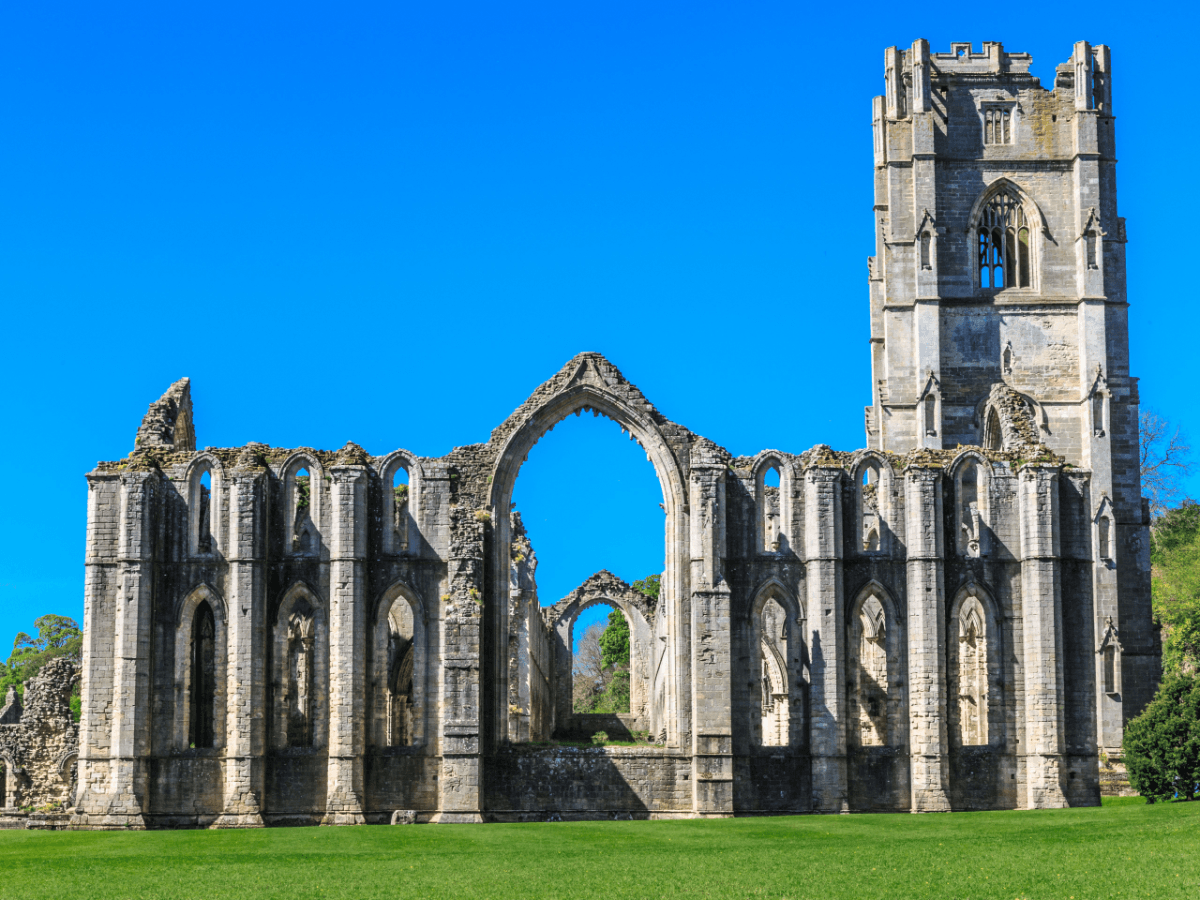
Few English regions are better at making history visible in the landscape. York Minster dominates its city with the sort of effortless authority only centuries can provide. Fountains Abbey lies in a designed landscape of such scale and coherence that it has World Heritage status. Whitby Abbey, though not formally in those world-heritage ranks, has the dramatic cliff-top ruins and sea-facing melancholy to make an awfully strong case for itself on visual grounds alone. The region is full of priory remains, castle fragments, Minster cities and old market centres that suggest the past here had rather a lot on.
Industrial heritage with real staying power
Yorkshire and the Humber is one of the places where England’s industrial history is still legible in bricks, terraces, mills, warehouses, civic halls, canals and rail lines. Saltaire is perhaps the neatest and most complete expression of that story, but not the only one. Leeds, Bradford, Halifax, Wakefield, Sheffield, Rotherham and Doncaster all bear the marks of textile, coal, steel and transport history. This gives the region a useful depth. It is not merely scenic and old. It is also modern Britain in one of the places where modernity was made.
A coastline with real character
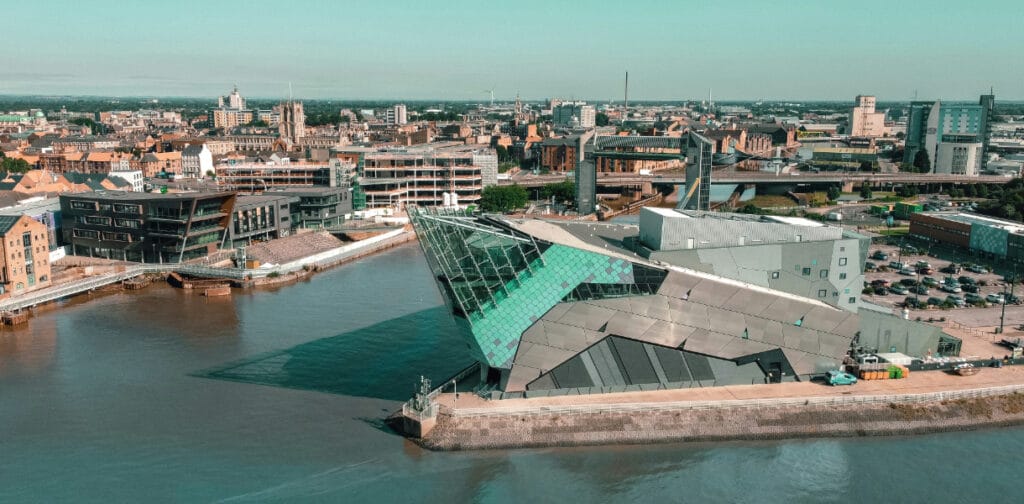
The Yorkshire coast has one of the best combinations in England. Whitby has abbey ruins, fishing-port history and enough atmosphere for several towns. Robin Hood’s Bay gives you steep lanes and dramatic setting. Scarborough has old-school seaside weight. Flamborough Head and Bempton bring cliffs and seabirds, while Bridlington and the East Riding coast lean more traditional and family-oriented. Further south, the Humber side of the region gives a more estuarial, working-waterfront character, especially around Hull and the bridge country. This is not one continuous mood of coast. It is several.
The different faces of the region
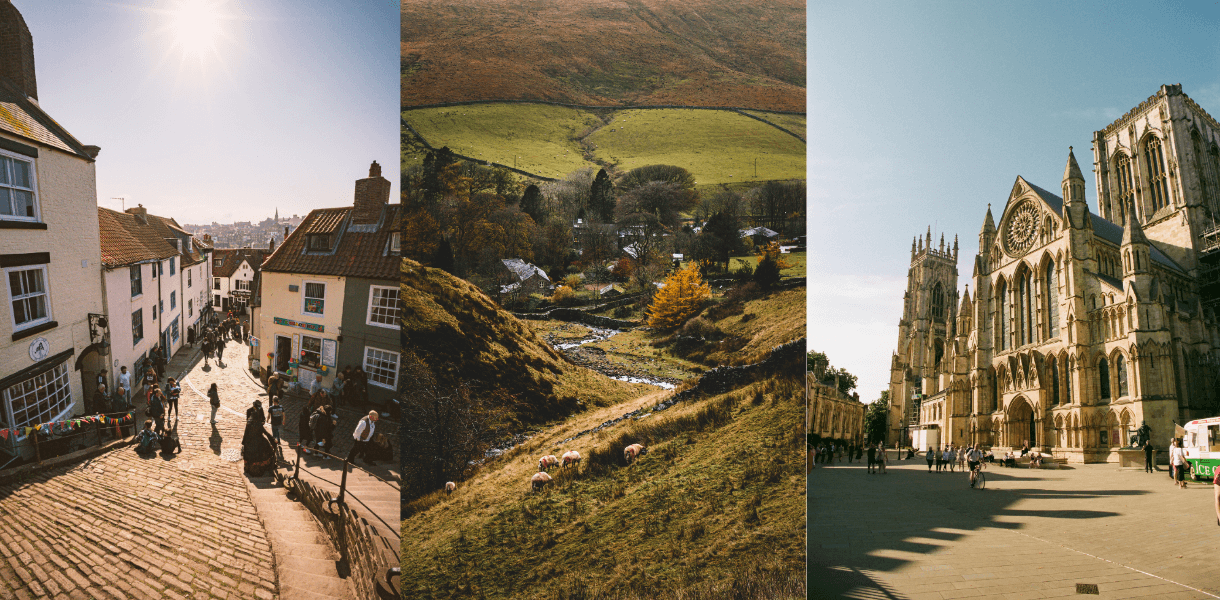
Yorkshire and the Humber is much easier to enjoy once you stop seeing it as one great slab of county pride and start noticing its distinct internal worlds. This is a region of historic cities, industrial valleys, big moors, dramatic coast, market towns, port life and overlooked estuary edges.
North Yorkshire and York is the classic visitor version, and for good reason. York, Harrogate, Whitby, Skipton, Ripon, Helmsley and Malton bring together medieval streets, abbeys, dales, moors, market-town polish and one of England’s most atmospheric coastlines.
West Yorkshire gives the region much of its urban and industrial depth. Leeds, Bradford, Halifax, Huddersfield, Wakefield, Saltaire and Hebden Bridge combine wool history, grand civic architecture, mill-town character, food, culture and surprisingly green edges.
South Yorkshire has a sturdier, more industrially forged feel, shaped by coal, steel and manufacturing, but softened by market-town history and nearby countryside. Sheffield is the obvious anchor, with Doncaster, Rotherham and Barnsley adding further layers of heritage, work, reinvention and local character.
East Riding, Hull and the Humber feel broader, flatter and more maritime. Hull gives the area its port-city punch, while Beverley, Bridlington, Driffield, Hornsea and Withernsea add market-town grace, chalk landscapes, seaside air and big estuary skies.
North and North East Lincolnshire bring a different texture to the south bank of the Humber. Grimsby, Cleethorpes, Barton-upon-Humber, Brigg and Scunthorpe add working-waterfront history, seaside familiarity, estuary landscapes and some pleasingly overlooked corners.
Counties within Yorkshire and the Humber
North Yorkshire
North Yorkshire is the region’s great all-purpose county. It has York on one side, national parks on another, abbey ruins, coastal drama and market towns almost indecently well arranged across the rest.
- Key places
York, Harrogate, Ripon, Whitby, Skipton, Helmsley, Malton - Known for
The Yorkshire Dales, the North York Moors, York and Fountains Abbey - Standout attractions
York Minster, Fountains Abbey, Whitby Abbey, Castle Howard, the Dales - Best kind of visit
A first regional trip, a scenic tour, or a long heritage-and-landscape break
West Yorkshire
West Yorkshire is where the wool story became city skylines, civic buildings and mill-country towns. It feels urban, textured and full of architectural reminders that industry once expected to impress.
- Key places
Leeds, Bradford, Halifax, Huddersfield, Wakefield, Saltaire - Known for
Textile history, industrial architecture, major cities and Saltaire - Standout attractions
Saltaire, Leeds city centre, Piece Hall in Halifax, Yorkshire Sculpture Park, Harewood House - Best kind of visit
A culture-and-history city break with town-hopping extras
South Yorkshire
South Yorkshire carries coalfield and steel-country history more openly than most regions would dare. It also has one of England’s most interesting cities in Sheffield and enough market-town texture to stop the whole place feeling like a lesson in furnaces.
- Key places
Sheffield, Doncaster, Rotherham, Barnsley - Known for
Steel, coal, engineering, music, football and resilient urban character - Standout attractions
Kelham Island Museum, Sheffield’s industrial quarters, Wentworth Woodhouse, Brodsworth Hall, Doncaster’s rail heritage - Best kind of visit
An urban heritage break with a strong modern edge
East Riding of Yorkshire and Hull
This part of the region mixes chalk country, old market-town ease, seaside traditions and the powerful maritime identity of Hull. It often gets less attention than the Dales and Moors, which is a useful way of keeping it pleasant.
- Must Visit
Hull, Beverley, Bridlington, Driffield, Hornsea - Known for
Hull’s port history, Beverley’s Minster, the Yorkshire Wolds and east coast resorts - Standout attractions
Hull’s Old Town and waterfront, Beverley Minster, Flamborough Head, Bridlington, Burton Agnes Hall - Best kind of visit
A coast-and-town trip with maritime history
North and North East Lincolnshire
These Humber-side districts sit a little outside the usual postcard idea of Yorkshire and that is part of their value. They add estuary breadth, fishing-port history and a more industrial-maritime note to the region as a whole.
- Key places
Grimsby, Cleethorpes, Barton-upon-Humber, Brigg, Scunthorpe - Known for
Fishing history, the Humber, working-waterfront character and overlooked heritage - Standout attractions
Cleethorpes seafront, Humber bridge approaches, Barton-upon-Humber’s old town, Grimsby’s maritime story - Best kind of visit
A quieter Humber-focused exploration
Cities and towns to know
Cities worth knowing
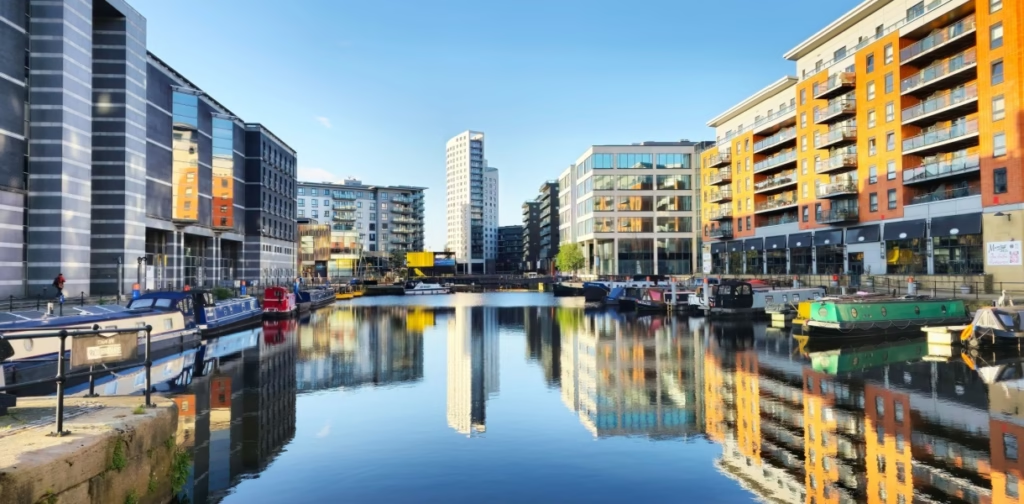
York
One of England’s great historic cities and still the easiest first base for many visitors. Roman, Viking, medieval and Georgian layers all pile up here with suspicious efficiency.
Leeds
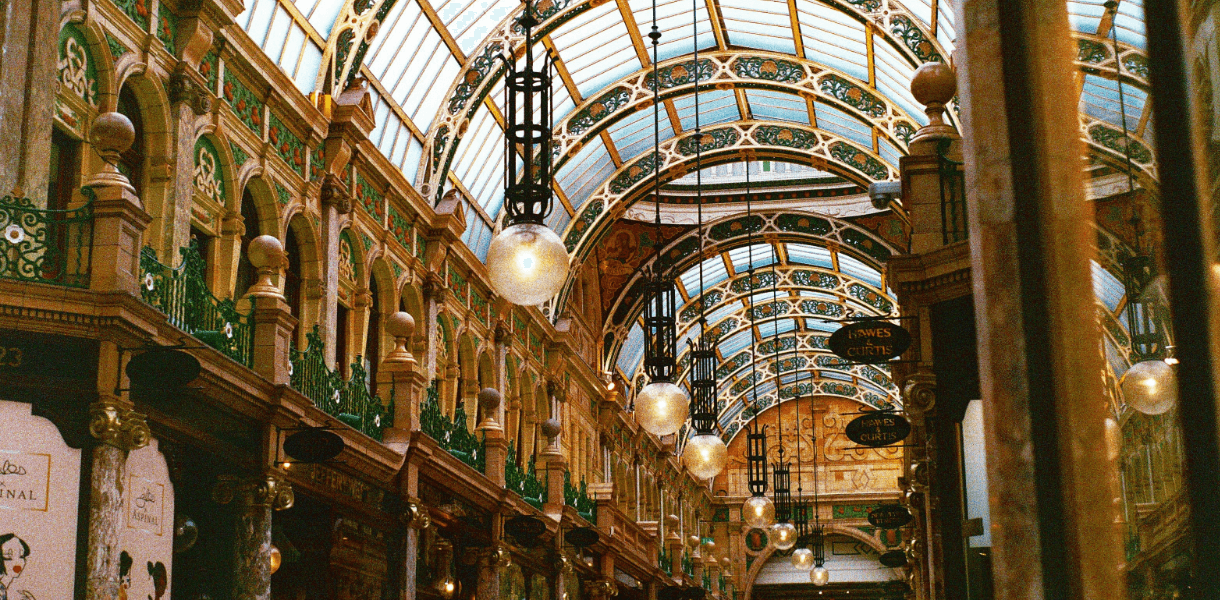
The region’s most expansive city, with grand shopping arcades, Victorian confidence, a strong food and culture scene and a good sense of present-tense momentum.
Sheffield
A city shaped by steel but now also by music, independent culture and its proximity to the hills. It feels tougher and greener than outsiders often expect.
Bradford
A city of mill-town grandeur, layered heritage and serious architectural scale. It helps explain why the region’s industrial history matters.
Hull
Broad, maritime and underestimated, Hull has real character and one of the strongest relationships to water anywhere in the north of England.
Towns with particular character

Harrogate
Spa-town polish, gardens, good eating and a slightly composed air that has not entirely worn off.
Whitby
Abbey ruins, fishing-port history, sea air and gothic associations combine to make Whitby one of the most atmospheric towns in England.
Halifax and Hebden Bridge
Pennine mill towns with independent spirit and a setting that does a good deal of the work for them.
Beverley
One of the region’s most agreeable smaller centres, with a Minster, good streets and a useful position between Hull and the Wolds.
Skipton
A market town with a castle, dales access and the sort of practicality that makes it very easy to like.
Robin Hood’s Bay
A steep, dramatic coast village that understands perfectly well what sort of effect it has on people.
Major tourist attractions
Cathedrals, abbeys and historic buildings
York Minster, York
The great ecclesiastical centrepiece of the region and one of the defining buildings of northern England.
Fountains Abbey and Studley Royal, near Ripon
A World Heritage Site combining abbey ruins and a designed landscape of exceptional scale and coherence.
Whitby Abbey, Whitby
A cliff-top ruin that gives the Yorkshire coast a considerable amount of its drama.
Beverley Minster, Beverley
One of the region’s most rewarding great churches, in a town that deserves more lingering than it always gets.
Industrial and cultural heritage
Saltaire, near Bradford
An exceptionally complete and well-preserved nineteenth-century industrial village, and a World Heritage Site.
Kelham Island Museum, Sheffield
A strong way into Sheffield’s metalworking and industrial story.
National Railway Museum, York
A major attraction that fits the region especially well given the long importance of transport and industry.
Hull’s Old Town and maritime quarter
A very useful reminder that this region also faces the sea and the estuary with real historical weight.
Natural landmarks and scenic highlights
The Yorkshire Dales
Limestone country, caves, valley views and some of the best walking landscapes in England.
The North York Moors
Heather, quiet roads, old tracks and broad moorland beauty.
Flamborough Head and Bempton cliffs
Some of the strongest coastal scenery in the region, especially if you like your sea views with seabirds and chalk.
The Humber Bridge
An estuarial landmark of modern engineering and one of the clearest visual symbols of the region’s wider geography.
Great houses and castles
Castle Howard
One of the grandest houses in northern England, Castle Hoiward is a reliable reminder that Yorkshire also did aristocratic display perfectly well.
Skipton Castle
A very satisfying market-town castle in a very satisfying market town.
Brodsworth Hall
A useful South Yorkshire counterweight to the more famous northern and eastern houses.
How to plan a trip here
How long to stay
A long weekend works well if you build the trip around one strand of the region, such as York and North Yorkshire, Leeds and West Yorkshire, or Sheffield and the south. For a stronger first regional trip, four to seven days is much better. That gives you enough time to combine a city, a scenic area and at least one stretch of coast without feeling constantly in transit.
Best bases
York is the easiest all-round base for first-time visitors. Leeds works well for a more urban trip with easy rail links. Sheffield is ideal if you want industry, food and proximity to open country. Harrogate, Skipton and Whitby all make good smaller bases depending on whether your priorities are spa-town ease, Dales access or coastal atmosphere.
Car or public transport
The region is unusually workable by rail if your trip focuses on cities and major towns. York, Leeds, Sheffield, Bradford and Hull are all easy to connect. A car becomes much more useful once you want to move freely between dales, moors, abbeys, smaller market towns and the less direct bits of coast. This is not a region that insists on a car, but it often rewards one.
Best first-time route through the region
A very strong first trip would be York, the Dales and the coast. Start with York, then move west into Dales country or south-west towards West Yorkshire’s industrial heritage, before finishing with Whitby, Robin Hood’s Bay or the East Riding coast. Another excellent version is York and Leeds with Saltaire, Harrogate and a national-park day out.
Best time to visit
Late spring and early autumn are especially good, when the landscapes look generous and the roads and towns feel more forgiving. Summer is excellent for coast and walking, though obvious places can be busy. Winter suits York and the larger cities rather well, especially if your ideal day involves history, bookshops and a pub that looks older than several countries.
Who this region suits best
It suits visitors who like variety without losing a sense of place. It is especially strong for people who want cities and scenery in the same trip, and for anyone who prefers history that still feels present in streets, skylines and landscapes rather than carefully separated off from everyday life.
Best ways to experience the region
Best for a first visit
Base yourself in York and add one Dales day, one coast day and one smaller-town or abbey day. That gives you the strongest introduction to the region’s breadth.
Best for history lovers
Focus on York, Fountains Abbey, Saltaire, Whitby Abbey and one of the industrial cities. Few English regions offer such a full sweep from Roman and medieval to industrial and modern.
Best for coast and scenery
Spend most of your time between the North York Moors and the coast, using Whitby, Helmsley or somewhere nearby as a base.
Best for a long weekend
Choose York and North Yorkshire, Leeds and West Yorkshire, or Sheffield and South Yorkshire. Trying to do the entire region in three days is an excellent way to become overfamiliar with road signs.
Best for a week-long tour
Use two bases, one urban and one scenic. York plus Leeds, or York plus Whitby, or Sheffield plus a northern base all work well.
Best for city and countryside balance
Leeds and the Dales, York and the Moors, or Sheffield and its western edges are all particularly strong combinations.
Final verdict
Yorkshire and the Humber has the useful quality of being famous without feeling exhausted. People know the name, the pudding, the dales and the general business of regional self-belief, but the place itself still has the power to surprise. It gives you some of England’s best historic cities, some of its most satisfying industrial heritage, two excellent national parks, a proper coastline and a long, richly worked landscape full of old labour and old ambition. That is an impressive amount for one region to be getting on with.
More than that, it rewards the kind of visitor who likes places with backbone. Not just beauty, though there is plenty of that. Not just history, though it has more than enough. What makes the region memorable is the way those things sit inside a larger regional temperament that feels practical, proud and entirely itself. For that sort of traveller, Yorkshire and the Humber is not just a strong option. It is one of England’s best.