
Scotland’s industrial heritage attractions reveal a country shaped by mills, mines, shipyards, bridges, canals, textiles, coal, iron, steel and engineering. From New Lanark and Verdant Works to the National Mining Museum Scotland, Summerlee, Riverside Museum, the Forth Bridge and the Falkirk Wheel, these sites show how modern Scotland was built, worked and transformed.
The Scotland built by steam, steel and stubborn brilliance
Scotland is often sold through mountains, castles, whisky, islands and the sort of lochs that make photographers behave strangely. All very fair. But look a little closer and another Scotland appears, one made of mills, mines, shipyards, canals, railways, foundries, bridges, engines, tenements, warehouses and workers’ rows. It is not always the Scotland of postcards. It is the Scotland that built, powered, moved, clothed and engineered its way into the modern world.
This industrial Scotland is not tucked away in one tidy corner. It runs through Glasgow and Dundee, across Lanarkshire and the Lothians, along the Clyde, through Fife, Ayrshire, Falkirk, the Borders and the old coal and steel country. Some of it is preserved in handsome museums. Some of it survives in working structures. Some of it has been softened into visitor centres, canal towpaths and family days out. Some still has the honest heft of brick, iron and hard graft.
Together, Scotland’s industrial heritage attractions tell a story every bit as dramatic as any castle. Less sword-waving, perhaps, but considerably more steam.
Quick takeaways
Best for first-time visitors
New Lanark, Riverside Museum, National Mining Museum Scotland, Verdant Works
Best for families
Summerlee Museum of Scottish Industrial Life, Riverside Museum, The Falkirk Wheel, Scottish Maritime Museum
Best for engineering drama
The Forth Bridge, The Falkirk Wheel, Riverside Museum, Denny Ship Model Experiment Tank
Best for social history
New Lanark, Verdant Works, National Mining Museum Scotland, Summerlee Museum
Best for Scotland’s shipbuilding story
Riverside Museum, Scottish Maritime Museum Irvine, Denny Ship Model Experiment Tank
Best for a full industrial heritage day out
New Lanark, Summerlee, National Mining Museum Scotland, Verdant Works
Scotland’s industrial heritage at a glance
Industrial Scotland was never one thing. It was cotton and jute, coal and iron, steel and shipbuilding, canals and railways, fishing and engineering, printing and textiles, bridges and locomotives. It was also crowded housing, skilled labour, dangerous work, radical politics, technical genius, hard lives, astonishing confidence and, in many places, a civic pride built on smoke, noise and payday.
New Lanark tells the story of cotton, planned industry and social reform. The site was founded in 1785 and became internationally important under Robert Owen, whose ideas about education, welfare and working conditions made the village a model industrial community. UNESCO describes it as an exceptional purpose-built eighteenth-century mill village near the Falls of Clyde.
Dundee’s Verdant Works tells the story of jute, mill work and the city’s industrial identity. The museum is housed in a restored mill building and focuses on Dundee’s workers, machinery and social history, bringing to life an industry that once shaped the city’s economy and atmosphere.
Coal, iron and steel come strongly through at places such as the National Mining Museum Scotland and Summerlee Museum of Scottish Industrial Life. The National Mining Museum is housed in the restored Lady Victoria Colliery in Newtongrange, while Summerlee sits on the site of the former Summerlee Iron Works in Coatbridge.
Then there is the Clyde, whose shipbuilding and engineering story still hangs over Glasgow like a magnificent, complicated inheritance. The Riverside Museum, at the junction of the Kelvin and Clyde, houses Glasgow’s transport and technology collections and reflects the city’s role in shipbuilding, train manufacturing and engineering.
Why Scotland’s industrial heritage matters
Scotland’s industrial story matters because it explains so much of modern Scotland. It shaped where people lived, how cities grew, how wealth moved, how communities formed and how political identities hardened. It gave Scotland an international reach far beyond its size. Ships from the Clyde, jute from Dundee, coal from the Lothians and Lanarkshire, iron from Coatbridge, locomotives, bridges and marine engineering all made Scotland part of a vast global network.
This history can be uncomfortable. Industrial heritage is not simply a tale of clever machines and handsome brickwork. It includes dangerous labour, poor housing, pollution, boom and collapse, exploitation and the human cost of prosperity. A good industrial attraction does not simply polish a boiler and invite everyone to admire the rivets. It asks what industry did to people, places and landscapes.
That is what makes Scotland’s industrial heritage so rewarding to explore. It is physical, social and emotional. You can stand in a mill, walk through a miners’ row, look at a ship model, cross a bridge, follow a canal or visit a colliery and feel the past in practical terms. This was not abstract history. It was work, wages, noise, skill, danger, invention and home.
New Lanark and the dream of a better industrial world
New Lanark is one of Scotland’s great heritage experiences because it combines industrial scale with a surprisingly humane story. The village sits beside the River Clyde in a wooded gorge, which is frankly showing off. You arrive expecting mills and machinery, and instead find one of the most beautifully placed industrial communities in Britain.
The cotton mills were founded by David Dale and later became famous under Robert Owen. Owen’s reforms made New Lanark internationally significant. Education, welfare, housing and working conditions were treated here with a seriousness that was unusual for the period. It was still an industrial village, of course, not a utopia with laundry facilities. But it showed that factory life could be imagined differently.
For visitors, New Lanark works because it is not only a museum. It is a whole place. The mill buildings, workers’ housing, school, village streets and riverside setting help you understand the relationship between industry and community. You can explore exhibitions, walk by the Clyde, continue to the Falls of Clyde, and come away with that rare heritage-site feeling that you have learned something without being bullied by interpretation panels.
It is also a useful reminder that industrial history is not always grim. New Lanark has hardship in its story, but also hope, reform and ambition. Scotland’s industrial past was often dirty and difficult, but it was also full of people trying, in their own imperfect ways, to improve the terms of modern life.
Dundee, jute and the power of Verdant Works
Dundee is one of Britain’s most fascinating industrial cities. Its famous trio of jute, jam and journalism is memorable partly because it sounds like the contents of an eccentric shopping list. But jute was the giant. The city’s mills processed raw fibre into sacks, rope, canvas and countless industrial materials, linking Dundee to global trade, imperial networks and hard factory labour.
Verdant Works is the best place to understand that story. Set in a former mill, it brings together machinery, worker stories and the atmosphere of industrial Dundee. The appeal is not just mechanical. It is human. You get a sense of the sound, rhythm and discipline of mill life, and of the people whose labour gave the city much of its nineteenth-century identity.
What makes Verdant Works especially valuable is that it connects industry to everyday life. Mills were not isolated machines for making money. They shaped neighbourhoods, gender roles, family economies, health, housing, politics and the working day. Dundee’s women workers were central to the jute industry, and that gives the city’s industrial story a distinct social texture.
It is also a fine companion to modern Dundee. Visit the waterfront, the V&A Dundee, the McManus or the city’s regenerated streets, and Verdant Works gives the deeper backstory. Dundee’s reinvention makes more sense once you have stood inside the industry that once defined it.
Coal, iron and the hard-working heart of central Scotland
If New Lanark has the feel of social reform and Dundee has the rhythm of textile machinery, central Scotland gives you the heavier stuff. Coal, iron and steel shaped communities across Lanarkshire, Ayrshire, Fife and the Lothians. This was not gentle industry. It was hot, dark, dangerous and absolutely central to Scotland’s modern growth.
The National Mining Museum Scotland at Newtongrange is one of the key attractions. Housed in the restored Lady Victoria Colliery, it tells the story of coal mining through buildings, exhibitions and the experience of a real colliery site. The museum describes the Lady Victoria as one of Europe’s finest surviving Victorian collieries, and the setting helps visitors understand mining as both industry and way of life.
This matters because coal was not simply fuel. It created towns, sustained families, powered factories, drove railways and shaped working-class politics. It also left scars. Mining communities knew solidarity, pride and skill, but they also knew danger, illness, uncertainty and loss.
Summerlee Museum of Scottish Industrial Life in Coatbridge widens the story. It stands on the site of the Victorian Summerlee Iron Works and includes industrial remains, social history, miners’ cottages, a heritage tramway and exhibits connected with iron, steel, engineering and everyday life.
Summerlee is especially good because it understands that industrial history belongs indoors and outdoors. You can move from heavy machinery to workers’ housing, from tram rides to the remains of iron production. It is a place where children can enjoy the movement and scale, while adults quietly realise how much of modern Scotland was forged in places like this.
Glasgow, the Clyde and the city that built the world’s ships
Glasgow’s industrial heritage is so large that it can be hard to know where to start. The city did not merely grow during the industrial age. It boomed, roared, blackened, expanded and announced itself to the world with the confidence of a place that had just discovered engineering and intended to use all of it.
The Clyde was central to that story. Shipbuilding, marine engineering, heavy industry and trade turned Glasgow into one of the great industrial cities of the world. The phrase “Clyde-built” still carries a certain muscular pride. It suggests strength, skill and a vessel that would not be easily embarrassed by weather.
Riverside Museum is the obvious modern starting point. Its transport and technology collections cover cars, trams, trains, ship models and the city’s wider engineering story. The location beside the Clyde matters. This is not industrial heritage placed neatly in a box. It sits beside the river that helped make it possible.
The Scottish Maritime Museum adds another important layer. Its sites at Irvine and Dumbarton are dedicated to Scotland’s national maritime collection, with the Dumbarton museum including the Denny Ship Model Experiment Tank, a remarkable survivor from the age when ship design was tested with scientific precision rather than crossed fingers and optimism.
For visitors, the Clyde story is best understood as a blend of museum-going and wandering. Glasgow’s former docks, warehouses, bridges, riverfront paths and regenerated districts all carry traces of the old industrial city. Some traces are obvious. Others have been polished into cafés, flats and cultural venues. The trick is to look twice.
The Forth Bridge and Scotland’s great engineering confidence
Some industrial heritage attractions are museums. Others are still doing the job they were built to do. The Forth Bridge is very much in the second category, which is one reason it is so thrilling.
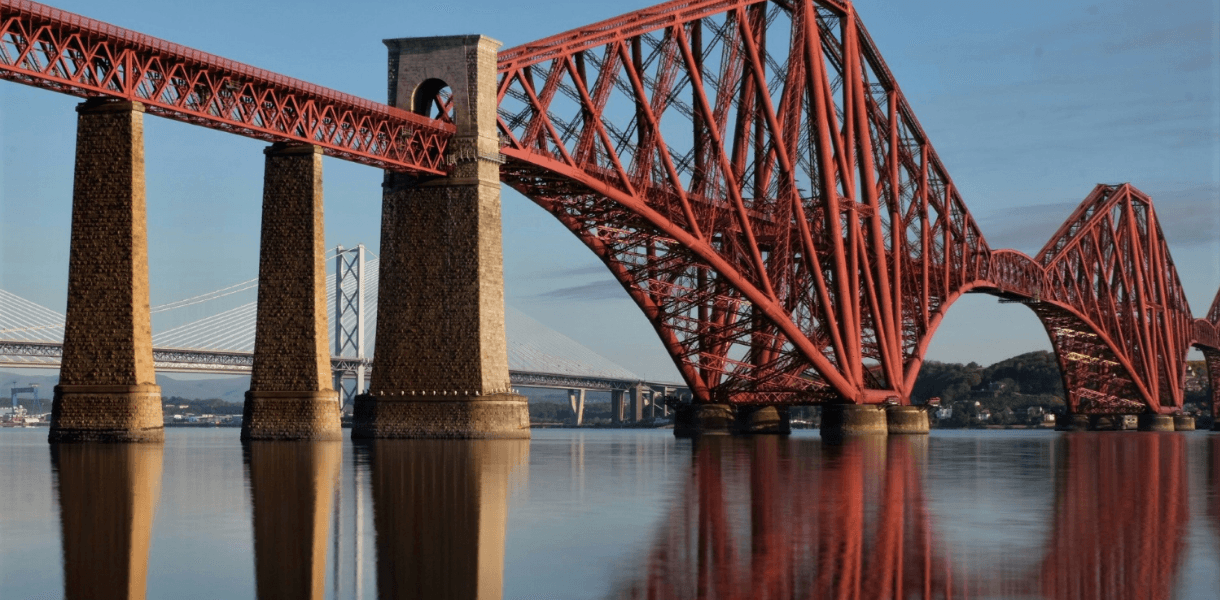
Opened in 1890, the Forth Bridge remains one of the greatest railway bridges in the world. The bridge had the world’s longest spans when it opened and remains a major example of cantilever trussed bridge design. It continues to carry passengers and freight across the Forth.
The bridge is astonishing partly because it makes no attempt to be delicate. It does not pretend to float or vanish into the landscape. It plants itself across the estuary in red steel and says, in effect, there you are. It is industrial architecture as pure declaration.
You can appreciate it from South Queensferry, from North Queensferry, from boat trips, from the rail crossing itself, or from walks around the Forth Bridges area. However you see it, the bridge has that rare quality of being both beautiful and slightly ridiculous. It is beautiful because of its structure. It is ridiculous because the structure is so immense that the human brain needs a moment to catch up.
The Forth Bridge is a reminder that Scotland’s industrial heritage is not only about memory. Some of it is still alive, useful and moving people about with Victorian swagger.
The Falkirk Wheel and industrial heritage with a grin
The Falkirk Wheel is newer than most of the sites in this article, but it belongs here because it links Scotland’s canal heritage with modern engineering imagination. It connects the Forth and Clyde Canal with the Union Canal using a rotating boat lift, raising vessels between waterways in a way that looks as if someone gave a giant piece of sculpture a practical job.
Scottish Canals describes it as the world’s only rotating boat lift, linking the Forth and Clyde Canal to the Union Canal 35 metres above. It is both engineering and theatre, which is a very pleasing combination.
The Wheel works particularly well for families because it makes engineering visible. You do not need to know the history of canal transport to enjoy seeing boats lifted into the air with calm mechanical confidence. It is one of those attractions where children grasp the point immediately and adults pretend not to be just as delighted.
The wider Falkirk area adds to the appeal. Canal towpaths, nearby walks and the Kelpies at Helix Park make this a strong day out. It also shows how industrial heritage can be renewed rather than simply preserved. The old canal network was built for work. Today, it carries leisure, memory, cycling, walking and one of Scotland’s most entertaining feats of modern engineering.
Smaller places, bigger stories
Scotland’s industrial heritage is not limited to the headline attractions. In fact, one of its pleasures is the way smaller places open up large stories.
In the Borders, textile towns such as Hawick, Galashiels and Selkirk speak of wool, mills, knitwear and river-powered industry. The machinery may not dominate the skyline in the way it once did, but the urban fabric still carries the pattern of mills, worker housing and riverside production.
In Fife and the Lothians, former mining landscapes tell a different story. Some pits have vanished, some have been landscaped, and some survive through memorials, museums and local memory. Industrial heritage here is often less about grand monuments and more about community identity.
In Ayrshire and Inverclyde, maritime, engineering and harbour histories sit alongside seaside leisure, which can make for oddly satisfying contrasts. You can move from shipbuilding heritage to sea views and ice cream with very little warning, which is one of Scotland’s better tricks.
The Highlands and islands have their own industrial strands too, from fishing and herring stations to slate, kelp, distilling, hydro-electric schemes and harbour infrastructure. They may not fit the classic image of industrial Scotland, but they matter. Industry was not only urban and smoky. It also existed in quarries, glens, harbours, islands and remote working landscapes.
How to plan an industrial heritage trip in Scotland
The best way to approach Scotland’s industrial heritage is by theme or region.
For a strong first trip, combine Glasgow, New Lanark and Summerlee. This gives you the Clyde, cotton, iron, steel, transport and social history in a manageable central Scotland loop. Add the Falkirk Wheel if you want a family-friendly engineering stop with a bit of spectacle.
For a Dundee-focused trip, make Verdant Works the industrial anchor and pair it with the waterfront, museums and city centre. This works especially well for visitors interested in urban regeneration, textiles and the way cities reinvent themselves without entirely escaping their past.
For coal and working-class history, visit the National Mining Museum Scotland and Summerlee, then explore the wider landscapes of Midlothian, Lanarkshire and Fife. This is a more sober itinerary, but a deeply rewarding one.
For engineering and transport, build a route around Riverside Museum, the Scottish Maritime Museum, the Denny Ship Model Experiment Tank, the Forth Bridge and the Falkirk Wheel. It is a fine reminder that Scotland did not just make things. It made things that moved.
The main rule is not to rush. Industrial heritage rewards attention. A beam engine, a loom, a miners’ cottage, a bridge span, a ship model or a mill floor can look simple at first. Give it a little time and the human story starts to come through.
Best ways to experience Scotland’s industrial heritage attractions
Start with one big museum, then add a place where the surrounding landscape still speaks. New Lanark works beautifully because the village, mills, river and gorge all belong together. The Forth Bridge works because the estuary gives the structure its drama. Summerlee works because the industrial site is part of the visit.
Look for the social history, not just the machinery. Machines are impressive, but people are the point. The most powerful industrial attractions are the ones that show work, housing, family life, danger, skill, discipline and community.
Use public transport where it makes sense. Glasgow, Dundee, New Lanark, Newtongrange, Falkirk and South Queensferry can all work well without a car, though some sites are easier with one. Industrial heritage often grew around railways, rivers and canals, so travelling by train can feel pleasantly appropriate.
Leave room for modern Scotland. These places are not frozen in the nineteenth century. Glasgow, Dundee, Falkirk and the Clyde have all changed dramatically. The best visits connect past and present rather than treating industry as a sealed museum case.
Final verdict
Scotland’s industrial heritage attractions are among the country’s most rewarding visitor experiences because they show a Scotland that is inventive, tough, skilled, restless and deeply human. This is not the Scotland of empty glens and romantic ruins, though there is plenty of romance in a red steel bridge or a mill village beside a river if you know where to look.
What makes these places so powerful is the combination of scale and intimacy. The Forth Bridge and the Clyde speak of global ambition. New Lanark and Verdant Works show how industry shaped daily life. The National Mining Museum and Summerlee bring you close to the communities whose labour powered modern Scotland.
Visit them and you begin to see the country differently. The grand scenery is still there, of course. Scotland has not mislaid its mountains. But behind the postcard view is another story, one of soot, steam, skill, experiment, hardship and pride. It is less tidy, less polished and sometimes more moving.
Scotland did not only preserve history in castles and abbeys. It forged it, milled it, mined it, riveted it, launched it and sent it out into the world.
Getting here
Glasgow, Edinburgh, Dundee and Falkirk are the best gateways for many industrial heritage attractions. New Lanark can be reached via Lanark, the National Mining Museum via Newtongrange, and the Forth Bridge is easily seen from South Queensferry or North Queensferry.
Where to stay
Glasgow works well for the Clyde, Riverside Museum, Summerlee and day trips to New Lanark. Edinburgh is handy for the National Mining Museum and the Forth Bridge. Dundee is the best base for Verdant Works. Falkirk works well for the Falkirk Wheel, canals and central Scotland exploring.
Where to eat
Look for cafés at major sites such as New Lanark, Riverside Museum, Summerlee, Verdant Works and the National Mining Museum. Glasgow, Dundee, South Queensferry and Lanark also offer good options for turning an industrial heritage visit into a fuller day out.
What to do
Pair museums with walks. Combine New Lanark with the Falls of Clyde, Riverside Museum with a Clyde riverside wander, the Forth Bridge with South Queensferry, and the Falkirk Wheel with canal towpaths and the Kelpies.
Nearby gems
Falls of Clyde, Glasgow’s riverfront, South Queensferry, the Kelpies, Dundee waterfront, the Clyde coast, Culross, Linlithgow and the wider Forth Valley all combine well with industrial heritage trips.
Best time to visit
Industrial museums are good year-round, especially for mixed-weather days. Spring and autumn are ideal for combining museums with walks. Summer gives longer days for linking several sites, while winter suits the moodier side of mills, mines, bridges and old industrial towns rather well.