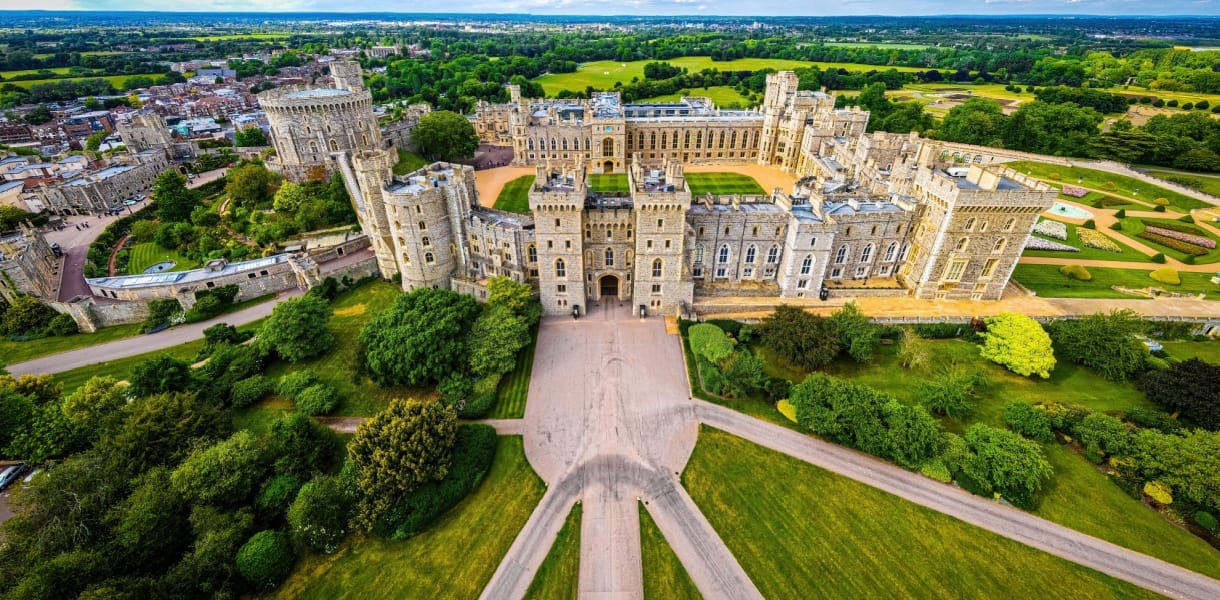
Perched above the Thames with the sort of quiet confidence that comes from being nearly a thousand years old, Windsor Castle is not just a royal residence. It is a fortress, a palace, a working symbol of the British monarchy, and one of those rare places that manages to feel both grand and oddly lived in. For all its stone walls and ceremonial splendour, it is not a frozen relic. It still has a job to do.
That is part of what makes Windsor Castle so compelling. Many historic buildings impress you with what they once were. Windsor impresses you with what it still is.
A castle built to dominate
Windsor Castle began life in the 11th century, after William the Conqueror set about securing England with a chain of fortresses. Its position was no accident. From here, the Normans could keep an eye on the Thames, protect the approaches to London, and project power into the surrounding countryside with considerable clarity. If you were wondering who was in charge, a castle on a hill tends to answer the question rather efficiently.
The original structure was wooden, as many Norman castles were, but over time it was rebuilt in stone and steadily enlarged. What started as a military stronghold evolved into something much grander. Successive monarchs added towers, chapels, state apartments, and ceremonial spaces, each leaving behind a little architectural fingerprint. The result is not a castle in a single neat style, but a building shaped by centuries of royal taste, ambition, war, fashion, and occasional over-decoration.
It is this layered quality that gives Windsor much of its character. You are not looking at one moment in history. You are walking through many of them at once.
More than a fortress
Unlike some castles that cling fiercely to their martial origins, Windsor softened into a residence without losing its sense of strength. Thick walls, battlements, and towers still give it the look of a place prepared for trouble, but inside there is also elegance, ceremony, and the unmistakable message that monarchs like comfort as much as anyone else.
By the late medieval period, Windsor had become one of the crown’s principal homes. Edward III was especially important in shaping the castle’s identity, turning it into a seat of royal magnificence and linking it with the Order of the Garter, the highest order of chivalry in England. That connection remains central to Windsor’s story. This is not merely a handsome old building. It is part of the machinery of monarchy.
That sense of continuity runs through everything here. Kings and queens have celebrated victories, mourned losses, held court, entertained dignitaries, and retreated from London within these walls. Some came to rule. Some came to hide from plague or politics. Some came, one suspects, because the views were rather better.
The Round Tower and the shape of the castle
One of Windsor’s defining features is the Round Tower, rising from the central mound and giving the whole complex its familiar silhouette. It is the kind of tower that looks exactly as a child might draw a castle tower, only much more imposing and with considerably more history attached.
The mound beneath it is part of the original Norman earthworks, which means the castle still carries the bones of its earliest design. From below, the tower provides a strong visual anchor, dividing the Lower Ward from the Upper Ward and reminding visitors that Windsor’s grandeur rests on military foundations.
The layout is part of the pleasure of visiting. It unfolds in distinct areas, each with its own mood. The Lower Ward has the spiritual and ceremonial heart of the site. The Upper Ward feels more palatial. The open courtyards and changing views give you the sense of moving through a place that was designed not just to be inhabited, but to impress.
St George’s Chapel and the quieter kind of magnificence
If Windsor Castle has a soul, it may well be St George’s Chapel. This is one of the great masterpieces of Gothic architecture in England, and one of the few places where the scale of the building and the intricacy of the detail manage to outdo each other.
The fan-vaulted ceiling is extraordinary. The stonework appears almost too delicate for the weight it carries, as though carved by patient magicians. Choir stalls linked to the Knights of the Garter line the chapel, each marked with heraldic banners and symbols that add colour and ceremony to the space. There is pageantry here, certainly, but also stillness.
St George’s Chapel is also a royal burial place, which lends it an emotional depth that goes beyond architecture. Monarchs and members of the royal family are buried here, and that makes the chapel feel less like a museum piece and more like a thread in an ongoing story. It is a place of worship, remembrance, and national ritual all at once.
Even visitors who arrive mainly for the castle’s grandeur often leave talking about the chapel. It has that effect on people. Magnificence can be impressive. Reverence tends to linger longer.
The State Apartments and royal theatre
If the chapel offers reflection, the State Apartments provide full ceremonial spectacle. These rooms were designed to glorify monarchy in the most direct and persuasive way possible. High ceilings, rich decoration, grand staircases, gilded details, armour, paintings, and lavish furnishings all work together to say that the crown is ancient, powerful, cultivated, and not remotely interested in minimalism.
The interiors are especially associated with Charles II and later George IV, both of whom helped shape Windsor into the theatrical royal setting visitors know today. The rooms are full of treasures, but what matters most is the cumulative effect. They feel like a stage set for the performance of monarchy, except the performance has been running for centuries.
And yet the castle does not feel purely ceremonial. It remains in use, which gives it an edge of reality many historic houses lack. This is not a replica of royal life. It is one of the places where royal life actually happens.
Fire, restoration, and resilience
One of the most dramatic chapters in Windsor Castle’s recent history came in 1992, when a major fire broke out and damaged a significant section of the castle. It was the kind of event that makes people collectively wince. A building that had survived wars, political upheaval, and centuries of changing taste was suddenly at the mercy of flames.
The restoration that followed was immense and carefully handled. Damaged spaces were repaired with great skill, balancing historical accuracy with practical renewal. The work became part of the castle’s story rather than an interruption to it. In some rooms, what you see today is the result of that restoration, proof that heritage is not just about preservation but about recovery.
There is something oddly fitting about Windsor surviving and adapting. A castle that has lasted this long was never going to remain untouched. Its strength lies not in staying exactly the same, but in continuing.
Why Windsor Castle still matters
Plenty of historic buildings are important. Fewer still feel relevant. Windsor Castle does.
Partly that is because of its role in national life. State occasions, ceremonies, private family events, and public symbolism all gather here. But it also matters because it offers a very direct connection to the long, uneven, theatrical story of the British monarchy. Windsor is where abstract ideas about kingship become bricks, banners, chapels, gates, and corridors.
It is also, quite simply, an extraordinary place to visit. The setting above the town, the mix of fortress and palace, the views, the scale, the detail, the sense of continuity all combine to create a site that feels larger than a single era. It rewards people who love architecture, history, religion, monarchy, military design, or just the deep satisfaction of looking at something that has been standing there for centuries, refusing to be ignored.
Windsor Castle is not quaint, and it is certainly not modest. It is a building built to embody authority, then refined into splendour, then carried forward into the present. That it still works on all those levels is what makes it remarkable.
Know before you go
Getting here
- Windsor is easy to reach from London by train, with services to Windsor and Eton Central and Windsor and Eton Riverside
- If you are driving, arrive early as parking in Windsor can fill up quickly, especially on weekends and school holidays
- The castle is in the centre of town and well signposted from the station
Where to stay
- Stay in Windsor itself if you want an easy early start and time to explore the town after the day visitors have thinned out
- There are smart hotels near the castle, plus smaller guesthouses and pubs with rooms in Windsor and Eton
- For a quieter base, look at nearby villages in Berkshire with good road or rail connections
Where to eat
- Windsor has plenty of cafés, pubs, and restaurants within a short walk of the castle
- Good options range from quick lunch spots for soup, sandwiches, and cakes to more polished places for a longer dinner
- Eton, just across the bridge, is also worth considering for somewhere slightly calmer to eat
What to do
- Visit the State Apartments and St George’s Chapel, allowing enough time not to rush
- Watch the Changing of the Guard if it is taking place during your visit
- Walk through Windsor town and across to Eton for a wider sense of the setting
- Combine the castle with a riverside walk along the Thames if the weather behaves itself
Nearby gems
- Eton College adds another layer of historic atmosphere just across the river
- Windsor Great Park is ideal if you want grand landscapes after royal interiors
- Runnymede is a short trip away and offers a very different but equally significant slice of English history
Best time to visit
- Spring and early autumn are particularly good, with pleasant weather and slightly softer crowds than peak summer
- Weekdays are usually easier than weekends
- Winter can be atmospheric, especially when the town is dressed for Christmas, though opening arrangements can vary around royal events and holidays