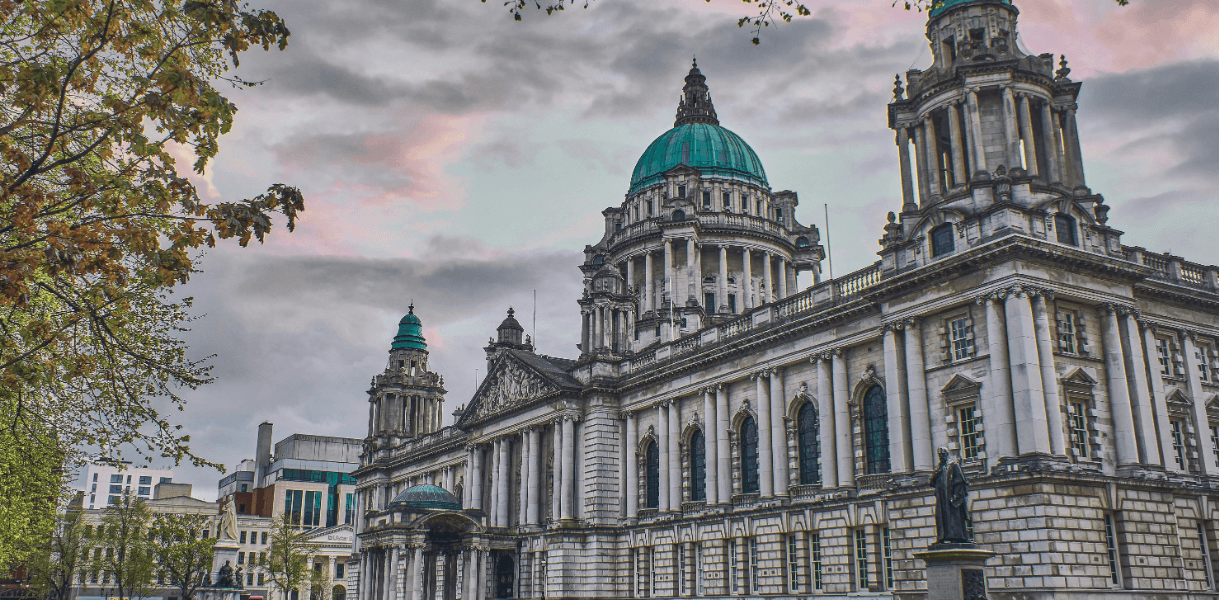
Belfast City Hall is one of those buildings that seems to steady the city around it. Grand without being stuffy, ornate without tipping into absurdity, it stands in the middle of Belfast like a confident Edwardian announcement that this was a city determined to be noticed. More than a century after it opened, it is still one of the clearest ways to understand Belfast’s ambition, history and civic pride.
Quick takeaways
- One of Belfast’s defining landmarks, right in the centre of Donegall Square.
- Opened on 1 August 1906 after Belfast was granted city status in 1888.
- Designed by Sir Alfred Brumwell Thomas in a richly decorative Baroque Revival style and built in Portland stone.
- Best visited with a guided tour so you can see the grand interiors, stained glass and council spaces properly.
- The grounds are part of the experience too, with memorials including the Titanic Memorial Garden and the Cenotaph.
A building made to announce a city
There are town halls, and then there are town halls that clearly had no intention of behaving modestly. Belfast City Hall belongs firmly in the second category. It rises from the centre of the city with a great dome, broad façades and the sort of self-confidence that suggests Belfast, at the start of the twentieth century, was not in the mood for understatement.
That confidence was well earned. In 1888 Queen Victoria granted Belfast city status, and the new city wanted a civic building to match its importance. When City Hall opened on 1 August 1906, Belfast was in a period of immense industrial prosperity, with shipbuilding, engineering and linen all helping to shape its reputation. The building was meant to express that success in stone. It still does.
First impressions
Seen from a distance, the dome is the thing that pulls the eye first. It rises above the shopfronts, buses and city-centre rush with the calm assurance of something that knows it is the main event. As you get closer, the details begin to do their work. The pale Portland stone, the balanced wings, the carvings and sculptural flourishes all give the building an air of ceremony without making it feel remote.
That is one of the most appealing things about Belfast City Hall. For all its grandeur, it does not feel detached from the life around it. It sits right in the middle of the city, with people crossing the grounds, meeting outside, taking photographs on the lawns and using it as the easiest point of orientation in Belfast. It is a landmark, but also a practical one. In many ways, it is the city centre.
Why the architecture matters
The building was designed by Sir Alfred Brumwell Thomas in the Baroque Revival style, which is architecture’s way of saying that plainness is for other people. This is a style that likes drama, symmetry, flourishes and carefully arranged grandeur. Belfast City Hall wears all of that very well.
Yet for all its decorative ambition, the building never feels gaudy. It has dignity. The dome gives it presence, the stone keeps it cool and solid, and the layout gives it that satisfying sense of order that grand civic architecture often aims for but does not always achieve. It looks exactly as a city hall ought to look if the city in question has decided it is going to be important and would like everyone else to notice.
Inside the building
The exterior is impressive enough, but the interior is where the place really starts enjoying itself. Guided tours take visitors through City Hall’s corridors and ceremonial rooms, including the Robing Room and Council Chamber. Visitors also see Lord Mayor portraits and hear stories tied to the building’s civic life and wartime history, including a painting left unrestored as a memorial to lives lost during the Belfast Blitz.
The Council Chamber is a particular highlight. It is not just handsome, it also carries major historical resonance. Two royal thrones used by King George V and Queen Mary during the 1921 state opening of the Parliament of Northern Ireland are among the artefacts associated with the room.
Then there are the function rooms, whose plasterwork, carved woodwork and woven carpets make it abundantly clear that early twentieth-century Belfast did not believe in doing civic business in drab surroundings.
The stained glass and decorative detail
Historic buildings often promise atmosphere and then deliver a staircase, a rope barrier and a laminated sign. Belfast City Hall offers rather more than that. Among its most striking features are the stained glass windows, especially in the reception room and banqueting hall. Official information notes that three stained glass windows dominate the reception room, with the central one displaying the British royal arms and a tablet marking the building’s official opening in 1906, flanked by the arms of Belfast.
These details matter because they reveal the mindset behind the place. This was not simply a municipal office block with ambitions. It was designed as a civic statement, full of symbolism, ceremony and visual richness. The beauty was part of the point.
The grounds and memorials
The building itself is only half the experience. The grounds surrounding Belfast City Hall contain memorials and statues linked to the city’s people and past, including the Titanic Memorial Garden, the Cenotaph and the Garden of Remembrance. The Titanic Memorial Garden is particularly poignant, naming all 1,512 victims of the disaster.
This gives the whole site an added depth. Belfast City Hall is not merely decorative civic theatre. It is also a place of remembrance. That matters in a city whose history has been shaped by industry, conflict, loss and reinvention. The lawns and memorials help turn a beautiful building into a more complete reflection of Belfast itself.
What makes it special today
Some historic civic buildings end up as handsome relics, admired politely and then left to the pigeons. Belfast City Hall has avoided that fate because it remains both a working civic building and a visitor attraction. Belfast City Council is still based here, while visitors can explore exhibitions, book tours and use the grounds as part of their time in the city centre.
That combination of ceremony and everyday life is what makes it so satisfying. It still matters to the city. It is still in use. It still hosts events. It still draws people in. Rather than being frozen in Edwardian grandeur, it continues to play an active part in Belfast’s story.
Final verdict
Belfast City Hall is one of the city’s essential buildings, not simply because it is beautiful, but because it explains so much. It tells you about Belfast’s confidence at the height of its industrial power, its desire to present itself as a city of importance, and its continuing need for places that hold memory as well as function.
If you only glance at it from the pavement, you will still come away impressed. But go inside, take the tour, linger in the grounds and it becomes something richer than a photogenic landmark. It becomes a way into Belfast itself.
Know before you go
Getting here
- Belfast City Hall stands in Donegall Square in the heart of Belfast city centre.
- It is an easy walk from central shopping streets, restaurants and many city-centre hotels.
- Belfast Welcome Centre is located opposite City Hall, which is handy for maps, advice and local information.
- If you are arriving by public transport, this is one of the easiest Belfast landmarks to reach on foot from central transport hubs.
Where to stay
- The Merchant Hotel for grand luxury and a special-occasion feel in the Cathedral Quarter. The hotel describes itself as a five-star property in Belfast’s historic Cathedral Quarter.
- Ten Square Hotel for a very central base, right on Donegall Square South and within easy reach of City Hall.
- Bullitt Hotel for something more modern, lively and well placed for exploring the city centre on foot.
Where to eat
- The Bobbin Coffee Shop at City Hall for the easiest on-site stop while visiting. Belfast City Council lists it as open to the public with daily opening hours.
- The Muddlers Club if you want a more ambitious meal later in the day. Its official site describes it as a Michelin-star restaurant in Belfast’s Cathedral Quarter.
- Holohan’s Pantry for something rooted in local flavour. The restaurant describes itself as a family-run Irish restaurant in Belfast.
- Established Coffee for strong coffee and a relaxed break. Its cafe page lists opening hours and its Hill Street location.
What to do
- Take a guided tour of Belfast City Hall to see the Robing Room, Council Chamber and ceremonial interiors.
- Visit the visitor exhibition, which offers more background on the building and the city. Tickets are available at reception and adult tickets are listed at £4, with children free with a valid ticket.
- Spend time in the grounds and memorial gardens, especially the Titanic Memorial Garden.
- Use City Hall as a springboard for exploring the rest of central Belfast.
Nearby gems
- Titanic Belfast for the city’s most famous maritime story.
- Crumlin Road Gaol for a very different slice of Belfast history.
- Ulster Museum if you want to add art, history and natural sciences to the day.
- The Cathedral Quarter for food, pubs and a good evening atmosphere.
Best time to visit
- Spring and early autumn are ideal for seeing the grounds looking their best without the full summer crowds.
- A dry bright day does the exterior plenty of favours, but the interior tour makes it worthwhile in any weather.
- If you are in Belfast for only a short break, City Hall works especially well as an early stop because it gives you a strong sense of the city straight away.