
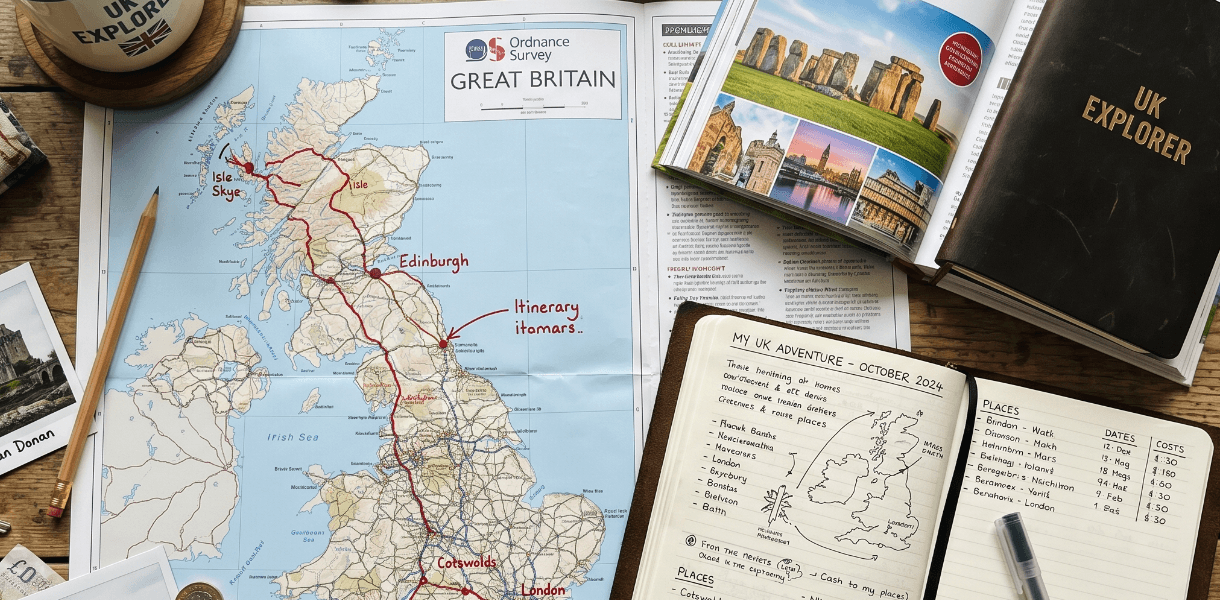
Planning a UK trip can feel oddly difficult for such a reasonably sized country. The trouble is not lack of choice. It is that Britain keeps offering up another handsome city, another dramatic coastline, another village that looks as though it has spent centuries practising for photographs. This guide is for overseas visitors trying to work out where to go, how to narrow the options, and how to choose a trip that feels enjoyable rather than overstuffed.
Quick takeaways
- Best for first-time visitors who want the classics
London, Bath, York, Edinburgh, Oxford and the Cotswolds - Best for scenery and dramatic landscapes
Scottish Highlands, Lake District, Eryri, Northumberland and Pembrokeshire - Best for coastal atmosphere
Cornwall, Devon, Norfolk, Northumberland, Pembrokeshire and Dorset - Best for historic cities
York, Bath, Edinburgh, Chester, Durham and Cambridge - Best for a slower regional trip
Northumberland, Cornwall, the Cotswolds, Yorkshire and the Scottish Highlands - Best for easy rail-friendly trips
London, York, Bath, Oxford, Cambridge, Edinburgh and Chester - Best for visitors who want fewer crowds and more local character
Northumberland, the Suffolk coast, Shropshire, Herefordshire and the Scottish Borders - Best planning rule
Choose the kind of trip first, then the region, then the individual places
Why choosing where to go in the UK can be harder than expected
The UK is one of those destinations that looks simple on a map and complicated in real life. Overseas visitors often begin with a list of familiar names, then discover that alongside London and Edinburgh there are cathedral cities, national parks, coast roads, market towns, harbour villages, castle-heavy corners, and entire regions that somehow seem to have slipped through the international tourism briefing while remaining extremely appealing.
That is why choosing where to go is less about finding the best place and more about finding the best fit.
A successful UK trip usually comes down to four things. What kind of experience you want, how much time you have, how much moving around you actually enjoy, and what season you are travelling in. Get those right and the trip begins to make sense surprisingly quickly. Ignore them and you can end up with an itinerary that looks excellent on paper and slightly exhausting in practice.
Start with the type of trip you want
A great many people begin by looking at destinations. It is more useful to begin by looking at yourself.
Think first about the experience you want your days to have. Do you want famous sights and major landmarks, or are you more interested in atmosphere and everyday charm. Would you rather spend a morning in a museum, a market town, on a clifftop path, or in a pub with low beams and a pie that takes its responsibilities seriously.
Broadly speaking, most overseas visitors fall into one or more of these categories.
The classic first-timer
You want to see places you have heard of all your life. You want at least some of the Britain of imagination. Big landmarks, famous streets, royal history, old colleges, cathedral cities, perhaps a village or two that looks suspiciously perfect.
This kind of trip often works well with London plus one or two classic companions such as Bath, Oxford, York, Edinburgh or the Cotswolds.
The scenery-first traveller
You are less concerned with ticking off famous names and more interested in coastlines, mountain roads, castles on headlands, lakes, valleys, moors and long views that make you temporarily forget to speak.
You may be happier in the Highlands, Northumberland, the Lake District, Eryri, Pembrokeshire, Cornwall or the Yorkshire Dales than in a city-heavy itinerary.
The history and heritage enthusiast
You like places with layers. Roman walls, medieval streets, abbeys, castles, old universities, stately homes, industrial heritage, stories attached to every stone and enough architecture to keep your camera occupied for days.
York, Bath, Edinburgh, Durham, Chester, Oxford, Cambridge and much of southern and northern England can be excellent for this sort of trip.
The slower traveller
You do not want to repack every other morning. You like settling in, learning the rhythm of a place, having time for detours and avoiding the sensation that your holiday has become a competitive event.
For this style, one city and one region is often ideal. Or even just one region done properly.
The mixed-trip planner
This is often the smartest choice of all. You want a little of everything. One major city, one scenic stretch, one smaller historic place perhaps, and enough variety to feel you have seen different sides of the country without spending half the trip in transit.
This is where combinations like London and the Cotswolds, Edinburgh and the Highlands, York and North Yorkshire, or Manchester and the Peak District tend to shine.
Understand what the UK is especially good at
The UK does not really compete by offering one overwhelming headline attraction. It competes by being unusually rich in combinations. It is very good at giving visitors a trip that feels varied, textured and full of character.
Historic cities
This is one of the UK’s great strengths. If you enjoy walkable centres, museums, church spires, Georgian crescents, castle views, old colleges, city walls and streets that still behave as though the modern era is a passing inconvenience, you are in the right country.
London is the obvious giant. Edinburgh is theatrical and dramatic. Bath is elegant. York is deeply satisfying. Oxford and Cambridge offer scholarship and architecture in generous quantities. Chester and Durham are smaller but memorable.
Countryside and landscapes
The UK is also remarkably strong on scenery, especially for a country that can seem modestly proportioned on a globe. It has mountains, lake districts, dales, moors, glens, sea cliffs, white chalk coast, rolling farmland and islands that look as if they have been painted by someone in a particularly romantic mood.
The Highlands offer scale and drama. The Lake District offers valleys, lakes and a concentrated dose of beauty. Northumberland offers space, coast and castles. Eryri offers rugged landscape and strong character. Cornwall and Devon offer sea views, villages and cliff-backed beaches.
Coast and seaside atmosphere
Britain can do coast in a number of different styles. There is grand and wild coast, pretty and sheltered coast, harbour-town coast, fossil-hunting coast, dune-backed coast and the sort of coast that makes you think a wool jumper may be the best souvenir.
For overseas visitors, coastal trips often feel distinctly British because they combine scenery with older towns, seafood, piers, cliff walks, sea air and weather that remains gloriously unwilling to take itself for granted.
Market towns and villages
Visitors often arrive with a mental picture of Britain that involves stone cottages, green squares, old churches, pub signs creaking in the breeze and lanes where even the potholes seem historical. There are indeed places where reality gets surprisingly close to the brochure image.
The Cotswolds, parts of Yorkshire, Shropshire, Herefordshire, Suffolk and southern England are particularly strong for this.
Easy combinations
The real trick is that these experiences can often be combined without absurd distances. A trip can be city and countryside, coast and castles, heritage and food, or grand icons and quieter corners. That is one of the UK’s great advantages for overseas visitors.
Be realistic about time
This is perhaps the most useful bit of advice in the whole guide.
Many visitors see that Britain is smaller than countries they are used to travelling in and conclude that they can fit in an ambitious number of stops. Then real travel enters the chat. Stations are not always next door to hotels. Roads take longer than expected. Checking in and out repeatedly is a nuisance. And even wonderful places become less wonderful when encountered with one eye on the clock.
A more restrained itinerary is nearly always better.
For a 5 to 7 day trip
Choose one major base and, at most, one second stop. This could be London and Bath, Edinburgh and the Highlands, or York and one surrounding region.
For a 7 to 10 day trip
Two or three bases is usually enough. This allows a city, a scenic area and perhaps a smaller historic place without turning the holiday into an exercise in luggage management.
For a 10 to 14 day trip
Three good stops often works very well. Four can work if the route is logical and you are comfortable moving about.
For longer trips
You have more freedom, but even then, not every extra day should automatically become another hotel booking. Longer stays often reveal more than longer checklists.
Choose between city-led and region-led travel
This single choice helps narrow things down enormously.
City-led trips
These work well for first visits, shorter stays, public transport users and anyone who wants a lot of options. Cities bring museums, restaurants, landmarks, day-trip possibilities and easy evenings.
A city-led UK trip might include London, Bath, York and Edinburgh, or just London with day trips.
This style suits travellers who enjoy culture, convenience and seeing a lot without needing a car.
Region-led trips
These work better for travellers who want scenery, atmosphere, road trips, villages, coasts, walks and a slower pace. Rather than asking which city next, you ask which region feels most rewarding.
Northumberland, Cornwall, the Highlands, the Cotswolds, Pembrokeshire, the Lake District and Norfolk are all good examples.
This style suits people who are happy to drive or who want fewer hotel changes and a stronger sense of one place.
Mixed trips
For many overseas visitors, this is the sweet spot. One city, one region, possibly one smaller stop in between. You get contrast without chaos.
A mixed trip often feels more like a rounded holiday and less like a determined attempt to outwit geography.
Think about transport earlier than you think you need to
Transport is not the glamorous part of trip planning, but it quietly decides a great deal.
Rail-based trips
If you do not want to drive, the UK can still work very well. London, York, Bath, Oxford, Cambridge, Edinburgh, Durham and Chester are strong rail choices. These places are compact, characterful and easy to explore on foot.
Rail trips are especially good for city breaks and classic cultural itineraries. They become harder if your heart is set on remote coastlines, villages, scattered rural attractions or national park wandering.
Self-drive trips
Driving opens up many of the places overseas visitors often imagine when they think of Britain. Scenic regions, coastal roads, village areas, castles in improbable locations, smaller beaches, flexible lunch stops, and the satisfying ability to pull over when the view suddenly becomes unreasonable.
A car makes a big difference in places like Cornwall, Northumberland, the Scottish Highlands, Pembrokeshire, Devon and much of rural Wales.
That said, combining London and a rental car is not always wise. It is often better to do the city by train and collect a car for the regional part.
Low-stress trips
If you want things to feel easy, build that into the plan on purpose. Choose fewer places. Stay longer. Pick destinations with simple transport and plenty to do nearby. There is no medal for itinerary complexity.
Match your destination to the season
The UK changes its mood very noticeably with the time of year. The same destination can feel glorious in one season and much less convenient in another.
Spring
Spring is one of the loveliest times to visit. Gardens wake up, countryside turns a confident green, blossom appears and many destinations feel lively without yet becoming crowded.
This is an excellent time for Bath, the Cotswolds, Oxford, Cambridge, York, Northumberland, the South Downs and much of southern England and Wales.
Summer
Summer is best for long days, scenic touring, island trips, coastal holidays and national park breaks. It is also the busiest and often the most expensive season in the best-known beauty spots.
Cornwall, Devon, the Highlands, the Lake District, Pembrokeshire, Norfolk and Northumberland all come into their own now.
Autumn
Autumn is an underrated triumph. Light softens, colours deepen, market towns become absurdly picturesque, cities feel rich and atmospheric, and many places are calmer than in summer.
Yorkshire, the Cotswolds, Bath, Oxford, Northumberland, Perthshire and the Lake District can be especially rewarding at this time of year.
Winter
Winter is usually strongest for cities and shorter breaks rather than complex regional touring. London and Edinburgh can be wonderfully atmospheric. York and Bath also wear winter well. Rural breaks can still work, but they ask a little more of the traveller in terms of weather tolerance, shorter days and careful planning.
Decide how much famous really matters to you
There is nothing wrong with wanting to see the best-known places. London is famous because it is extraordinary. Edinburgh is one of the great city settings in Europe. Bath and York are popular for very good reasons.
But the UK is one of those countries where some of the most memorable parts of a trip may turn out not to be the global headline acts. A quiet stretch of Northumberland coast. A market town in the Welsh borders. A hillside village in Yorkshire. A small harbour in Cornwall at the end of the day. A local pub in a place no one told you to visit and which you then refuse to stop talking about.
A strong trip often includes both. Some famous places, because they matter and because they are genuinely worthwhile, and some less famous places, because they give texture, surprise and relief from crowds.
Choose by atmosphere, not just by category
Guidebooks often organise places by geography or sight type. That is useful, but atmosphere may be even more important.
Ask what sort of feeling you want from the trip.
For grandeur and polish
Choose Bath, Oxford, Cambridge, parts of London and some of the smarter southern English destinations.
For dramatic history
Choose Edinburgh, York, Durham, Chester and much of Northumberland.
For creative urban energy
Choose London, Manchester, Glasgow, Bristol and Liverpool.
For gentle rural charm
Choose the Cotswolds, the Yorkshire Dales, Suffolk, Herefordshire and parts of Shropshire.
For sea air and wide views
Choose Cornwall, Devon, Norfolk, Northumberland, Pembrokeshire and parts of Scotland.
For big, cinematic landscapes
Choose the Highlands, Eryri, Skye and the Lake District.
A place can be excellent and still not be right for the mood you want. That is not a flaw in the place. It is simply a question of fit.
Think in clusters
One of the easiest ways to choose where to go in the UK is to think in groups of places that naturally work together.
London and the southern classics
Best for first-time visitors who want major landmarks, historic day trips and a very recognisable England. Good companions include Bath, Oxford, Cambridge, Windsor and the Cotswolds.
Edinburgh and scenic Scotland
Best for travellers who want a capital city with great visual drama and a natural route into Highlands scenery, lochs, castles and smaller Scottish towns.
York and northern England
Best for travellers who want one of England’s great historic cities paired with market towns, moors, dales, abbeys and a very strong sense of regional character.
Southwest England
Best for those who want coastal beauty, villages, gardens, food stops and a slower, scenic sort of trip. Bath, Devon, Dorset and Cornwall can all sit within this broad family depending on time.
Wales
Best for travellers wanting castles, mountain scenery, coast and a slightly less predictable first or second UK trip. Cardiff can be a practical gateway, but much of the appeal lies beyond the capital.
Northumberland and the borderlands
Best for visitors wanting dramatic coast, castles, open landscapes, fewer crowds and a quieter sort of beauty that tends to win people over rather completely.
Thinking in clusters makes an itinerary feel coherent. It stops the trip becoming a collection of attractive but disconnected impulses.
Common mistakes people make when choosing where to go
Trying to see every part of Britain at once
England, Scotland and Wales in a short trip may sound satisfyingly comprehensive, but unless you have plenty of time, it can feel rushed. Depth usually beats coverage.
Confusing map distance with travel ease
A place can look close and still take time to reach properly. Connections, roads, parking and local transport all matter.
Building the whole trip around one fantasy image
Yes, Britain does contain charming villages, old pubs and castles in the mist. It also contains rain, early closing times in small places, and occasional logistical inconvenience. Aim for a balanced trip, not a postcard hostage situation.
Ignoring weather backup
A good UK itinerary leaves room for museums, indoor sights, good lunches and flexible plans. This is not pessimism. It is simply experienced travel.
Choosing only by fame
Big names are good, but some of the finest parts of a UK trip come from places you had not considered at the start.
A practical way to narrow your options
If you are still undecided, try this.
Write down three possible trip types, not just three destinations.
For example
- London plus one classic southern destination
- Edinburgh plus a scenic Scotland extension
- York plus a northern region or coastline
Then score each one against these questions
- How excited am I by it
- How easy is it to do well
- How much travel time does it involve
- How well does it suit the season
- How well does it match my budget
- How much variety does it offer
- How memorable does it feel for me personally
The right choice is usually the one that balances excitement with ease. The best trip is not necessarily the most ambitious one. It is the one most likely to leave you with strong memories and enough energy to enjoy them.
Take this guide with you
Prefer something you can save, print, or glance at while planning? Download the printable version here.
Final verdict
Choosing where to go in the UK is really about choosing what kind of trip you want the country to become. Do you want famous landmarks and great museums, coast and castles, villages and countryside, historic cities, wild landscapes, or a little of several different things arranged sensibly.
That last part matters. Arranged sensibly.
The UK is full of places worth visiting. You do not need to win it. You do not need to cover the whole map. You do not need to prove anything by sleeping in five different places in seven nights. What you need is a shape that makes sense. A route that fits your energy. A balance between the famous and the atmospheric. Enough structure to feel confident and enough breathing room to let the place surprise you.
That is usually when a UK trip becomes memorable. Not when it is crammed to the edges, but when it gives you time to look around properly. A city that rewards wandering. A region that repays staying put. A coastline that deserves an unhurried afternoon. A town you had not planned on loving quite so much.
Need to know
Best first question to ask yourself
- Do I want cities, countryside, coast, or a mix of them
Best first-trip formula
- One major city plus one scenic or historic region
Best choice for easy planning
- Rail-friendly cities with day trips
Best choice for deeper atmosphere
- One region explored properly rather than too many short stops
Best way to avoid a rushed trip
- Limit the number of hotel changes and build in free time
Best mindset
- Choose what suits your style, not just what sounds famous