
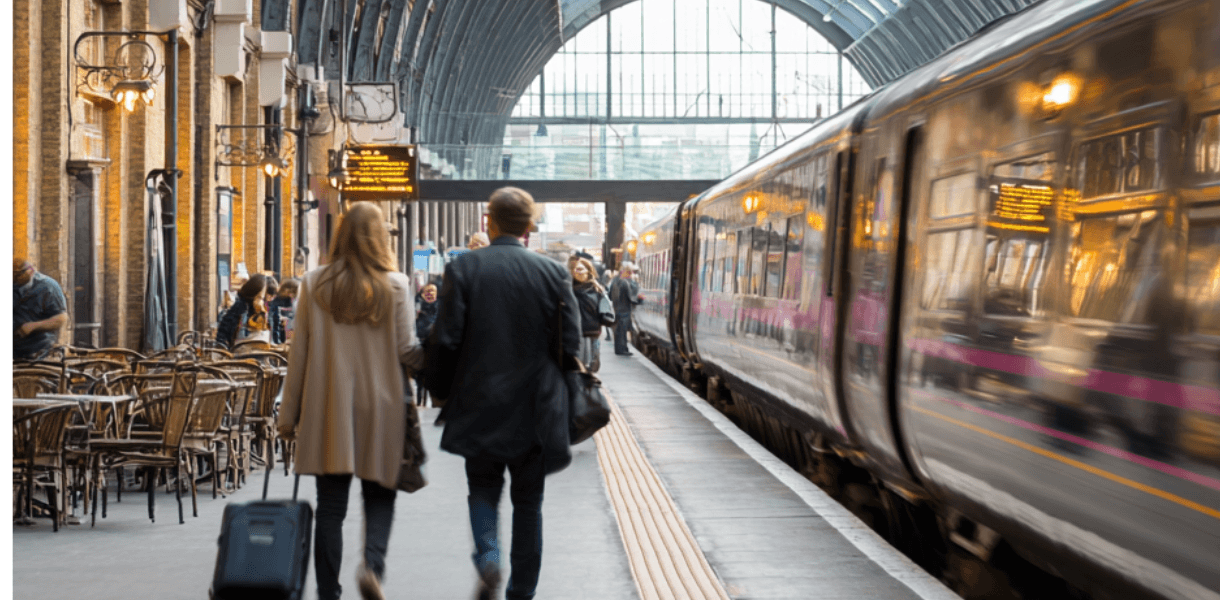
A no-car trip in the UK can be easier, cheaper and more enjoyable than many people expect, but only if you plan around the transport network rather than treating public transport like a reluctant substitute for a car. Britain has an extensive rail network, national coach services, local buses, ferries and urban transport systems, and official journey-planning tools make it perfectly realistic to build a trip without driving.
Quick takeaways
- Best approach for most travellers
Choose one to three well-connected bases and take day trips from them rather than changing hotel every night. - Easiest no-car trips
Cities and larger historic towns with rail stations, walkable centres and strong local transport. - Best planning tool for mixed public transport
Traveline, because it covers bus, train, tram, coach and ferry journey planning across Great Britain. (Traveline) - Best tool for rail planning
National Rail for train times, fares, stations, disruptions and railcards. (National Rail) - Best tool for long-distance coach travel
National Express for route planning, timetables and network coverage. (National Express) - Biggest mistake to avoid
Booking accommodation that sounds charming but is awkward from the station or bus stop with luggage. - Key planning principle
Use trains or coaches for the backbone of the trip and buses, ferries or short taxi hops for the final stretch.
Why a no-car UK trip can work so well
The UK often looks, from a distance, like a country best tackled with a steering wheel, a sat nav and a willingness to pretend that narrow lanes are character-building. In reality, many of its most enjoyable trips work very well without a car. The reason is simple. Much of Britain’s visitor-friendly geography is strung along rail corridors, historic city centres are often easiest to reach on foot once you arrive, and public transport planning tools now make route-building much easier than it used to be. National Rail positions itself as the official source for train times, fares, tickets and station information, while Traveline offers journey planning across bus, train, tram, coach and ferry services in Great Britain.
A no-car trip also changes the rhythm of travel in rather a pleasant way. You arrive in city centres instead of ring roads. You watch the landscape rather than the lane markings. You are spared car parks, wrong turns and the low-level resentment that sometimes blooms when someone says “it said turn left back there”.
Start by choosing the right shape of trip
The first thing to plan is not the route but the type of trip.
The easiest no-car trips are city breaks and town-based holidays. Places like York, Edinburgh, Bath, Bristol, Liverpool, Newcastle, Cardiff and Glasgow are straightforward because you can arrive by train and do a great deal on foot or by local transport. The next easiest option is a base-and-day-trips holiday, where you stay in one well-connected place and head out each day by train or bus.
This matters because not every attractive destination is equally attractive without a car. The trick is not just choosing where you want to go, but choosing the version of that destination that works well by public transport. A stay in a station town with strong onward bus links is one thing. A lovely cottage described as “peacefully secluded” can, in practice, mean dragging a suitcase up a dark lane while reconsidering your life choices.
Build around rail and coach backbones
The most reliable no-car trips usually have a strong transport spine. In Britain, that usually means rail first and coach second.
National Rail’s journey planner allows you to search routes, times and fares, and its ticketing information makes clear that the network is designed around different fare types, station information and disruption updates. National Express provides nationwide coach travel to towns, cities and airports, as well as timetables and a network map that is especially useful for longer point-to-point journeys or places where rail is more expensive.
In practical terms, that means your itinerary is usually strongest when the long moves are simple. London to York, York to Edinburgh, Edinburgh to Inverness is a sensible transport shape. Six small rural bases linked by a heroic combination of branch lines and infrequent buses is usually less sensible, however pretty it looked on the map.
Pick accommodation for access, not just atmosphere
This is where good no-car planning earns its keep.
When travelling without a car, proximity matters. A hotel near the station, a guesthouse on a main bus route, or a central apartment within walking distance of restaurants and key sights is often a better choice than somewhere with more rustic charm but awkward logistics. The transport may get you to the town, but the final stretch still matters.
Before booking, check the following in plain practical terms. How far is it from the station on foot. Whether that walk is flat and manageable with luggage. Whether buses still run in the evening and on Sundays. Whether you may need a taxi on arrival. Whether you can reach food, shops and basic services without needing a minor expedition.
The prettiest listing text in the world does not change the fact that “just outside town” is a very different phrase when you do not have a car.
Use the right kind of transport for the right job
A good no-car trip is rarely a train-only trip. It is usually a mixture.
Use trains for the main distances and major intercity connections. Use coaches where they are cheaper, more direct or better for airport travel. Use local buses to reach scenic areas, coastal towns, walking routes and smaller places beyond the rail network. Use ferries where geography insists upon it. Traveline is especially helpful here because it covers multiple modes in one journey-planning system, including ferries.
This is a useful way to think about it. Rail or coach gives you the skeleton of the trip. Local transport gives it limbs. The occasional short taxi, used tactically, saves the whole thing from becoming a test of your commitment to public virtue.
Plan fewer bases than you think you need
One of the easiest ways to spoil a no-car trip is to overcomplicate it.
Public transport rewards slower pacing. Three nights in one base with easy day trips is often far more enjoyable than one night in each of three places. Longer stays reduce the number of travel days, make disruptions less annoying, and let you experience places rather than merely changing trains in them.
This is especially true in scenic regions. A traveller based in Inverness, Windermere, Exeter or Penzance can have an excellent no-car trip by making selected outings from a strong hub. Trying to change accommodation every day across a rural region usually creates more admin than pleasure.
Understand the basic ticketing tools
You do not need to become a railway obsessive, but a few basics help.
National Rail’s tickets and offers pages explain ticket types, railcards and fare savings, including the range of National Railcards available. National Rail also states that railcards can offer one-third off many fares, making them worth checking for eligible travellers.
That means it is usually sensible to do three things.
First, check whether a railcard applies to you.
Second, book long-distance rail legs early if your dates are fixed.
Third, compare rail with coach for expensive intercity segments.
The cheapest ticket is not always the best ticket, though. A very restrictive fare that leaves you stranded at an awkward time can be false economy. A slightly dearer ticket that makes the day run properly is often money well spent.
Pack for stations, platforms and pavements
This is not glamorous advice, but it is very good advice.
Travelling without a car means your bag is no longer something hidden in a boot until required. It becomes a regular travelling companion. National Express publishes luggage guidance alongside its coach travel information, and transport operators generally expect you to manage what you bring.
So pack lighter than your more theatrical instincts suggest. One manageable suitcase or backpack is better than one giant one. Shoes are the usual culprit. Britain contains shops, washing facilities and civilisation. You do not need to prepare for every meteorological possibility between Kent and the Highlands.
Check Sundays, evenings and rural service levels
This is one of the most important practical points in the whole process.
When planning, do not merely confirm that a route exists. Confirm that it exists on the day and at the time you need it. Traveline’s planner and live departure tools are useful for this, because they are built for real journey checking rather than daydreaming over a map. (Traveline)
Pay particular attention to Sunday travel, evening arrivals, onward buses from smaller stations, and ferry-dependent routes. Rural Britain can be wonderfully connected in some places and surprisingly shy in others. A bus route that looks perfectly serviceable at 10.30 on a Wednesday may be distinctly less serviceable on a Sunday afternoon.
Use one strong base in more complex regions
Some of Britain’s most rewarding regions are perfectly possible without a car, but benefit from a base-town strategy.
That means staying somewhere that has both accommodation and onward transport, then making selective day trips. In practice, this often works well with places such as Inverness, Fort William, Windermere, Keswick, Oban, Penzance, Exeter or Llandudno. The details vary, but the logic stays the same. One good base with reliable onward options is usually far better than a string of awkward overnight stops.
The secret is not trying to do every corner of a region in a single visit. A no-car trip works best when it is selective rather than exhaustive.
Do not neglect the last mile
Britain’s transport network is often very good at getting you close. The last mile is where plans become either elegant or annoying.
For every accommodation booking and every day trip, ask yourself one final question. How do I actually get from where public transport drops me to where I need to be. That might be a short walk. It might be a local bus. It might be a five-minute taxi ride. The point is to know in advance.
The no-car traveller who plans the last mile usually looks unreasonably calm. The one who does not is often found peering uphill with luggage.
A simple step-by-step method
A practical way to plan a no-car UK trip is this.
Choose the region or trip type first.
Pick one to three transport-friendly bases.
Book the long rail or coach legs early.
Choose accommodation near stations, bus routes or easy taxi access.
Use Traveline to test each day trip and return journey.
Check Sundays and evening service levels.
Pack lighter than you think you need.
Leave breathing room in the itinerary.
That last point matters more than people think. A little spare time is not wasteful on a no-car trip. It is what makes the whole thing feel like travel rather than a relay race.
Final verdict
A no-car trip in the UK is not a compromise trip. At its best, it is a better way to travel.
It works particularly well for cities, historic towns, scenic rail corridors and selective regional breaks built around one or two strong bases. It asks for a little more thought upfront, but often repays that effort with a more relaxed, more human and more enjoyable journey. You spend less time navigating and more time noticing where you are.
That is not a bad exchange.
Take this guide with you
Prefer something you can save, print, or glance at while planning? Download the printable version here.
Useful transport information links
Here are some genuinely useful places to bookmark at the planning stage.
- National Rail journey planner for train times, routes and fares. (National Rail)
- National Rail tickets, railcards and offers for fare types and money-saving options. (National Rail)
- National Rail main site for stations, disruptions and wider rail travel information. (National Rail)
- Traveline journey planner for bus, train, tram, coach and ferry route planning across Great Britain. (Traveline)
- Traveline services for live departures, timetables and broader public transport planning tools. (Traveline)
- National Express for long-distance coach travel and airport connections. (National Express)
- National Express timetables for checking scheduled coach services. (National Express Timetables)
- National Express network map for seeing how coach routes connect around the UK. (National Express)