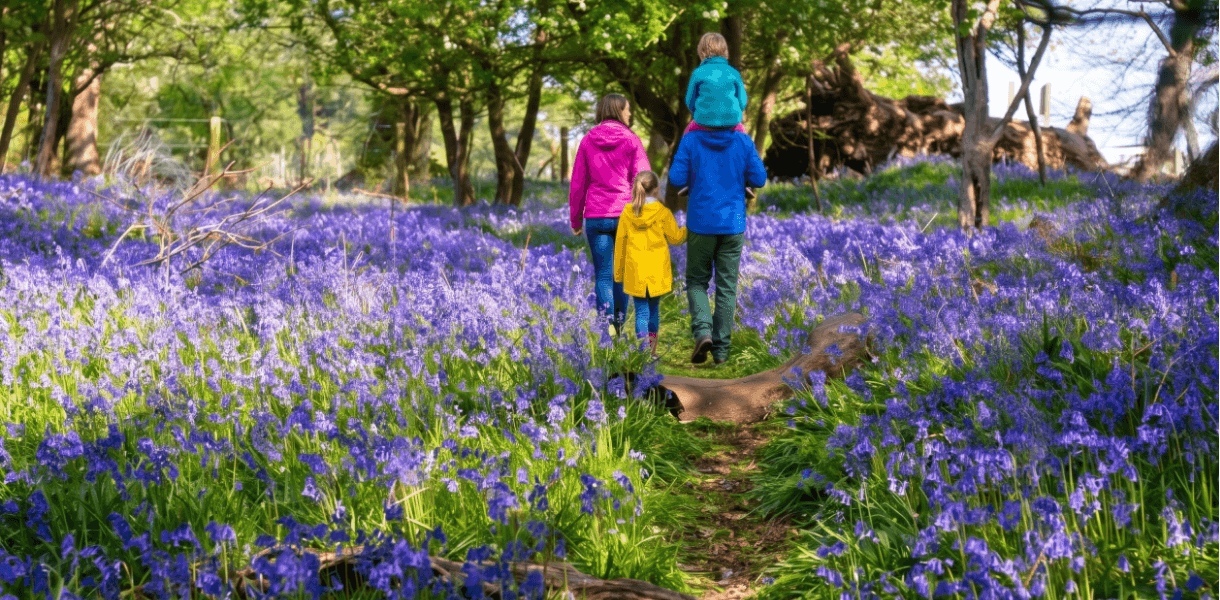
For a few brief weeks each spring, parts of Britain stop behaving like ordinary woodland and turn into something closer to enchantment. Old woods glow violet-blue, shady paths soften into haze, and otherwise sensible people begin making detours for “just one more stretch of bluebells”. These are 20 of the best places in Britain to enjoy the show, from famous southern blockbusters to coastal, Highland and Northern Irish beauties. Bluebells usually peak from mid spring into early May, depending on region and weather, and Britain is home to more than half the world’s bluebells, which is one reason these woods matter so much.
Quick take
- Best for a classic bluebell pilgrimage
Ashridge Estate, West Woods, Micheldever Wood - Best for drama beyond the flowers
Hackfall, The Hermitage, Abermawr - Best for a quieter feel
Everdon Stubbs, Geilston Garden, Prehen Wood - Best for mixing bluebells with history
Coed Cefn, Wentwood, Chawton Park Wood
The walks
1. Ashridge Estate, Hertfordshire
Ashridge is one of the great headliners of bluebell season, and Dockey Wood is the bit that tends to make people go slightly quiet and reach for their camera with unusual reverence. The National Trust describes Dockey Wood as the best place to view bluebells on the estate, and it is actively managed for spring visitors, which tells you quite a lot about how famous the display has become.
Even with the fame, it still feels magical when the beech and oak canopy begins to lift and the floor turns almost absurdly blue. Go early in the day if you can. It suits the place.
- Where
Near Berkhamsted, Hertfordshire - Best for
A classic bluebell outing with a proper wow factor - Walk feel
Well-managed estate paths with the main spring focus on Dockey Wood - Good to know
This is one of the busiest bluebell spots in England in season
2. West Woods, Wiltshire
West Woods has the sort of spring reputation that makes people speak of it in slightly hushed, proprietary tones, as though they have discovered it themselves and would rather not see too many coaches arriving. Forestry England describes it as a beautiful ancient woodland south of Marlborough, with fantastic displays of bluebells and a good network of trails.
This is a place for lingering rather than charging through. The trees are beautiful, the tracks are generous, and when the bluebells are at full tilt the whole wood seems to glow from below.
- Where
South of Marlborough, Wiltshire - Best for
A big, satisfying spring woodland walk - Walk feel
Extensive beech woodland with multiple trails and an accessible route - Good to know
Bluebell season here is especially associated with April and May
3. Micheldever Wood, Hampshire
Micheldever is one of those woods that does not need to shout. It is already ancient, already handsome, already rich with stories underfoot. Forestry England describes it as a predominantly beech wood noted for its ancient woodland status and archaeology, with Bronze Age burial mounds and Iron Age farmsteads.
Add spring bluebells to that and you have a walk that feels layered in the nicest possible way. Not just flowers, but atmosphere. Not just colour, but time.
- Where
Northeast of Winchester, Hampshire - Best for
Bluebells with a side order of ancient history - Walk feel
Predominantly beech woodland with waymarked options including a family-friendly trail - Good to know
Spring displays here are often highlighted alongside the archaeology
4. Chawton Park Wood, Hampshire
Chawton Park Wood has one considerable advantage over many bluebell woods, which is that it comes with Jane Austen in the background. Forestry England says these were the woods where she took her regular strolls, which rather improves the atmosphere before you have even set off.
The paths are gentle, the big trees are handsome, and the spring display feels generous rather than showy. It is the sort of place where bluebells and literary daydreaming get on extremely well.
- Where
Near Chawton in the South Downs National Park, Hampshire - Best for
A literary bluebell walk - Walk feel
Accessible main paths through beech and maple woodland - Good to know
A good option if you want an easier stroll rather than a hard march
5. Clumber Park, Nottinghamshire
Clumber’s bluebell walk is pleasingly varied. The National Trust trail begins in Hardwick village and takes in woodland, heathland, farmland and the lake, which means the flowers arrive as part of a wider spring landscape rather than the whole plot.
That makes it a very good pick for people who want a full walk, not just a floral cameo and an immediate return to the car park. There is space here, and shape, and the nice sense that the day has properly gone somewhere.
- Where
Clumber Park, near Worksop, Nottinghamshire - Best for
A longer-feeling bluebell walk with plenty of variety - Walk feel
Circular trail through woodland and open estate landscapes - Good to know
The featured bluebell route is about 3.5 miles or 5.6km
6. Hackfall, North Yorkshire
Hackfall does not so much offer a walk as a romantic episode. Woodland Trust describes it as restored historic woodland in a steep rocky gorge of the River Ure, with waterfalls and heritage features as well as spring wildflowers.
Bluebells here are part of a broader mood of moss, stone, rushing water and mild theatricality. If you like your spring outings with a touch of drama, this is a splendid choice.
- Where
Near Masham, North Yorkshire, on the edge of the Yorkshire Dales and Nidderdale area - Best for
Bluebells with waterfalls, follies and real atmosphere - Walk feel
Steep-sided historic woodland with an intricate path network - Good to know
This is better for walkers who enjoy uneven, characterful terrain
7. Oversley Wood, Warwickshire
Oversley Wood is less famous than some spring favourites, which is part of its appeal. Forestry England highlights ancient woodland, wide paths and carpets of bluebells in spring, all just west of Stratford-upon-Avon.
It has a relaxed, easygoing feel and works well for a gentle outing where the point is mainly to wander, look, and remember that Britain can occasionally put on a very decent show when it tries.
- Where
West of Stratford-upon-Avon, Warwickshire - Best for
An easy bluebell stroll in the Midlands - Walk feel
Ancient woodland with wide paths and good spring wildflower displays - Good to know
A good stop if you are building a wider Stratford or Warwickshire trip
8. Westonbirt Arboretum, Gloucestershire
Westonbirt is famous for trees with global star quality, but Silk Wood gives it a very convincing bluebell season too. Forestry England notes that the abundance of bluebells in Silk Wood indicates this woodland has been around for centuries, with parts of it classed as semi-ancient woodland.
That mixture of planted grandeur and older woodland character gives the place unusual range. You can come for the bluebells and accidentally end up staying for everything else.
- Where
Westonbirt, Gloucestershire - Best for
Bluebells combined with one of Britain’s best tree collections - Walk feel
Managed arboretum routes with the best bluebell interest in Silk Wood - Good to know
Silk Wood’s bluebells are tied to its long woodland history
9. Mortimer Forest, Shropshire and Herefordshire
Mortimer Forest adds views to the bluebell equation, which is always a strong move. Forestry England highlights spring displays on the Climbing Jack Trail, where bluebells combine with panoramic outlooks.
This is the place to choose if you like your flowers with a bit more effort and a bit more sweep. Woodland one moment, wider border-country scenery the next.
- Where
On the Shropshire and Herefordshire border near Ludlow - Best for
Bluebells with a big-view payoff - Walk feel
Large forest with several routes, including the longer Climbing Jack Trail - Good to know
A good choice if you want more of a proper walk than a short wander
10. Everdon Stubbs, Northamptonshire
Everdon Stubbs has a marvellously old-fashioned name and the good manners to back it up with a lovely spring display. Woodland Trust highlights woodland paths and glades, with bluebells, wood anemones and wild daffodils among the seasonal draws.
It feels like the sort of place best enjoyed at a calm pace, preferably with nowhere urgent to be afterwards. A wood for unhurried people.
- Where
Near Daventry, Northamptonshire - Best for
A quieter bluebell escape in the Midlands - Walk feel
Woodland paths and glades rather than a single formal trail - Good to know
Look out for other spring woodland flowers as well as bluebells
11. Kinclaven Bluebell Wood, Perthshire
With a name like Kinclaven Bluebell Wood, there is frankly nowhere to hide, and happily it delivers. Woodland Trust highlights it as a wildlife-rich wood and a strong place for bluebells in May.
This is one of the Scottish choices that feels properly immersive, the sort of woodland where the floor seems to dissolve into violet-blue and the whole place settles into a quiet spring hush.
- Where
Near Stanley, Perthshire - Best for
One of Scotland’s standout bluebell displays - Walk feel
Ancient oak woodland with defined walking routes - Good to know
Also notable for birds, red squirrels and pine martens
12. The Hermitage, Perthshire
The Hermitage is already one of Scotland’s great short woodland walks before the bluebells even get involved. National Trust for Scotland notes that in spring bluebells carpet the wooded bank near the car park, while Woodland Trust points to the waymarked trail, waterfalls and features such as Ossian’s Hall.
This is not a one-note bluebell outing. It is a glorious combination of towering trees, rushing water and flower-rich spring banks. In other words, a bit of a show-off.
- Where
Near Dunkeld, Perthshire - Best for
Bluebells with dramatic Scottish scenery - Walk feel
Waymarked woodland routes with waterfalls and man-made viewpoints - Good to know
A short walk from Dunkeld and Birnam station is possible according to the property’s own visitor messaging
13. Geilston Garden, Argyll and Bute
Geilston is gentler than some of the more blockbuster bluebell destinations, but that is precisely why it works. National Trust for Scotland’s woodland garden highlight describes a spring carpet of flowers and a haze of bluebells in May beside the Geilston Burn.
It is more intimate than epic, more murmured than shouted. If you like your spring walks tranquil, shaded and pleasantly unshowy, Geilston is wonderfully persuasive.
- Where
Cardross, Argyll and Bute, west end of the village on the A814 - Best for
A calm bluebell walk with garden character - Walk feel
Woodland paths along the burn within a historic garden setting - Good to know
Bus and train access are both noted on the planning page
14. Rockcliffe, Dumfries and Galloway
Rockcliffe is an excellent reminder that bluebells and sea air can coexist very nicely. National Trust for Scotland says spring brings a stunning display of bluebells here, while the wider reserve combines coastline, broadleaved woodland and meadows along the Solway Firth.
That gives the walk an unusually fresh feel. Woodland softness one moment, salt-edged openness the next. A very good combination.
- Where
Rockcliffe on the Solway Firth, Dumfries and Galloway - Best for
Coastal bluebells with birdlife and wider scenery - Walk feel
Reserve paths across coastline, woodland and meadow habitats - Good to know
Low-tide access to Rough Island is possible before nesting restrictions begin in May
15. Coed Cefn, Powys
Coed Cefn has the useful habit of being both very pretty and slightly epic. Woodland Trust describes it as ancient woodland with an Iron Age hillfort in the centre, a circular woodland walk, beautiful views and fantastic displays of bluebells in April and May.
So this is not just a flower walk. It is a flower walk with ancient earthworks and the broader Welsh landscape waiting around the edges. Which feels about right for Wales.
- Where
Near Crickhowell, Powys - Best for
Bluebells with history and a sense of place - Walk feel
Circular woodland route with viewpoints and a hillfort at its heart - Good to know
Peak interest is usually in April and May
16. Wentwood, Monmouthshire
Wentwood has real pedigree. Woodland Trust notes that it was once part of the hunting grounds of Chepstow Castle and offers views over the Severn Estuary, while Natural Resources Wales describes it as the largest area of ancient woodland in Wales.
That is a rather fine backdrop for a spring walk. The sense of age lingers here, and the bluebells add just enough softness to stop the whole thing becoming too solemn.
- Where
Near Newport in Monmouthshire, South East Wales - Best for
Big woodland atmosphere and spring history vibes - Walk feel
Large-scale woodland with estuary views in places - Good to know
Wentwood is one of the major bluebell woods highlighted by Woodland Trust for Wales
17. Abermawr woods and beach walk, Pembrokeshire
Abermawr is one of the most appealing plot twists in the whole list. The National Trust trail crosses bluebell woods and meadows before reaching a shingle beach and marsh on one of the wilder stretches of the Pembrokeshire coast.
That means you get two excellent spring moods for the price of one. First the hush of woodland, then the clear bright opening of the coast. Very satisfying.
- Where
Abermawr, Pembrokeshire - Best for
A bluebell walk with a sea view finale - Walk feel
Gentle to moderate circular walk through woods, meadows, beach and marsh - Good to know
The route can be muddy and includes shingle and minor road sections
18. Llanerchaeron, Ceredigion
Llanerchaeron’s bluebells arrive with a particularly graceful sort of setting. National Trust says bluebells appear from late April along the banks of the Afon Aeron and through the woodland in this wooded valley landscape, while Visit Wales highlights the mix of bluebells and wild garlic.
It is less a woodland spectacle in the blockbuster sense and more a lovely unfolding of spring through an estate landscape that already knows how to be handsome.
- Where
Near Aberaeron, Ceredigion - Best for
A softer, more elegant bluebell outing - Walk feel
Woodland and riverside estate walking in the Aeron valley - Good to know
Look for bluebells from late April, with wild garlic also prominent
19. Mourne Park, County Down
Mourne Park gives Northern Ireland a very strong entry. Woodland Trust highlights its ancient woodland and three circular walking trails, including a Bluebell Walk of 1.8km.
Set against the wider Mourne landscape, it feels both peaceful and faintly cinematic, which is a neat trick. It is also a very approachable choice if you want a shorter, manageable spring outing.
- Where
Near Newry, County Down - Best for
A shorter bluebell walk in a grand Northern Irish setting - Walk feel
Ancient woodland with short circular waymarked trails - Good to know
The named Bluebell Walk is 1.8km according to Woodland Trust
20. Prehen Wood, Derry-Londonderry
Prehen Wood is one of those places that proves you do not need enormous scale to feel charmed. Woodland Trust says it is home to at least 60 plant species, including bluebell, lesser celandine and wood anemone, and its spring displays come with views over the River Foyle and the city.
It is quieter in tone than some others here, but very rewarding for that. A good reminder that bluebell season is often best enjoyed at a slightly slower pace.
- Where
Derry-Londonderry above the River Foyle - Best for
A compact and atmospheric Northern Ireland bluebell walk - Walk feel
Ancient woodland with spring ground flora and city-and-river views - Good to know
Prehen Wood is highlighted by Woodland Trust as one of its top bluebell woods
Need to know before you go
Bluebells are ancient woodland indicator species, and both Woodland Trust and The Wildlife Trusts stress that their presence often points to very old, undisturbed woodland. They are also vulnerable to trampling, with colonies taking years to recover, so sticking to paths is not just polite, it is the whole point.
Timing varies from south to north and year to year, but mid spring through early May is the broad sweet spot for many of these walks, with later displays more likely farther north or in cooler upland settings. Checking the managing organisation’s latest visitor page before setting out is wise.
Final thought
A bluebell walk is one of Britain’s finest seasonal pleasures because it never lasts quite long enough. Just when the woods begin to look impossibly lovely, the moment is already starting to slip away. Which is perhaps why it feels so special.