
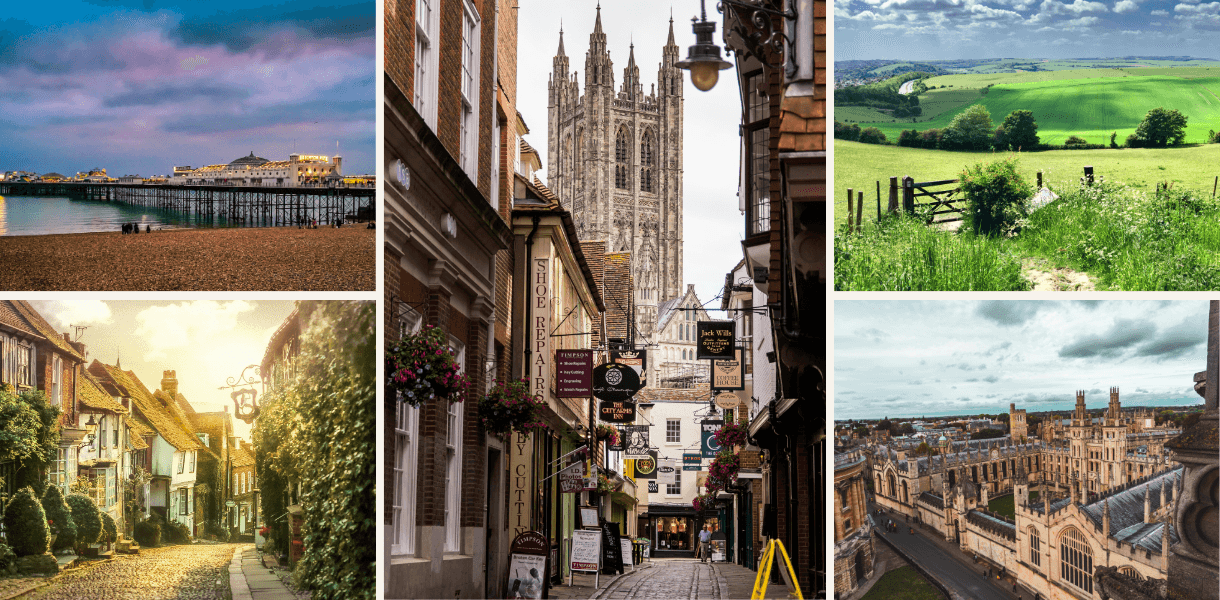
South East England has the slight disadvantage of seeming familiar before you have properly looked at it. People think of commuter belts, expensive villages and the road to somewhere else, which is a pity for a region that contains cathedral cities, ancient kingdoms, chalk hills, great houses, old ports, seaside resorts, literary landscapes, Roman remains and some of the most quietly beautiful stretches of coast and countryside in the country. Officially, the region includes counties and areas such as Kent, East and West Sussex, Surrey, Hampshire and the Isle of Wight, Oxfordshire, Buckinghamshire and Berkshire.
What makes the South East so rewarding is that it is not one thing. It can give you Oxford’s academic grandeur, Winchester’s old authority, Canterbury’s ecclesiastical weight, Brighton’s seaside flamboyance, the chalk drama of the Downs, the softer countryside of Surrey and Sussex, and coastal places that range from polished to weather-beaten in a pleasantly English way. This is a region that helped shape early England through places such as Kent and Wessex, and still carries that long history in its cities, roads, churches and landscapes.
Quick takeaways
- Best for
Historic cities, coastal breaks, chalk-down walking, castles, gardens and mixed short-break touring - Known for
Oxford, Canterbury, Winchester, Brighton, the South Downs, Kent coast, Isle of Wight and handsome old market towns - Don’t miss
Oxford, Canterbury, Winchester, one stretch of the South Downs, one stretch of coast in Kent or Sussex, and either the Isle of Wight or the Chilterns - Best base ideas
Oxford, Canterbury, Winchester, Brighton, Lewes, Chichester and Rye - Ideal trip length
Four to seven days for a first trip, longer if you want both cities and coast without treating the whole thing like a military exercise - Best time to visit
Late spring to early autumn for coast and countryside, though the historic cities work beautifully year round
The region at a glance
South East England is one of England’s official top-level regions and, on paper, includes a large and varied group of counties and unitary areas stretching around London but excluding it. The ONS groups the area into Berkshire, Buckinghamshire and Oxfordshire, Surrey, East and West Sussex, Hampshire and the Isle of Wight, and Kent.
From a visitor’s point of view, though, the region feels less like an administrative ring and more like a broad sweep of southern England held together by old importance, chalk landscapes and a long relationship with the sea. Kent and Canterbury carry some of the earliest Christian and Anglo-Saxon weight in England. Hampshire and Winchester reach back into Roman Britain and the kingdom of Wessex. Oxfordshire brings the country’s oldest university city, while Sussex gives you chalk downs and a coast that runs from old fishing settlements to Brighton’s theatrical seafront.
For visitors, this is a region that works especially well in layers. It can do a cathedral-city trip, a literary weekend, a coast-and-countryside break, a gardens-and-great-houses tour or a chalk-hills walking holiday. Its beauty is often more cultivated than wild, but no less rewarding for that. The South East is one of those regions that keeps reminding you how much of England’s long story happened here.
Why this region matters

Where early England took shape
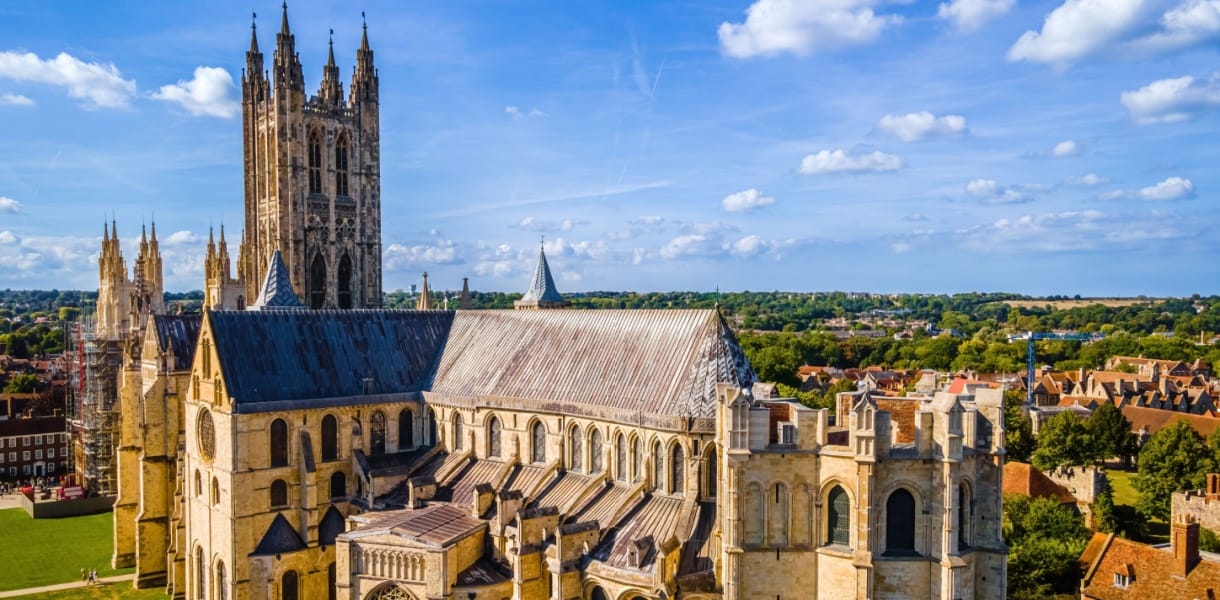
South East England matters because it contains some of the oldest centres of English political, religious and cultural life. Kent was one of the kingdoms of Anglo-Saxon England and was central both to early settlement and to the arrival of Christianity in 597, when Augustine’s mission was welcomed there. Canterbury became the primary ecclesiastical centre of England, and its cathedral has held that role since the early medieval period. This is not incidental historical decoration. It is part of the reason the South East still feels foundational.
Winchester and the memory of Wessex
Hampshire and Winchester carry similarly deep weight. Winchester was important in Roman times and later became the capital of the kingdom of Wessex, a centre of learning under Alfred the Great, and for a long period the most important city in England before London’s dominance was secure. When you walk through Winchester now, the place still has that old-capital authority about it, as though it has never entirely accepted demotion.
Oxford and the power of learning
Oxfordshire adds another kind of national importance. Oxford developed first as a Saxon settlement and defensive burh, then became home to the University of Oxford, the oldest university in England, whose colleges and courts have shaped not only the city but also the country’s intellectual and political life for centuries. Few places in Britain feel so completely formed by learning, ritual, architecture and habit.
Chalk, coast and changing fortunes
The region’s landscapes matter too, and not merely as scenery. The chalk downs of southern England run through parts of Hampshire, Sussex, Surrey and Kent, shaping routes, settlement and long views. The coast brought trade, defence, fishing, naval life and later the rise of the seaside resort. Sussex’s modern growth was strongly coastal, while Brighton itself grew from a small fishing settlement into a major resort under eighteenth- and nineteenth-century sea-bathing fashions and royal patronage.
What survives for visitors now is a region of unusual historical density. Roman remains, cathedral precincts, castles, old ports, college quads, Regency crescents, seaside piers, chalk escarpments, market towns and country estates all sit within a comparatively compact area. The South East matters because it shows how England’s church, monarchy, learning, landscape and leisure all helped shape one another. It is one of the places where the country still makes sense in the longest possible way.
What makes it special today
Historic cities with real authority
The South East is unusually strong on cities that still feel important in their bones. Oxford has that effortless academic grandeur that only centuries can provide. Canterbury carries ecclesiastical weight almost beyond competition. Winchester feels old in the most satisfying sense, with Roman and Saxon roots still shaping the place. Chichester, while smaller, adds another cathedral city to the line-up. These are not just places with one nice building and a few tea rooms. They are cities that have helped define England.
Coastlines with very different personalities
The coast here is more varied than people sometimes allow. Kent has old Channel-facing seriousness, with places shaped by ports, crossings and long historical exposure to the continent. Sussex shifts between chalk-cliff drama, old resort towns and the brighter performance of Brighton. The Isle of Wight adds its own separate rhythm, while Hampshire’s coast carries maritime and naval associations. This is not one continuous beach holiday region. It is a long sequence of different edges.
Chalk landscapes and slower beauty
The Downs are among the defining landscapes of southern England, running through parts of the South East in a long sequence of rounded chalk hills, scarps and valleys. They give the region much of its walking appeal and much of its sense of openness. This is not mountain scenery, and all the better for not trying to be. The beauty here comes from light, slope, grass, hedgerow, old paths and those long southern views that seem to go on thinking after you have stopped walking.
Seaside culture, elegance and oddity
Brighton alone would give the region a strong claim on England’s seaside imagination. Its rise from fishing settlement to fashionable resort under the influence of sea bathing and royal patronage is one of the country’s great reinventions. Elsewhere the South East has gentler coastal towns, older ports and quieter shorelines that feel more reflective than Brighton’s bright self-awareness. Together they make the region excellent for coastal breaks that are not all the same.
A region made for layered trips
One of the nicest things about the South East is that it suits more than one kind of visitor without losing its shape. You can come for literature, gardens, cathedral cities, stately homes, walking, seaside breaks, Roman history or old market towns and still feel you are travelling through one coherent part of England. That is a rare skill in a region this large, and it is what makes the South East so useful for repeat visits.
The different faces of the region
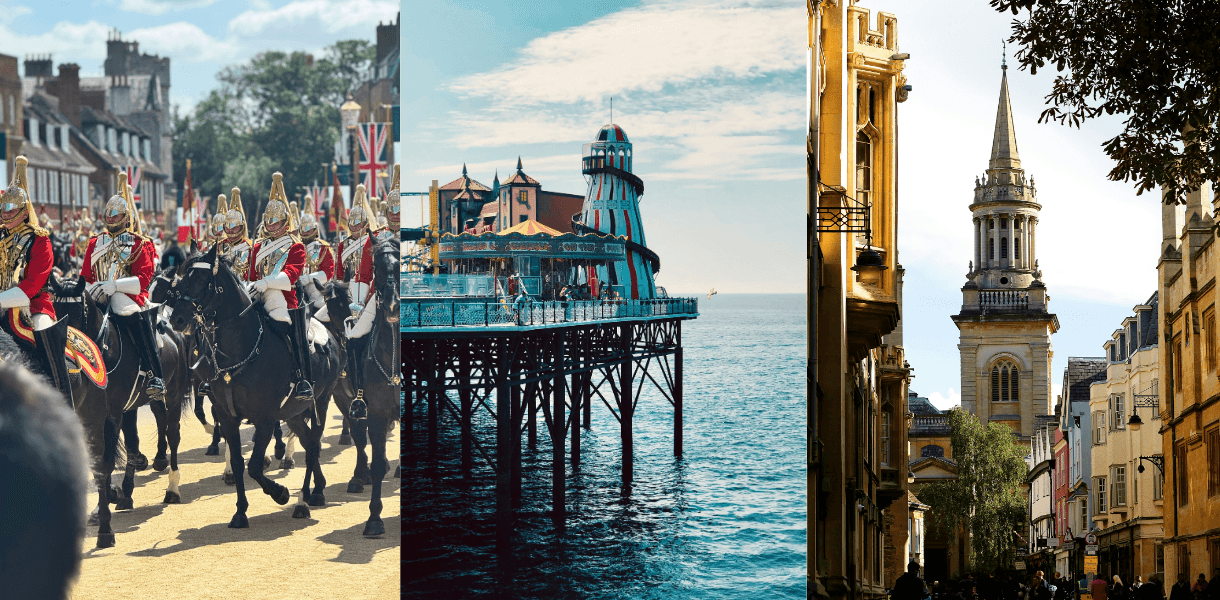
The South East works much better once you stop seeing it as everything south of London that is not London. It has several distinct moods, from cathedral city and old port to chalk downland, island coast, river town, university grandeur and wooded countryside.
Kent gives the region some of its deepest historical roots, with Canterbury, Dover, Rochester, Deal, Whitstable and Margate linking cathedral history, Roman and Anglo-Saxon layers, castles, old ports and a coast that has always looked both inland and across the water.
Hampshire and the Isle of Wight bring old Wessex authority, maritime history and island ease. Winchester, Portsmouth and Southampton anchor the mainland story, while Cowes, Ryde and Yarmouth add sailing, beaches, ferry crossings and a holiday mood that feels distinct from the rest of the region.
Sussex gives the South East chalk hills, beach towns and a strong old-county character. Brighton, Lewes, Chichester, Rye, Eastbourne and Arundel move the story from South Downs walking country to seaside energy, historic towns, castle views and stylish short breaks.
Oxfordshire, Buckinghamshire and the Thames-side west feel more collegiate, river-shaped and quietly prosperous. Oxford leads the way, but Henley-on-Thames, Marlow, Aylesbury and Woodstock add market towns, great houses, riverside wandering and gentler inland touring.
Surrey is the region in its greener, more polished register, with Guildford, Farnham, Dorking, Reigate and the Richmond-adjacent edges offering wooded hills, old villages, gardens, market towns and easy countryside escapes close to London.
Counties within South East England
Kent
Kent is one of the region’s great foundational counties, rich in early English history, cathedral prestige and coast. It is not called the Garden of England for nothing, though it also has rather more grit and old exposure than that phrase sometimes suggests.
- Key places
Canterbury, Dover, Deal, Whitstable, Rochester, Margate - Known for
Canterbury, castles, coast, early Christianity and continental-facing history - Standout attractions
Canterbury Cathedral, Dover area, old port towns, coastal walks - Best kind of visit
A historic-and-coastal touring break
Hampshire
Hampshire carries Wessex depth, cathedral-city stature and a long relationship with the sea. It is one of the strongest counties in the region if you want old authority mixed with maritime life.
- Key places
Winchester, Portsmouth, Southampton, Petersfield, Lymington - Known for
Winchester, Wessex history, coast and maritime identity - Standout attractions
Winchester Cathedral, historic Winchester, south coast bases, New Forest and chalk-country edges - Best kind of visit
A city-and-coast break with deep historical grounding
East and West Sussex
Sussex is now divided into East Sussex and West Sussex, but it still works best as one of the South East’s great all-round areas, with chalk landscapes, old towns, beach resorts, harbour settlements and market-town depth. East Sussex brings the drama of the South Downs, Rye, Lewes, Hastings and Brighton’s restless seaside energy, while West Sussex adds cathedral Chichester, Arundel, the Weald, genteel coastal towns and some of the region’s loveliest countryside. Its modern growth may have been strongly shaped by the coast, but Sussex’s appeal reaches far beyond the seafront.
- Key places
Brighton, Lewes, Rye, Chichester, Arundel, Eastbourne - Known for
Brighton, the South Downs, resort towns, castles and old Sussex towns - Standout attractions
Brighton seafront and Pavilion, chalk-cliff coast, Lewes, Arundel, Rye - Best kind of visit
A coast-and-countryside short break
Oxfordshire
Oxfordshire is the South East at its most academically self-assured. Oxford dominates, but the wider county adds river landscapes, estate country and deep historical texture.
- Key places
Oxford, Woodstock, Henley-on-Thames, Abingdon, Banbury - Known for
Oxford, university history, Thames landscapes and old towns - Standout attractions
Oxford colleges, historic centre, river settings, country-house country - Best kind of visit
A city-and-estate break with riverside extras
Buckinghamshire and Berkshire
Buckinghamshire and Berkshire give the region some of its quieter inland strength, with market towns, rolling countryside, Thames-side places and a generally well-kept air.
- Key places
Marlow, Aylesbury, Windsor-adjacent Berkshire areas, Henley-linked Thames country - Known for
River towns, market centres, greener inland touring - Standout attractions
Historic town centres, Thames-side wandering, estate and village country - Best kind of visit
A gentler inland touring break
Surrey
Surrey brings woodland, hills, old villages and polished market towns. It is one of the region’s best counties for a shorter countryside escape that still feels connected to the wider South East story.
- Key places
Guildford, Farnham, Dorking, Reigate - Known for
Green landscapes, old towns and easy-access countryside - Standout attractions
Historic town centres, downs country, gardens and walking routes - Best kind of visit
A compact countryside-and-market-town break
Cities and towns to know
Cities worth knowing
Oxford
One of England’s great cities, and still worth the cliché risk. It is not only beautiful. It also feels purposeful, ritualised and intellectually overqualified in a way that somehow improves the place.
Canterbury
A city of exceptional ecclesiastical importance and one of the clearest ways to understand how early Christian England took shape.
Winchester
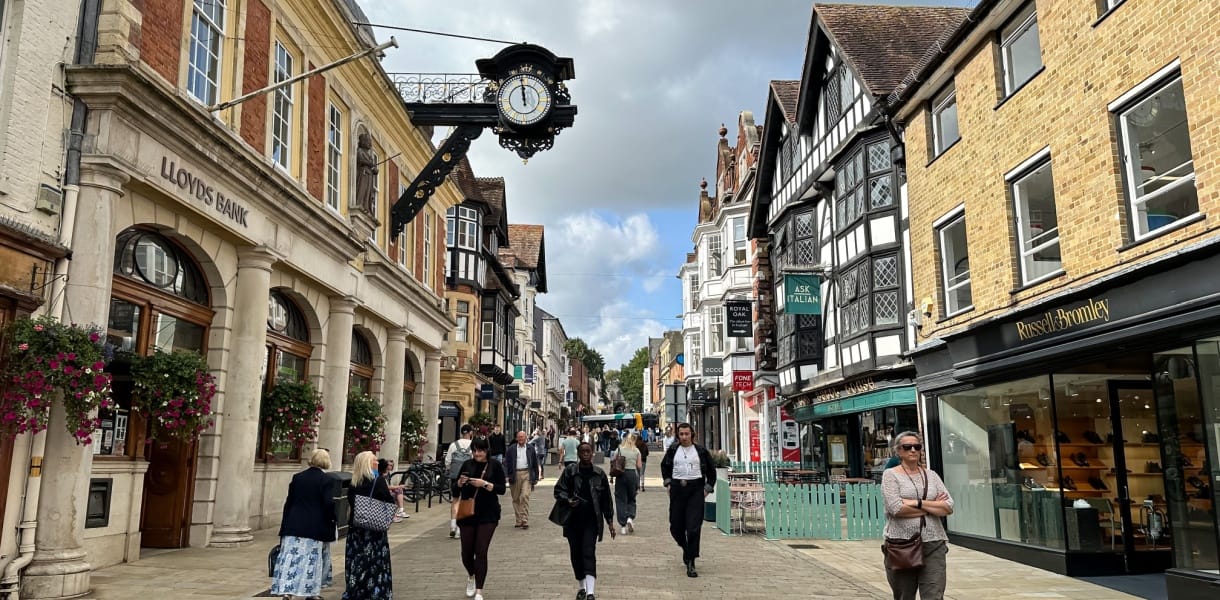
Old-capital England at its most persuasive, with Roman roots, Wessex authority and a cathedral that does not need to raise its voice.
Brighton and Hove
The region’s brightest urban personality, where seaside history, Regency confidence and modern city energy all meet on the coast.
Chichester
Smaller and quieter than the headline names, but full of cathedral-city charm and a very good South Downs position.
Towns with particular character
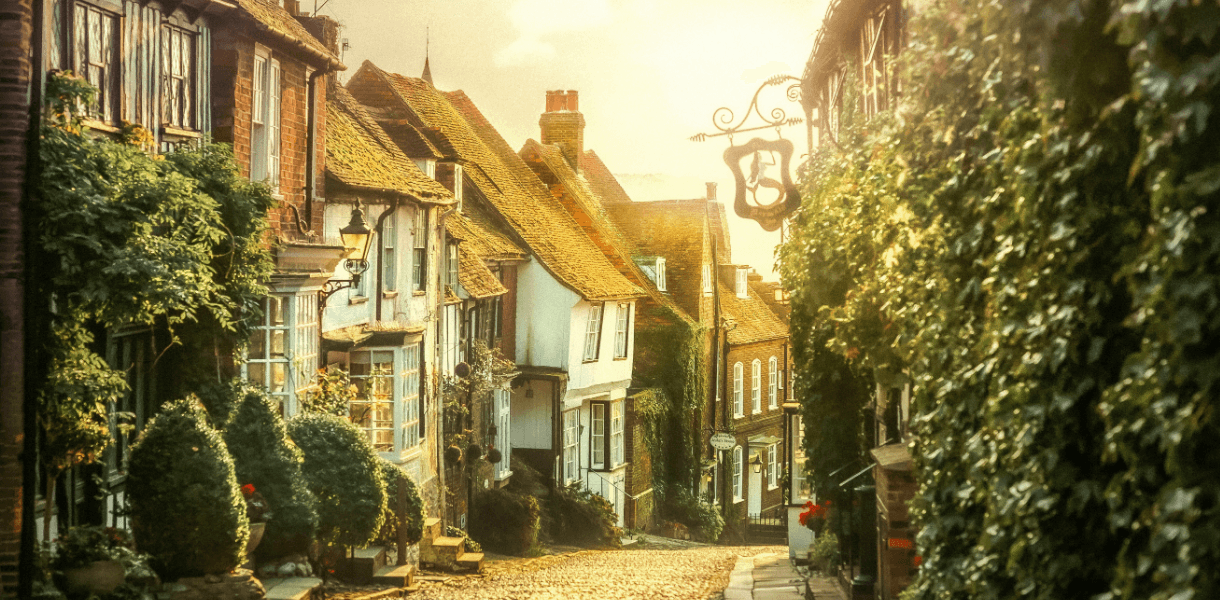
Rye
One of the South East’s most atmospheric towns, all old streets, sea-history echoes and pleasing self-possession.
Lewes
A proper Sussex town, well-shaped and well-situated, with enough history and hills nearby to keep things interesting.
Whitstable
A coast town with character, food appeal and enough working-town memory to stop it becoming too polished.
Arundel
A handsome town with a castle, cathedral and the useful habit of looking extremely well-composed from most angles.
Henley-on-Thames
A river town with more poise than urgency, excellent for a slower inland South East mood.
Major tourist attractions
Cathedrals, castles and historic buildings
Canterbury Cathedral, Kent
One of the most important religious buildings in England and the historic ecclesiastical centre of the country.
Winchester Cathedral, Hampshire
A defining landmark of one of England’s most historically important cities.
Oxford’s colleges and historic core
A whole urban ensemble rather than one single sight, and all the stronger for it.
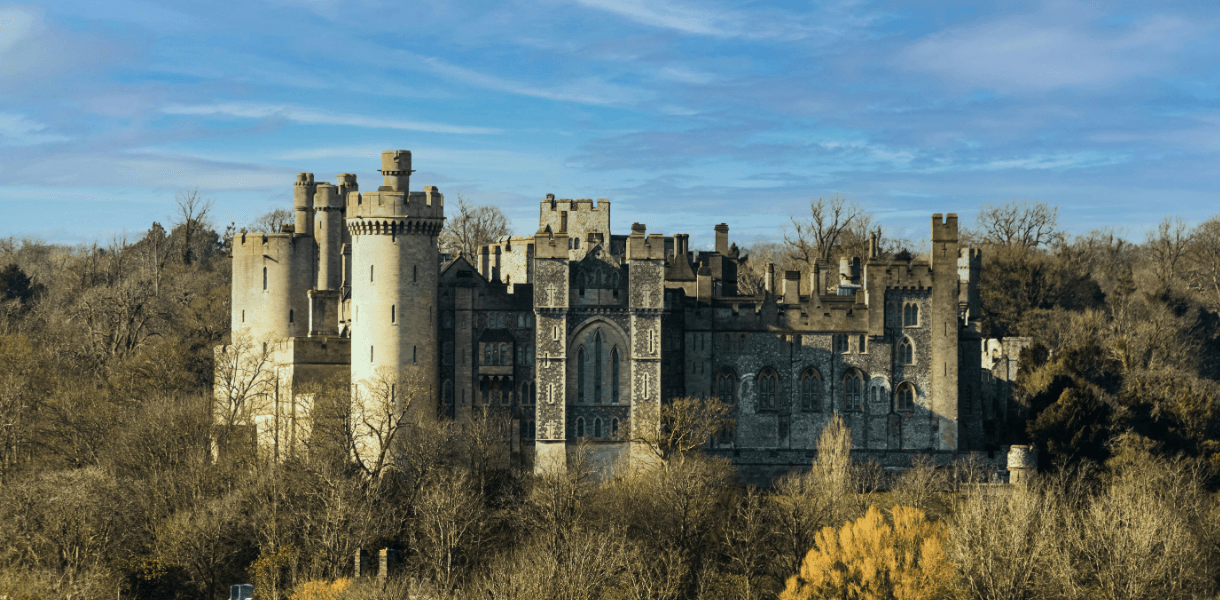
Arundel Castle and townscape
One of the South East’s strongest combinations of castle drama and town character.
Seaside and cultural highlights
Brighton seafront and Royal Pavilion
A classic South East combination of resort history, spectacle and urban confidence.
Eastbourne and Beachy Head side of Sussex
A strong meeting of resort-town history and chalk-coast drama.
Landscapes and scenic highlights
The South Downs
One of the defining landscapes of southern England, with chalk hills, scarps, old paths and long views.
Kent coast and channel edge
A coastline full of crossings, fortifications, old ports and sea-facing history.
The Isle of Wight
A distinct island chapter in the region’s story, excellent for a slower mixed coast-and-landscape break.
Family favourites
Brighton and Hove
An easy family urban-seaside option with enough going on to keep different age groups occupied.
Oxford riverside and museum days
A strong city choice if the trip needs both beauty and practical rainy-day options.
South coast beach towns
Useful for classic family days without needing to commit to one giant resort mood.
How to plan a trip here
How long to stay
A long weekend works very well if you focus on one strand of the region, such as Oxford and Oxfordshire, Canterbury and Kent, or Sussex coast and Downs country. For a broader first trip, four to seven days is much better. The South East improves considerably when you allow time for both the big historic names and the quieter landscapes in between.
Best bases
Oxford, Canterbury and Winchester are the strongest historic city bases. Brighton works well if you want coast and city energy together. Lewes and Chichester are excellent for Sussex-focused breaks. Rye suits a more atmospheric east-Sussex-and-Kent edge trip.
Car or public transport
You can do many of the headline cities and towns well by rail, especially Oxford, Canterbury, Winchester and Brighton. A car becomes more useful once you want chalk-hill walking, smaller coastal towns, old villages, gardens and the quieter bits of the region that do not always believe in direct routes.
Best first-time route through the region
A very strong first trip would be Oxford, Winchester and Sussex or Kent coast. That gives you academic grandeur, old-capital history and a proper taste of the South East’s coastal and landscape character. Another excellent version is Canterbury, Rye and the Sussex coast, with Brighton or Lewes added for contrast.
Best time to visit
Late spring and early autumn are especially good, when the countryside has colour, the coast is attractive and the historic cities feel busy without quite becoming hard work. Summer is excellent for the seaside and Downs walking, though obvious hotspots get crowded. Winter suits Oxford, Winchester and Canterbury extremely well.
Who this region suits best
It suits visitors who like history, coast, gardens, chalk-hill walking, old towns and trips that move easily between cultured and scenic. It is especially good for people who want deep English history without giving up short-break comfort.
Best ways to experience the region
Best for a first visit
Combine one great historic city with one coast-and-countryside base. Oxford and Sussex works very well. So does Canterbury and the Kent coast.
Best for history lovers
Focus on Canterbury, Winchester, Oxford and one or two castles or cathedral cities. Few regions offer early Christian, Saxon, medieval and university history in such a tight area.
Best for coast and scenery
Spend most of your time in Sussex, Kent or on the Isle of Wight, with at least one day in the Downs. The South East is at its best when coast and chalk country are allowed to speak to each other.
Best for a long weekend
Choose one of these and stay loyal to it
Oxford and Oxfordshire
Canterbury and Kent
Brighton, Lewes and the Sussex coast
Best for a week-long tour
Use two bases, usually one city and one coastal or countryside base. Oxford and Rye is strong. Winchester and Sussex also works beautifully.
Best for city and countryside balance
Oxford and the Thames-side west, Winchester and Hampshire downs, or Canterbury and east Kent all make very strong pairings.
Final verdict
South East England has the great advantage of being both deeply important and surprisingly easy to underestimate. It can give you some of England’s most historically significant cities, some of its most characteristic southern landscapes, coastlines with real variety, and a whole series of old towns and villages that seem to have understood proportion rather well. It does not need London to make its case. In many ways, it becomes easier to appreciate once London is removed from the frame.
What makes the region memorable, though, is its range of old authority. This is where kingdoms, cathedrals, colleges, chalk hills, ports and seaside reinventions all ended up living alongside one another. It is a region for visitors who like their England layered, legible and still quietly full of surprises. For that sort of traveller, the South East is not just convenient. It is one of the country’s richest regional journeys.