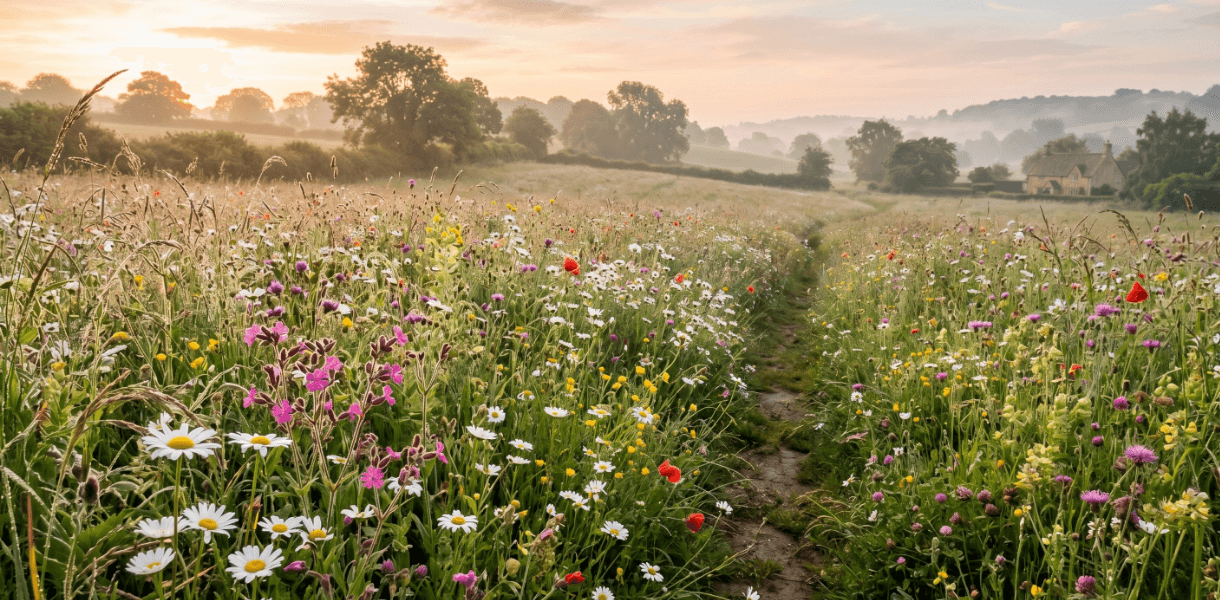
There are few more satisfying signs of an English summer than a meadow getting gloriously on with the business of flowering. Grasses soften in the breeze, butterflies drift about with no apparent plan, and the whole place hums like a small, cheerful engine. These are 10 of the best places in England to see summer wildflower meadows, chosen for flower-rich landscapes, visitor appeal, and the simple pleasure of going somewhere that feels wonderfully alive in June and July. The Wildlife Trusts note that hay meadows are generally at their best in June and July, before the hay cut, when flowers and pollinators are at their richest.
Quick takeaways
Best for classic hay meadow splendour
North Meadow, Clattinger Farm, Kingcombe Meadows
Best for flowers with dramatic scenery
West Pentire, Peak District meadows, Hannah’s Meadow
Best no-car options
North Meadow, Frogmore Meadows, Peak District meadows
Best for a first wildflower meadow day out
North Meadow, Kingcombe Meadows, West Pentire
Why summer meadows are such a joy
A proper summer meadow has a pleasing lack of self-importance about it. It does not need a castle, a cliff railway, or a cathedral close to impress you. It simply gets on with being full of colour, movement and life. In England, the best surviving meadows are often precious fragments of an older farming landscape, and that scarcity only makes them feel more special. Catch one at the right moment, ideally on a dry day in late June or early July, and even a modest field can seem to have outperformed half the country’s grander attractions. The Wildlife Trusts also ask visitors to keep to field-edge paths so plants and wildlife are not trampled.
1. North Meadow, Cricklade, Wiltshire
North Meadow is one of those places that meadow enthusiasts mention in tones normally reserved for cathedrals and Test batting averages. Natural England describes it as one of the finest examples of lowland hay meadow in Europe, and it earns that reputation handsomely. Summer brings a rich mix of flowers including great burnet, common knapweed, meadow buttercup, ox-eye daisy, yellow rattle, meadow rue and meadowsweet.
What makes it so satisfying is not just the number of flowers, but the feeling that you are seeing something genuinely rare and important rather than a field that happens to be having a good week.
- Getting here
Cricklade is reachable by bus, and the meadow is about a 15 minute walk from the town centre. [map] - Best time to go
Late June into July for the main summer meadow display. - Facilities
Use Cricklade for cafes, parking and other essentials. - Don’t miss
The sense that this is a surviving piece of ancient rural England rather than a modern recreation.
2. Kingcombe Meadows, Dorset
Kingcombe in Dorset is meadow country as many people secretly hope England still looks. Highlights include bee orchid, southern marsh orchid, sneezewort, devil’s-bit scabious, harebell and tormentil, along with summer butterflies such as marbled white, meadow brown and ringlet. One of its meadows, Lady’s Mead, is part of the Coronation Meadows project.
The charm here lies in the whole setting. It is not simply one flower-packed field, but a lovely patchwork of meadows, hedges, streams and soft rural contours that make you feel immediately calmer and slightly more virtuous.
- Getting here
Best by car. Lower Kingcombe, Toller Porcorum, Dorset DT2 0EQ [map] - Best time to go
June and July. - Facilities
Check Dorset Wildlife Trust visitor information before travelling. - Don’t miss
The butterfly-rich meadows and the broader pastoral landscape around them.
3. Clattinger Farm, Lower Moor, Wiltshire
If North Meadow is the star name, Clattinger Farm in Wiltshire is the meadow connoisseur’s choice. Described as the finest remaining example of enclosed lowland grassland in the UK and notes that it is internationally important for hay meadow flora. It is also one of only two floodplain meadows in the UK where the burnt-tip orchid occurs.
This is the sort of place that rewards people who enjoy flowers at close quarters and derive unusual levels of pleasure from hearing that a field is botanically exceptional.
- Getting here
Best by car, or by combining rail with taxi. Oaksey, Nr Cricklade, Wilts, SN16 9TW [map] - Best time to go
June into early July before hay cutting. - Facilities
Limited on site, so plan ahead. - Don’t miss
The richness of the grassland and the chance to see one of England’s finest traditional meadows.
4. West Pentire, Cornwall
This is not the quiet scholar of the meadow world. This is the show-off. The fields at West Pentire, between Holywell Bay and Crantock Beach in Cornwall, burst into red poppies and yellow corn marigolds in early summer.
What makes it memorable is the contrast between the flowers and the setting. You get vivid colour, sea air, cliff views and the sort of broad Atlantic light that makes everything look faintly cinematic.
- Getting here
Manageable from Newquay by local transport plus walking. [map] - Best time to go
Early summer, especially June. - Facilities
Use nearby coastal villages and beaches for refreshments and basics. - Don’t miss
The view of flower-filled fields with the Cornish coast beyond.
5. Peak District hay meadows, Derbyshire
The Peak District has a useful talent for making almost everything look better by adding stone walls, folded hills and excellent views. The National Park highlights meadows around Bakewell, Hard Rake and Stanage-North Lees, with species including ox-eye daisy, knapweed, hay rattle, meadow vetchling, common spotted orchids and field scabious. It also says that June and the first half of July are especially good.
This is a wonderful choice for people who want the meadow experience without sacrificing big scenery.
- Getting here
One of the best no-car choices. The Peak District National Park notes an extensive public transport network with regular train and bus links to popular areas. - Best time to go
June and early July. - Facilities
Good in nearby towns and villages such as Bakewell. - Don’t miss
The combination of flower-rich grassland and classic limestone scenery.
6. Frogmore Meadows, Hertfordshire
Frogmore Meadows is proof that a summer wildflower day out does not have to involve heroic logistics. Herts and Middlesex Wildlife Trust says the reserve is best visited from April to August, with summer flowers including meadowsweet, lady’s bedstraw, southern marsh orchid and heath spotted orchid. Access is via the Chess Valley Walk.
It feels pleasantly tucked away, the sort of place that makes you wonder why you do not do this sort of thing more often.
- Getting here
A strong train-and-walk option for London and the south-east. Frogmore Meadows, Chenies, Hertfordshire, WD3 6ER [map] - Best time to go
June and July for peak summer meadow colour. - Facilities
Limited on the reserve, so bring what you need. - Don’t miss
The combination of meadow flowers and chalk stream valley walking.
7. Chimney Meadows, Oxfordshire
Chimney Meadows is less neat and decorative than some of the others, and all the better for it. Renowned as the largest nature reserve in Oxfordshire and one of the most charismatic wildflower meadow sites, as well as part of the Coronation Meadows project.
This is a place for big skies, floodplain character and the satisfying feeling that you have stepped into an older, slower landscape.
- Getting here
Best by car, though possible with planning from nearby rail points. [map] - Best time to go
June and July. - Facilities
Minimal, so come prepared. - Don’t miss
The broader floodplain atmosphere rather than just one single flower-rich patch.
8. Hannah’s Meadow, County Durham
Hannah’s Meadow in County Durham has a more rugged, northern air than the softer southern sites. Durham Wildlife Trust describes it as species-rich upland hay meadow and grazing pasture, and it is part of the Coronation Meadows network.
This is a lovely option if you prefer your meadows with a bit of weather, a bit of solitude, and the sense that the landscape has been shaped by long farming tradition rather than visitor convenience.
- Getting here
Best by car. Hannah’s Meadow Nature Reserve, Hunderthwaite, DL12 9UX [map] - Best time to go
Summer, especially June and July. - Facilities
Very limited, so plan ahead. - Don’t miss
The upland setting and the wilder feel of the surrounding countryside.
9. South Close Field, Northumberland
South Close Field in Northumberland is one of those quieter meadow sites that feels all the better for not being endlessly talked about. Northumberland Wildlife Trust describes it as one of the best lowland meadows in the region, and says it is especially good from April to July and valuable for butterflies as well as flowers. Access is by permit.
It is not the easiest place to pop into on a whim, but that slight effort only adds to the sense that you are visiting somewhere special.
- Getting here
Best by car and best planned in advance due to permit access, see NWT website for details. - Best time to go
June and early July for a classic summer visit. - Facilities
None to speak of on site. - Don’t miss
The butterflies and the quieter, more local feel.
10. Lower Moor reserve, Wiltshire
Lower Moor earns its place because it offers a fuller wildlife day rather than a single meadow stop. Wiltshire Wildlife Trust’s reserve information notes its mix of lakes, wetlands and grassland, including the celebrated Clattinger Farm meadows within the wider site.
This is the kind of place that suits a slow summer wander, where the meadows are the headline act but not the only pleasure.
- Getting here
Best by car. Somerford Keynes Rd, Oaksey, Wiltshire, SN16 9TW [map] - Best time to go
June and July for peak meadow interest. - Facilities
Limited, so check reserve information before visiting. - Don’t miss
The variety of habitats and the chance to make a fuller nature day of it.
The best no-car meadow trips in England
For a car-free summer meadow outing, three stand out most clearly.
North Meadow, Cricklade is one of the handiest, with the reserve within walking distance of town.
Frogmore Meadows works especially well for London and south-east visitors who want a train-and-walk day out.
Peak District meadows are probably the strongest choice if you want the biggest mix of good transport, strong scenery and flower-rich walking.
Final verdict
If you want the grand old names, start with North Meadow and Clattinger Farm. If you want atmosphere and soft English beauty, go to Kingcombe Meadows. If you want flowers with a dramatic flourish, West Pentire is hard to beat. And if you like the idea of meadows but would also quite enjoy handsome hills, good walking and the possibility of a decent lunch afterwards, the Peak District may be the sweet spot. All of them make a strong case for the English summer being at its best not on a beach, not in a beer garden, but in a field that has decided to bloom as extravagantly as possible.