The Scottish Highlands are not a place to rush, which is fortunate, because rushing here would be both foolish and faintly rude. This is a landscape that has taken several million years to get itself arranged and does not particularly care about your lunch booking.
Here, roads uncoil around lochs, mountains appear with theatrical indifference, and villages seem to exist in a quieter agreement with the weather. The Highlands are not about ticking things off. They are about slowing down until the place begins to make sense.
Quick takeaways
Best for
Slow travel, road trips, walking, wildlife, lochs, mountain scenery, islands and big quiet
Best bases
Inverness, Fort William, Ullapool, Aviemore, Plockton, Torridon, Oban, Portree
Best time to visit
May, June, September and early October
How long to stay
At least 5 days, ideally 10 to 14
Best first trip
Inverness, Loch Ness, the Black Isle, Glen Affric and the west coast around Torridon or Applecross
Do not miss
Glen Coe, Glen Affric, Wester Ross, the Cairngorms, the Road to the Isles and the west coast sea lochs
Why the Highlands suit slow travel so well
The Highlands are often sold as a grand adventure, and they certainly can be. There are ridges, passes, empty beaches, ferry crossings and roads that make you sit a little more upright at the wheel. But their real gift is not drama. It is space.
This is one of the few parts of Britain where distance still feels meaningful. A village ten miles away may involve a single-track road, a sheep consultation, two lochside pauses and an unexpected emotional moment caused by light falling on a hill. Nothing is quite as quick as the map suggests, and this is precisely the point.
Slow travel works here because the Highlands reward attention. A second morning in the same place is not repetition. It is a different place entirely. The weather has moved. The water has changed colour. A stag has appeared where yesterday there was only bracken. The mountain that looked stern at dusk now looks faintly benevolent, as if it has had a decent breakfast.
A landscape that refuses to be ordinary
The Highlands are not one landscape, but a whole committee of them. There are the great inland glens, broad and ancient, where rivers wander beneath hills with the unhurried confidence of things that have seen off several empires. There are sea lochs, long and silver, pushing deep into the land as though the Atlantic could not bear to stop at the coast.
Then there are the mountains. Some rise in dark, sudden walls. Others sit back, broad-shouldered and remote, like old gods who have decided against conversation. In Glen Coe the drama is immediate and almost operatic. In Assynt it becomes stranger and more elemental, with isolated peaks standing above a landscape of lochans, bog, rock and sky. In the Cairngorms, the scale is different again, vast, open and quietly severe.
It is easy to understand why people try to photograph the Highlands constantly. It is harder to understand why they think one photograph will do.
The pleasure of going slowly
A rushed Highland itinerary quickly becomes absurd. You can, technically, attempt to see Inverness, Skye, Glen Coe, Loch Ness, the Cairngorms and the North Coast in a few days. You can also technically eat soup with a fork. Neither is recommended.
The better approach is to choose a corner and let it unfold. Stay three nights where you might otherwise stay one. Give yourself a day with no heroic plan. Follow a minor road because it looks interesting. Stop in a village shop. Sit by a harbour. Walk only part of a trail and feel no guilt whatsoever.
The Highlands are full of small rewards. A coffee van in a layby with a view that would make a landscape painter weep. A tiny ferry crossing that feels like an event. A bookshop in a town where the rain makes perfect sense. A beach reached after a walk through dunes and sheep-nibbled machair. A pub where everyone seems to know the weather personally.
The west coast and the art of lingering
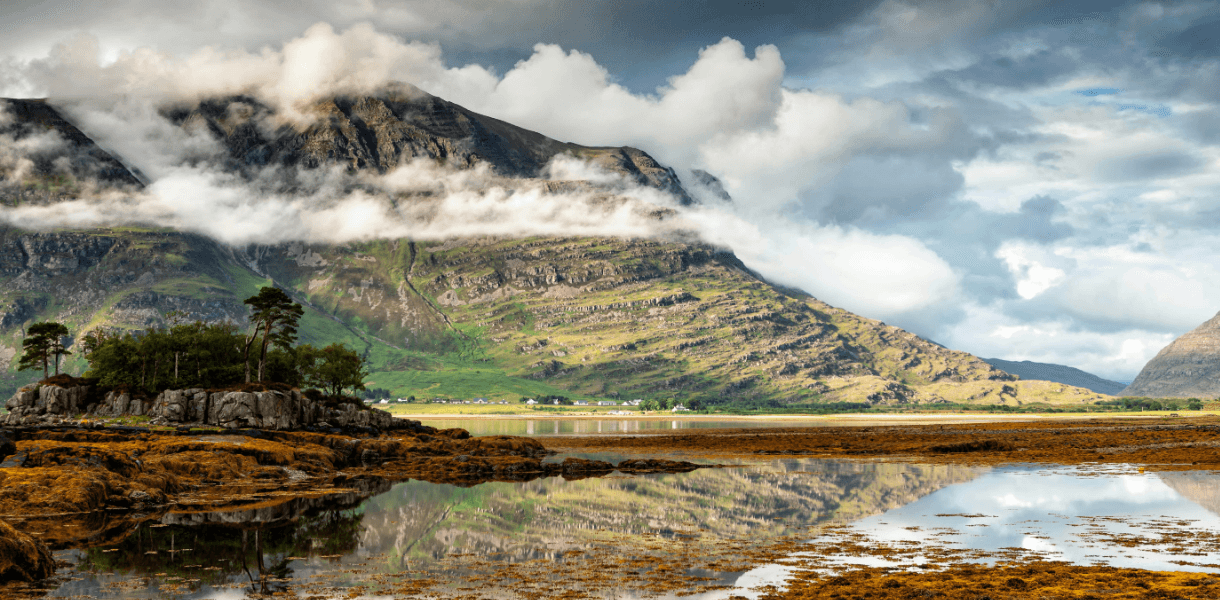
The west coast is where the Highlands become most lyrical. Around Torridon, Applecross, Ullapool and Gairloch, the land and sea fold into one another in ways that feel almost excessive. Roads bend around bays. Islands hover on the horizon. Mountains descend towards the water with great dark confidence.
This is slow travel country of the highest order. Not because there is nothing to do, but because there is too much to absorb at speed. One day might be a walk above a sea loch. Another might be a drive over Bealach na Bà, taken carefully, reverently and preferably without meeting a campervan at a philosophical moment. Another might involve nothing more strenuous than sitting near a harbour and watching weather happen.
The west coast teaches you that a good view does not have to be consumed. It can simply be kept company.
Inverness and the gentle gateway north
Inverness is often treated as a starting point, which is fair enough, but slightly unfair. It is a useful, likeable city with the River Ness running through it, good places to eat, and enough calm confidence to make arrival feel easy.
From here, the Highlands open in several directions. Loch Ness lies to the south-west, famous enough to attract a certain amount of monster-based nonsense, but still beautiful when approached with patience. The Black Isle sits just to the north, with villages, dolphins, beaches and a softer, more domestic Highland character. Glen Affric, one of Scotland’s loveliest glens, is close enough for a day trip yet feels properly removed from the ordinary world.
Inverness works especially well for first-time Highland visitors because it gives you options without demanding instant commitment. You can ease into the region rather than hurling yourself at it with a rucksack and a grim expression.
The Cairngorms and the spacious interior
The Cairngorms are not the Highlands of postcard drama. They are wider, colder in mood, more elemental. Around Aviemore, Braemar, Kingussie and Grantown-on-Spey, the landscape opens into forests, moors, rivers and high plateaus.
This is a wonderful region for slow travel because it offers both activity and stillness. You can walk among ancient pines, follow rivers, visit castles, look for wildlife, or take low-level routes with vast views. You can also sit in a café after a damp walk and feel that civilisation has rarely been better arranged.
The Cairngorms are especially good for visitors who want the Highlands without constantly being on the move. Choose a base, settle in, and let the days become shaped by weather, paths, light and appetite.
Glen Coe and the danger of arriving too quickly
Glen Coe is one of the great landscapes of Britain, which means it is sometimes loved a little too energetically. People drive through, gasp, stop briefly, take a photograph, and leave before the place has properly introduced itself.
Stay nearby if you can. See it early, late, in cloud, in rain, in that sudden clear light that makes the whole glen seem carved from shadow and silver. Walk into the smaller side valleys. Learn the shape of the hills. Let the history settle too, because Glen Coe is not just scenic. It carries memory.
The strange thing about famous places is that they often become quieter when you give them more time. Glen Coe is no exception. The hurried version is impressive. The slower version stays with you.
How to plan a slow Highland trip
The secret is not to cover too much ground. Pick one or two areas and build the trip around them.
For a first visit, combine Inverness and the central Highlands with Wester Ross or the Cairngorms. For a coast-led trip, base yourself around Ullapool, Gairloch, Torridon or Plockton. For mountains and classic drama, look at Fort William, Glen Coe and the Road to the Isles. For forests, rivers and gentler adventure, choose Aviemore or Speyside.
Try to stay at least two nights in each base. Three is better. Four begins to feel wise. The Highlands are not improved by constant repacking.
Getting around
A car gives the most flexibility, especially for the west coast, remote glens and small villages. But the Highlands are not entirely car-dependent. The train lines to Inverness, Fort William, Kyle of Lochalsh and Mallaig are among the most scenic in Britain, and buses can work well on certain routes if you plan carefully.
The train to Mallaig deserves special mention. It crosses the Glenfinnan Viaduct, passes lochs, hills and coast, and does the rare thing of making the journey feel like the main event rather than a prelude.
For a slow travel trip, consider mixing rail and longer stays. Take the train north, base yourself in one place, then explore locally by foot, ferry, bus, bike or occasional tour. It will not suit every itinerary, but when it works, it feels beautifully freeing.
Best ways to experience the Highlands slowly
Walk, but do not turn every walk into a conquest. Some of the best Highland walks are modest ones. A forest circuit. A lochside path. A climb to a viewpoint. A wander from a village to a beach.
Drive, but stop often. The Highlands are full of laybys that appear to have been placed by poets.
Take ferries where possible. Even a short crossing changes the rhythm of a trip.
Eat locally, especially seafood on the west coast, venison, baking, whisky, cheese and anything served after a walk in weather.
Leave space in the plan. This is not laziness. It is good Highland technique.
When to go
May and June are superb, with long days, fresh colour and a feeling of the whole region opening up. September is perhaps even better for slow travel, with softer light, fewer crowds and a lovely edge of autumn. Early October can be glorious, though the weather begins to carry more opinions.
July and August bring long days and energy, but also more visitors, midges in some areas, and busier roads. Winter is beautiful, serious and not to be underestimated. It suits experienced travellers who are prepared for short days, limited services and difficult conditions.
Common mistakes to avoid
The first mistake is trying to see too much. The Highlands are large, and the roads are slower than they look.
The second is treating bad weather as failure. Weather is not an interruption here. It is part of the show. Pack properly and let the mood change.
The third is only chasing famous names. Skye, Glen Coe and Loch Ness have their place, but some of the richest Highland experiences happen in quieter glens, smaller villages and less celebrated stretches of coast.
The fourth is forgetting that local communities live here. Drive courteously, use passing places properly, book ahead where needed, support local businesses, and do not treat fragile landscapes as a backdrop for poor decisions.
Final verdict
The Scottish Highlands are one of Britain’s great slow travel regions because they resist being reduced to a checklist. They are too large, too layered, too weather-shaped and too quietly powerful for that.
Come for the mountains, lochs, roads and coast, by all means. They are magnificent. But stay for the pauses. The harbour at dusk. The empty morning road. The sound of wind through pine. The way a loch changes colour while you are looking at it. The small Highland village that makes you think, quite seriously, about reorganising your life.
The Highlands do not need you to rush. In fact, they are much better when you finally stop trying.