
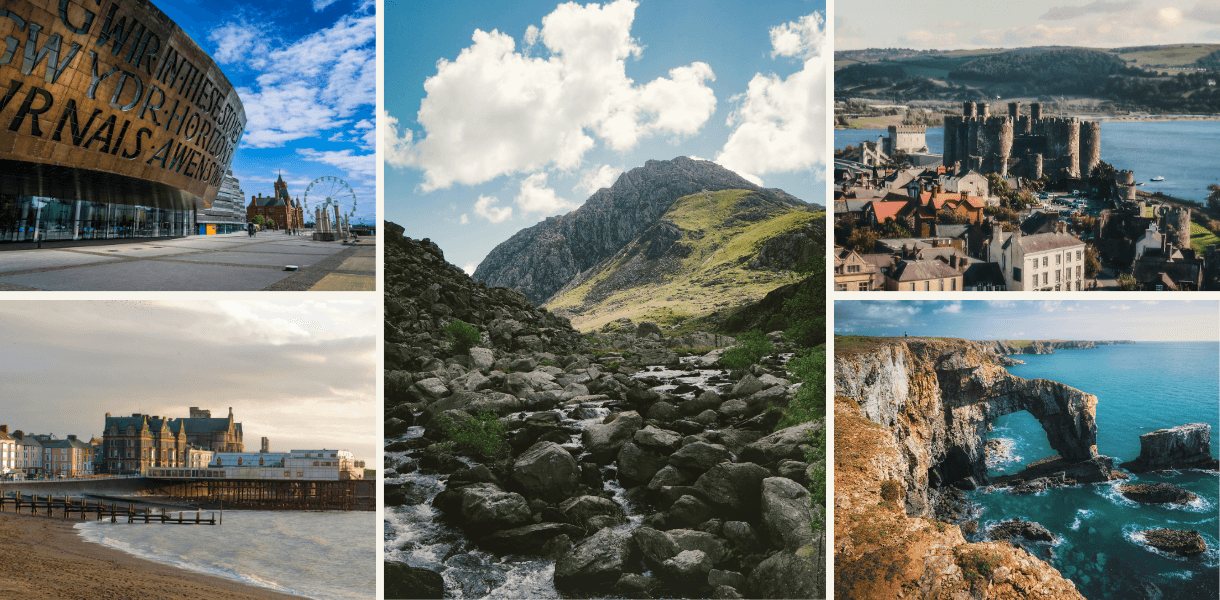
Wales is one of those countries that manages to feel both compact and enormous, depending on where you are standing. On the map it can look modest enough, tucked against England with a long western coastline and a shape that seems almost manageable. Then you arrive and find mountains, castles, chapel towns, estuaries, old industrial valleys, market towns, sea-facing villages, long roads through sheep country and enough regional variation to make any idea of a single Welsh mood collapse fairly quickly. It is a country of strong landscape, strong memory and strong local identity, and all three still matter.
What makes Wales so rewarding is that it does not merely offer scenery. It offers a distinct national character shaped by language, history, geography and a long habit of cultural persistence. You come for the mountains of Eryri, the Pembrokeshire coast, Cardiff, castles or a weekend by the sea, perhaps, and end up discovering a country whose real strength lies in the way its landscapes, towns and traditions still feel connected. Wales rewards visitors who slow down, cross regions rather than skimming them, and let the country reveal how different one part can feel from the next.
Quick takeaways
- Best for
Mountains, coast, castles, scenic road trips, walking, smaller cities, heritage and longer touring holidays - Known for
Eryri, Pembrokeshire, Cardiff, rugged coastlines, castles, old industrial valleys, strong cultural identity and beautiful small towns - Don’t miss
Cardiff, at least one stretch of north or west coast, a national park, a major castle and one smaller town for contrast - Best base ideas
Cardiff, Conwy, Llandudno, Aberystwyth, St Davids, Tenby and Brecon - Ideal trip length
A week for a strong first trip, longer if you want north, south and west without turning the whole holiday into a motorway apology - Best time to visit
Late spring to early autumn for scenic touring and walking, though cities, castles and cultural trips work well year round
The nation at a glance
A small country with many faces
Wales occupies the western side of Great Britain, bordered by England to the east and the Irish Sea, St George’s Channel and Bristol Channel on its other sides. From a visitor’s point of view, it is best understood not as a single sweep of mountain scenery but as a country of distinct regions held together by language, memory, landscape and a very settled sense of self. It is smaller than Scotland, yes, but no less regionally varied. North Wales does not feel like south Wales. The west coast does not feel like the border country. Cardiff does not feel like Gwynedd. That variety is one of the country’s great pleasures.
Mountains, coasts, cities and borderlands
Broadly speaking, Wales breaks down into several travel moods. North Wales brings mountain drama, castles, resort towns and some of the strongest scenery in Britain. Mid Wales offers space, quieter roads, reservoirs, market towns and a long, spacious central backbone. West Wales and Pembrokeshire give you harbours, beaches, estuaries, pilgrimage history and coastlines that can look improbably beautiful when the weather decides to behave. South Wales brings Cardiff, the Valleys, Swansea, industrial heritage and the shift from old coal country to coastal escape. Then there is the border country, where Welsh and English history have rubbed against one another for centuries and the landscape becomes softer, greener and full of marcher echoes.
Why Wales rewards a slower look
For visitors, Wales suits several kinds of trip at once. It can be a city-and-castle weekend, a coast-and-country road journey, a walking holiday, a heritage tour, a literary and cultural exploration, or a slow touring holiday built around smaller towns and scenic routes. The great mistake is to imagine it as one uninterrupted mountain backdrop populated entirely by ruined castles and sheep, though it does admittedly have very good examples of all three.
Why this country feels distinct
A country with its own voice
Wales feels distinct because it is distinct, historically, culturally and linguistically, and because that distinctiveness remains visible and audible in everyday life. This is not simply a scenic western appendage to England. It has its own national story, its own language tradition, its own patterns of settlement and industry, and a deeply rooted sense of identity that long predates modern tourism and has never depended on outside approval.
The living importance of the Welsh language
The Welsh language is central to that distinctiveness. Not every part of Wales speaks Welsh to the same degree, and the balance varies sharply from region to region, but the language remains one of the clearest ways the country announces itself as more than a picturesque corner of Britain. In the north and west especially, Welsh is not ornamental. It is lived. That matters for visitors, not because they are expected to become overnight linguists, but because it shapes place names, soundscapes, local culture and the feeling of being in a country whose identity rests on something older and deeper than branding.
Castles, princes and the long memory of conquest
Historically, Wales was shaped through a long story of competing kingdoms, regional loyalties, conquest, resistance and absorption. Medieval Wales was never one simple unified political block in the modern sense, but it was a place of rulers, courts, princely power and a strong native tradition. The later conquest by Edward I left one of the country’s most obvious legacies in the great castles of north Wales, which still dominate towns and estuaries with all the subtlety of an occupying force made of stone. Yet even conquest did not erase Welsh identity. It survived in language, law, poetry, religious life, local memory and later political and cultural revival.
Chapels, coalfields and working landscapes
Religion also shaped Wales strongly. Nonconformist chapel culture became a major force in Welsh life, particularly in the nineteenth century, leaving its mark on towns, villages and social values across large parts of the country. Visitors may not think immediately of chapels when planning a Welsh trip, but once you begin moving through the place, especially away from the biggest tourist centres, their presence becomes part of the country’s texture. Wales was also transformed by industry, perhaps more violently and dramatically than many outsiders realise. The south Wales coalfield, ironworks, copper, slate and associated industries turned parts of the country into some of the most important working landscapes in the world. Towns and valleys were reshaped by extraction, labour, migration and class politics on a huge scale.
Where beauty and history are tangled together
This matters because Wales is not only a country of mountain passes and castles. It is also a country of quarrying scars, pit communities, industrial ports, rail heritage and social memory. North Wales bears the imprint of slate. South Wales bears the imprint of coal and iron. Cardiff’s rise was closely bound to coal export and dockland expansion. Swansea and the west had their own industrial and maritime stories. So did many of the border and market towns, in quieter forms. What visitors experience now is not a neatly separated country of natural beauty on one side and history on the other. The two are tangled together.
Landscape has always shaped Welsh identity powerfully. Mountains, valleys, coasts, estuaries and a comparatively small number of east-west routes gave different regions their own feel and fostered strong local identities. The result is that Wales often feels regional from within and national from without, which is an unusually rewarding combination for travellers. You notice real internal contrasts. Cardiff’s broad civic confidence is not the same as Gwynedd’s more language-shaped identity. Pembrokeshire’s maritime softness is not the same as the dramatic mountain-and-castle country of the north. Mid Wales can feel almost meditative in its spaciousness compared with the historical density of the south.
Why Wales still feels unmistakably itself
Visitors still feel all this now. You feel it in bilingual signage, in the sound of Welsh in shops and streets, in castle towns that never stopped looking strategic, in mining museums and old industrial valleys, in pilgrimage sites and chapels, in roads that twist around terrain rather than disciplining it, and in the sheer persistence of local character. Wales feels distinct because it has had to keep asserting itself for centuries, and because it still does so not through theatrical display but through the ordinary reality of being Wales.
What makes it special today
Landscapes that change far more than outsiders expect
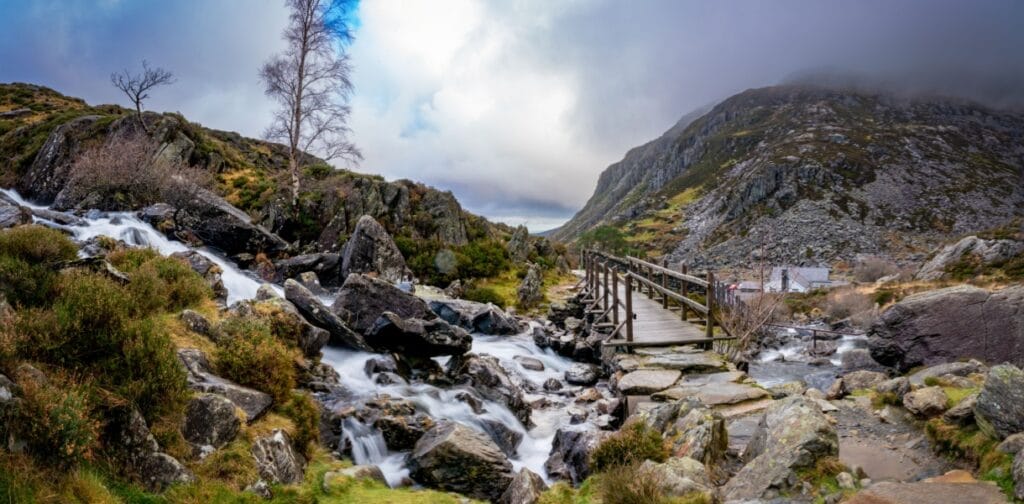
Wales has some of the strongest scenery in Britain, but its real triumph is variety. Eryri gives you mountain drama, ridgelines, lakes and stone-built towns with a proper sense of weather. Mid Wales offers broader, quieter country where roads run through moor, valley and reservoir landscapes with a kind of spacious calm. Pembrokeshire changes the whole mood with sea cliffs, beaches, estuaries and harbours. The Brecon Beacons, or Bannau Brycheiniog, add another register again, more open and rounded, but no less rewarding. The scenery is excellent. The better discovery is how different each part feels.
Castles and visible history everywhere
If Wales has a visual signature beyond mountains, it may well be castles. They rise above rivers, harbours, town centres, cliffs and estuaries with a frequency that begins to feel almost competitive. Some are princely. Some are conquest castles. Some are romantic ruins. Some are improbably intact. But castles are only part of the story. Wales also gives you abbeys, cathedral cities, industrial relics, old market towns, miners’ institutes, harbour quays and nonconformist chapels. It is a country where the past is not discreetly filed away. It remains on the skyline.
Coastlines with range and personality
The Welsh coast is one of the country’s great strengths because it refuses to settle into one mood. North Wales can be dramatic, resort-like or estuarial within a relatively short stretch. Cardigan Bay gives you broad beaches, wildlife and gentler western light. Pembrokeshire delivers some of the finest coastal scenery in the UK, with cliff paths, headlands, tiny coves and sea-facing towns. The south coast, around Swansea and the Gower, adds another blend of beach beauty and urban access. A visitor could build several completely different Welsh holidays around the coast alone.
Cities and towns that give the country shape
Cardiff matters enormously because it shows Wales as modern, civic, cultural and confident, not merely scenic. But Wales also has other urban and town-centred pleasures that help explain the country better. Swansea brings coast and city together. St Davids is tiny but nationally resonant. Wrexham, Bangor and Newport all tell different stories. Then there are towns such as Conwy, Tenby, Aberystwyth, Crickhowell, Monmouth and Machynlleth, each of which adds something distinct to the sense of Welsh place. Wales is not only a landscape destination interrupted by services. Its towns and cities are central to its character.
Cultural identity that still feels lived
One of the nicest things about travelling in Wales is that its culture does not generally feel staged for outsiders. The language, music, rugby loyalties, local food, chapel legacies, festival life and regional distinctions all feel lived rather than arranged. This is particularly noticeable in places where Welsh remains strong, but it is present more broadly too. Wales has a strong sense of itself without needing to shout. For visitors, that gives the country a depth and coherence that can linger long after the specific views have blurred together.
The different parts of Wales
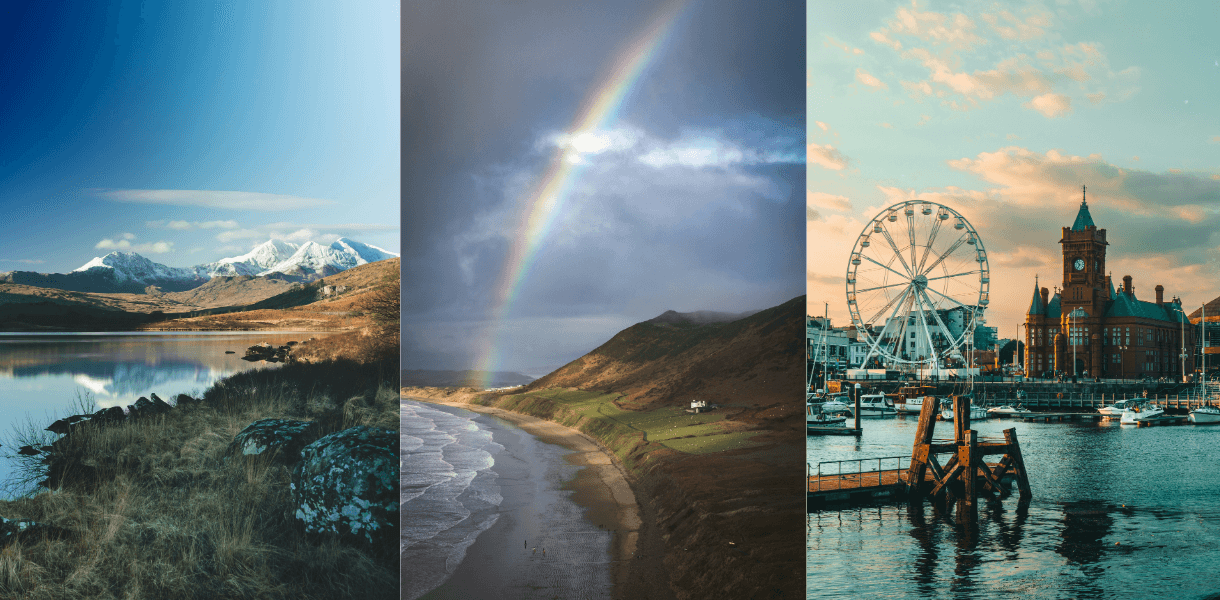
Wales makes most sense once you stop thinking of it as one mountain-backed sweep and start seeing the distinct regions that give it structure.
North Wales
North Wales is the country at its most dramatically mountainous and castle-heavy. Eryri, Conwy, Caernarfon, Llandudno and the north coast together create one of the strongest first-time visitor regions in Britain.
Key places
Conwy, Caernarfon, Llandudno, Betws-y-Coed, Bangor, Harlech
Best for
Mountains, castles, scenic driving, first visits and dramatic coast-and-country contrast
Mid Wales
Mid Wales is often the quieter revelation. It offers space, reservoirs, market towns, long roads, sheep country and a slower, less crowded version of Welsh beauty.
Key places
Aberystwyth, Machynlleth, Rhayader, Welshpool, Newtown
Best for
Scenic touring, quiet road trips, slower travel and repeat visits
West Wales and Pembrokeshire
This is one of the country’s loveliest travel zones, all coast paths, small harbours, beaches, estuaries and sea-facing towns, with St Davids and Pembrokeshire giving it real historical and visual heft.
Key places
Tenby, St Davids, Fishguard, Cardigan, Newport, Pembroke
Best for
Coastal holidays, walking, smaller towns and longer scenic breaks
South Wales and the Valleys
South Wales combines the national capital with one of Britain’s most important industrial landscapes. Cardiff, Swansea, the Valleys and the old coalfield towns give the country much of its modern social and political story.
Key places
Cardiff, Swansea, Merthyr Tydfil, Pontypridd, Caerphilly
Best for
Cities, industrial heritage, castles, coast and understanding modern Wales
The border country and south-east hills
This part of Wales gives you market towns, marcher echoes, gentler landscapes and useful access to the Brecon Beacons and Wye Valley side of things. It is less obviously famous than other parts of the country, which is often part of the appeal.
Key places
Monmouth, Abergavenny, Hay-on-Wye, Brecon, Crickhowell
Best for
Market towns, books, food, walking and slower scenic touring
Cities and towns to know
Cities worth knowing
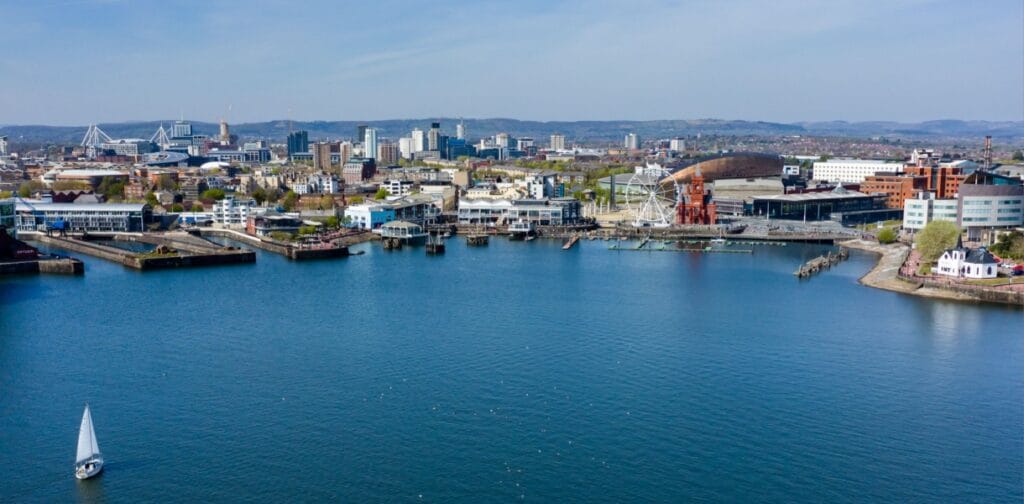
Cardiff
Wales’s capital is broad, confident and surprisingly easy to enjoy. It brings civic architecture, castle drama, bay redevelopment, cultural venues and a strong sense of modern national life.
Swansea
A coastal city with industrial memory, literary associations and easy access to the Gower, Swansea gives a different kind of south Wales experience from Cardiff.
Bangor
Small for a city, but useful as a base and important within the north Wales picture, especially for access to mountains and coast.
St Davids
Tiny in scale but huge in historical resonance, St Davids feels less like a normal city and more like a beautiful act of ecclesiastical stubbornness.
Towns with particular character
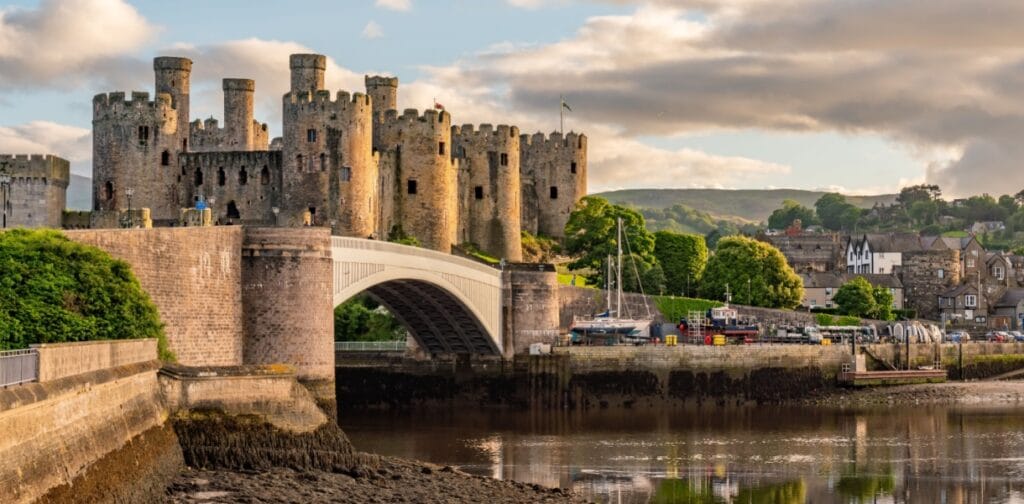
Conwy
One of the great Welsh town-and-castle combinations, and almost unfairly good at being photogenic from nearly every angle.
Caernarfon
A town with real gravity, shaped by its fortress and history, and far more than a quick castle stop.
Tenby
A harbour town with enough pastel seaside charm to win people over quickly, but enough historical shape to avoid feeling flimsy.
Aberystwyth
Part seaside, part university, part cultural outpost, and all the more enjoyable for refusing to be only one thing.
Hay-on-Wye
Books, border-country setting and a long habit of attracting people who like wandering and browsing as if it were a competitive sport.
Abergavenny
A very strong food-and-hills base, with the sort of market-town character that makes a stay feel easy from the outset.
Major tourist attractions
Castles and fortresses
Conwy Castle, Conwy
One of the country’s great fortress sites and part of a townscape that makes a very strong case for north Wales all by itself.
Caernarfon Castle, Caernarfon
A castle of real national importance and one of the most visually powerful historic sites in Wales.
Harlech Castle, Harlech
A dramatic west-coast fortress with the sort of setting that makes strategic history look almost cinematic.
Caerphilly Castle, Caerphilly
A major south Wales stronghold and one of the strongest historical stops within easy reach of Cardiff.
Historic buildings and heritage sites
St Davids Cathedral, St Davids
One of the country’s great ecclesiastical sites, and made stronger by its relatively remote setting.
The great abbeys and religious sites of Wales
Places such as Tintern and Valle Crucis add another layer to Wales beyond castles and mountains.
Portmeirion
An odd, delightful and entirely un-Welsh-looking place that somehow still belongs in the broader national picture.
Natural landmarks and scenic highlights
Eryri
The most famous mountain region in Wales and still capable of making the reputation seem justified.
Pembrokeshire Coast
One of the finest coastal landscapes in Britain, ideal for walking, beaches and dramatic sea views.
Bannau Brycheiniog
Rounded peaks, broad valleys and some of the strongest walking country in southern Wales.
The Gower
A beautiful south Wales peninsula that proves Wales can do city-and-coast combinations exceptionally well.
Museums and cultural attractions
St Fagans, near Cardiff
One of the best introductions to Welsh history and everyday life, and a superb place to understand the country beyond headline landmarks.
Big Pit and south Wales industrial heritage sites
Essential if you want to understand the country’s modern social and industrial story, not just its scenic one.
National Museum Cardiff
A strong capital-city cultural stop and a useful rainy-day anchor.
Family favourites
Castle-and-coast combinations in north and west Wales
Wales is particularly strong at trips where the setting and the history do half the entertaining.
Cardiff’s city attractions and parks
A good family option if the trip needs flexibility.
Coastal railway, harbour and beach towns
Useful for turning travel days into part of the fun rather than merely the gap between things.
How to plan a trip here
How long to stay
A long weekend works if you focus tightly on one part of the country, such as Cardiff and south Wales, north Wales and Eryri, or west Wales and Pembrokeshire. For a proper first trip, a week is much better. Trying to see north, south and west Wales all in a long weekend is an excellent way to appreciate road surfaces more than intended.
Best bases
Cardiff is the easiest urban base and a strong first choice for south Wales. Conwy or Llandudno work well for north Wales, especially for a first trip. Tenby and St Davids are strong west Wales bases depending on whether you want broader appeal or deeper coastal atmosphere. Aberystwyth is useful for mid Wales and the west-central coast. Abergavenny or Brecon suit trips built around walking, food and the southern hills.
Car or public transport
Some parts of Wales work well by rail, especially Cardiff, Swansea and parts of the north coast. Scenic rail travel can also be part of the pleasure. But if you want flexibility across the country, especially in mid Wales, the national parks, smaller coastal towns and the more rural interior, a car is usually much more practical. Wales often looks short on the map and long in reality.
Best first-time route through the country
A very strong first trip would be Cardiff, the Brecon Beacons and west Wales, or north Wales with Conwy, Caernarfon and Eryri as the backbone. Another excellent route is Cardiff, Hay-on-Wye and Pembrokeshire if you want city, border-country and coast in one sweep.
Best time to visit
Late spring and early autumn are especially good, when the coast is attractive, the mountains are clearer more often and the roads and towns are less pressured than in peak summer. Summer is excellent for beaches, walking and longer road trips, though obvious places get busy. Winter works well for Cardiff, some market towns and castle-focused short breaks, but the weather will quite rightly expect you to show some resilience.
Who this country suits best
Wales suits visitors who like strong scenery, visible history, coast, castles, smaller towns and trips that combine culture with landscape rather than separating the two. It is especially good for people who enjoy slower touring and who understand that some of the best parts of a holiday may involve a road, a view, a market town and an unexpectedly good lunch.
Best ways to experience the country
Best for a first visit
Choose either north Wales or south-and-west Wales rather than trying to conquer the entire country at once. Wales rewards depth much more than hurried collection.
Best for history lovers
Focus on Conwy, Caernarfon, St Davids, Cardiff and at least one industrial heritage site. Wales is especially strong when medieval, religious and industrial history are allowed to sit side by side.
Best for coast and scenery
Spend most of your time in Pembrokeshire, west Wales or north Wales, depending on whether you want softer maritime beauty or mountain-and-sea contrast.
Best for a long weekend
Choose one of these and stay loyal to it
Cardiff and south Wales
Conwy and north Wales
Pembrokeshire coast
Trying to “do Wales” in three days is a very efficient way to miss what makes it distinctive.
Best for a week-long tour
Use two bases and let the country unfold in stages. One urban or historic base and one scenic coastal or mountain base works particularly well.
Best for city and countryside balance
Cardiff and the Brecon Beacons, Conwy and Eryri, or Swansea and the Gower all make especially strong pairings.
Final verdict
Wales has the great advantage of being more varied than many outsiders assume and more deeply itself than they often expect. It can give you mountain roads, harbour towns, castles, industrial valleys, cathedral cities, beaches, language, rugby, chapels, market squares and some of the strongest coastal and upland scenery in Britain, all within a country that still feels coherent rather than overstuffed. That is a very good offer.
What makes Wales memorable, though, is not only the beauty. It is the strength of national character that runs through everything, from the language on the signs to the shape of the towns and the old stories in the land. This is a country for travellers who like places with backbone, internal variety and a sense that history still has a grip on the present. For that sort of visitor, Wales is not just a beautiful neighbour to England. It is one of the most rewarding countries in Europe to explore.