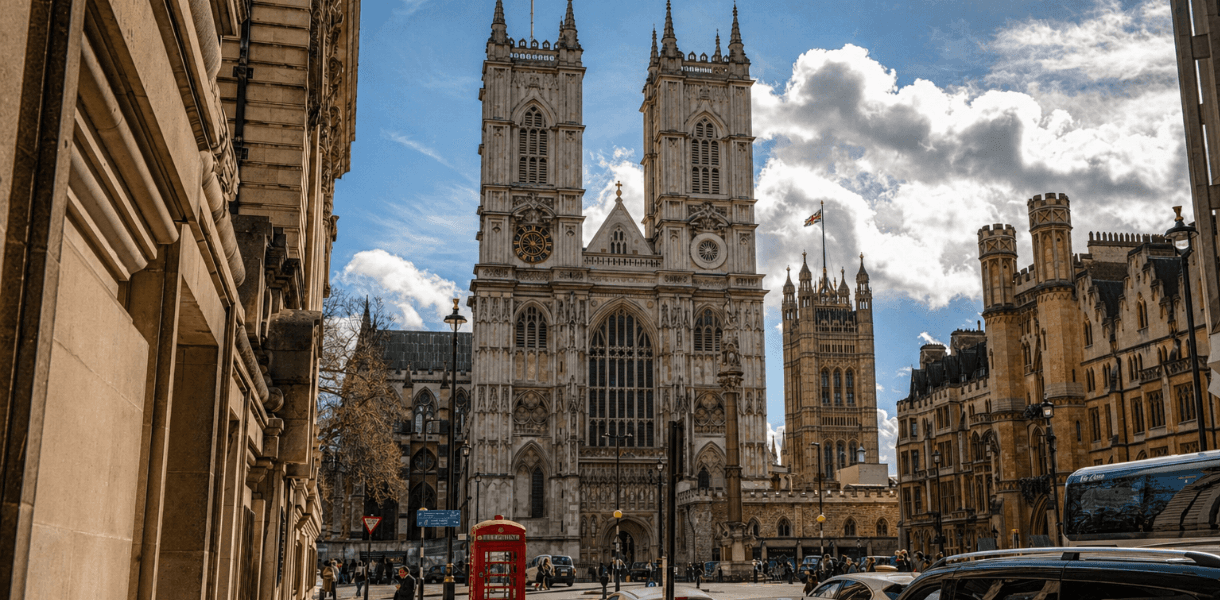
Looking for the best abbeys and abbey ruins to visit in Britain? This guide rounds up 15 of the most atmospheric monastic sites, from the grand ruins of Fountains, Rievaulx and Tintern to the clifftop drama of Whitby, the Border abbeys of Scotland, the urban calm of Kirkstall and the living splendour of Westminster and Bath Abbey. Expect roofless naves, riverside ruins, medieval power, royal history, gentle melancholy and, almost certainly, a strong desire for tea afterwards.
Quick takeaways
Best for sheer scale
Fountains Abbey
Best for romance
Tintern Abbey
Best coastal setting
Whitby Abbey
Best abbey trail
The Scottish Borders abbeys
Best urban abbey ruin
Kirkstall Abbey
Best for a history-packed day out
Battle Abbey
Best living abbey church
Westminster Abbey
Best quieter choice
Byland Abbey
The strange pleasure of a ruined abbey
A ruined abbey is one of Britain’s most dependable forms of theatre. It offers drama without requiring anyone to shout, history without too many laminated panels, and architecture that seems to improve once the roof has gone missing.
There is something especially powerful about these places because they sit between grandeur and loss. They were built to last forever, which of course they did not. In England and Wales, the Dissolution of the Monasteries scattered monastic life, wealth and buildings with extraordinary speed. Elsewhere, war, reform, neglect and the weather did their own steady work. Yet what remains can be more moving than a complete building. The gaps do some of the storytelling. The sky becomes part of the ceiling. The grass grows where monks once crossed in silence. A jackdaw lands on a window arch and instantly improves the composition.
This list is not just about the biggest ruins. It includes the famous, the beautiful, the historically important and the quietly haunting. Some are full day trips. Some are best folded into a wider weekend. A few are not ruins at all, but living abbey churches where Britain’s religious, royal and civic history is still very much on display.
1. Fountains Abbey, North Yorkshire
Fountains Abbey is the abbey ruin that seems to have misunderstood the word ruin. It is vast, elegant, imposing and so spectacularly placed that you begin to suspect medieval monks were secretly landscape designers with a sideline in spiritual discipline.
Set within the Studley Royal estate, Fountains is not just a ruin but a whole day’s worth of walking, looking, lingering and saying things like “good heavens” in a slightly more serious voice than usual. The abbey ruins and water garden form part of a UNESCO World Heritage Site, which feels entirely reasonable once you have seen the place doing its grand stone-and-water performance in the Yorkshire light.
This is one of the great historic sites in Britain. It suits families, walkers, photographers, garden lovers, history enthusiasts and anyone who likes the idea of an abbey ruin with enough scenery attached to justify a picnic.
Getting here
Near Ripon in North Yorkshire. Best reached by car, though Ripon is the nearest practical public transport base.
Best for
Scale, scenery, photography and a full heritage day out.
Facilities
Visitor facilities, toilets, café options and estate walks.
Time needed
Half a day at least. A full day if you want to explore properly.
Don’t miss
The cellarium, the abbey tower and the walk through Studley Royal Water Garden.
Official website
Fountains Abbey and Studley Royal, National Trust (National Trust)
2. Rievaulx Abbey, North Yorkshire
Rievaulx sits in its valley with the quiet confidence of a place that knows it has absolutely nailed the setting. The ruins rise among wooded slopes near Helmsley, pale stone against green fields, with the kind of atmosphere that makes even the least poetic visitor briefly consider becoming lyrical.
It was one of the earliest Cistercian abbeys founded in England and grew into one of the great monastic houses of the north. English Heritage describes the ruins as among England’s most majestic and complete abbey remains, and the site still carries that sense of power softened by time.
Rievaulx is especially good as part of a North York Moors or Helmsley break. It pairs beautifully with Byland Abbey, Helmsley Castle and a slow lunch somewhere with stone walls and excellent cake.
Getting here
Near Helmsley in North Yorkshire. Car is easiest.
Best for
Atmosphere, Cistercian history and peaceful valley scenery.
Facilities
Visitor facilities and interpretation on site. Helmsley has good nearby food and accommodation options.
Time needed
One to two hours, longer if combined with a walk.
Don’t miss
The view across the abbey from the surrounding valley slopes.
Official website
Rievaulx Abbey, English Heritage (English Heritage)
3. Tintern Abbey, Monmouthshire
Tintern Abbey has been making visitors go misty-eyed for centuries, and it shows no sign of stopping. Set beside the River Wye, with wooded hills rising around it, the roofless church seems less like a ruin than a carefully arranged lesson in melancholy.
It was founded by Cistercian monks in 1131 and later became one of the great romantic ruins of Britain. Cadw describes it as standing in “roofless splendour” on the banks of the Wye, which is one of those phrases that sounds a touch extravagant until you stand there and realise it is simply accurate.
Tintern is a wonderful anchor for a Wye Valley trip. It has beauty, accessibility, history and a strong sense of place. It also has the great advantage of looking magnificent without demanding that visitors understand every medieval detail before enjoying it.
Getting here
In the Wye Valley, close to the Wales and England border. Best reached by car, though bus connections operate from nearby towns.
Best for
Romantic ruins, riverside scenery and autumn breaks.
Facilities
Facilities in and around Tintern village, with places to eat nearby.
Time needed
One to two hours for the abbey, half a day with a river walk.
Don’t miss
The view through the great east window and a wander along the Wye.
Official website
Tintern Abbey, Cadw (Cadw)
4. Whitby Abbey, North Yorkshire
Whitby Abbey is proof that location can do at least half the work. Put a ruined abbey on a clifftop above a fishing town, add sea wind, gulls, graveyards, Dracula connections and 199 steps, and you have one of the most dramatic heritage sites in Britain.
But Whitby Abbey is not just a Gothic silhouette. The headland has hosted St Hild’s Anglo-Saxon monastery, the later medieval abbey and a Stuart mansion, which gives the site an unusually long and layered story.
This is an abbey ruin that works brilliantly for first-time visitors because the whole experience around it is so rich. You can climb from the harbour, explore the ruins, look back over the town and then reward yourself with fish and chips. Many historic sites try to offer a rounded visitor experience. Whitby simply has one waiting at the bottom of the hill.
Getting here
In Whitby on the North Yorkshire coast. The town has rail and bus connections, though services can be slow.
Best for
Coastal drama, Gothic atmosphere and town-and-heritage weekends.
Facilities
Visitor facilities at the abbey and plenty of food, drink and accommodation in Whitby.
Time needed
One to two hours for the abbey, a full day for Whitby.
Don’t miss
The clifftop views over Whitby harbour.
Official website
Whitby Abbey, English Heritage (English Heritage)
5. Glastonbury Abbey, Somerset
Glastonbury Abbey is less a ruin than a whole atmosphere with stonework attached. It sits at the centre of one of Britain’s richest layers of myth, faith, medieval power and glorious Somerset oddness. Early Christianity, pilgrimage, royal burials, Arthurian legend and later alternative spirituality all seem to gather here like guests at a very unusual garden party.
The abbey’s own visitor information describes it as a scheduled ancient monument, church and legendary burial place of King Arthur, which gives you some idea of the sort of historical company you are keeping.
A visit here works best when combined with the wider town, Glastonbury Tor and the Somerset Levels. Come expecting clean answers and you may leave disappointed. Come expecting stories, atmosphere and a place that has been tugging at the British imagination for centuries, and it delivers handsomely.
Getting here
In Glastonbury, Somerset. Best reached by car or by bus from nearby towns such as Wells and Street.
Best for
Legend, early Christianity, atmosphere and a wider Somerset day out.
Facilities
Town facilities close by, with cafés, shops and places to stay.
Time needed
Two hours for the abbey, a full day with the Tor and town.
Don’t miss
The abbey grounds, the Abbot’s Kitchen and the wider view of Glastonbury’s layered history.
Official website
Glastonbury Abbey (glastonburyabbey.com)
6. Melrose Abbey, Scottish Borders
Melrose Abbey has the look of a place that has lived through everything and still kept its manners. Founded in 1136 by David I, it became Scotland’s first Cistercian monastery and later endured repeated damage in the unsettled world of the Anglo-Scottish border.
The stonework is superb, with carved details that reward slow looking. The setting beneath the Eildon Hills gives the ruin extra presence, while the town of Melrose adds ease and charm. This is not an isolated ruin in a field. It is part of a place, and that makes it especially satisfying.
Melrose also works beautifully as the starting point for a Borders abbey trail. The region is rich in ruined religious houses, castles, riverside towns and rolling countryside, all packed into a surprisingly manageable area.
Getting here
In Melrose in the Scottish Borders. Tweedbank railway station is nearby, with onward bus, taxi or walking options.
Best for
Scottish history, carved stonework and Border country atmosphere.
Facilities
Facilities in Melrose, including places to eat and stay.
Time needed
One to two hours, longer if walking nearby.
Don’t miss
The carved details and views towards the Eildon Hills.
Official website
Melrose Abbey, Historic Environment Scotland (Historic Environment Scotland)
7. Jedburgh Abbey, Scottish Borders
Jedburgh Abbey has a different mood from Melrose. It is more fortress-like, more severe, and wonderfully impressive. Its great church still has enough height and structure to give a powerful sense of the building’s original presence.
Part of the pleasure here is the architecture. The building has an unusual mix of Romanesque and early Gothic styles, which is a grand way of saying that the place looks both muscular and elegant at the same time.
Jedburgh is ideal for visitors who enjoy the sense of a ruin as a piece of architectural evidence. You can see the ambition in the surviving walls. You can also sense the repeated pressures of a frontier region where religious buildings often found themselves uncomfortably close to politics, warfare and heavily armed neighbours.
Getting here
In Jedburgh in the Scottish Borders. Best reached by car or by bus from nearby towns.
Best for
Architecture, Scottish Borders history and town-based exploring.
Facilities
Facilities in Jedburgh, with shops, cafés and nearby visitor attractions.
Time needed
One to two hours.
Don’t miss
The towering nave and the sense of scale inside the abbey church.
Official website
Jedburgh Abbey, Historic Environment Scotland (Historic Environment Scotland)
8. Dryburgh Abbey, Scottish Borders
Dryburgh Abbey is the quieter Border abbey, and all the better for it. Set near the River Tweed, surrounded by trees and gentle countryside, it has a reflective quality that makes visitors lower their voices without quite knowing why.
The ruins are remarkably complete in places, and Historic Environment Scotland notes there is surviving plaster and paintwork in the chapter house. That small detail is rather moving. It reminds you that these places were not always bare stone and silence. They had colour, texture, order and everyday life.
If Melrose gives you grandeur and Jedburgh gives you architecture, Dryburgh gives you atmosphere. Together, they make the Borders one of Britain’s best regions for abbey lovers.
Getting here
Near St Boswells in the Scottish Borders. Car is easiest.
Best for
Peace, riverside atmosphere and literary associations.
Facilities
Visitor facilities on site, with nearby services in local villages and towns.
Time needed
One to two hours.
Don’t miss
The riverside setting and the grave of Sir Walter Scott.
Official website
Dryburgh Abbey, Historic Environment Scotland (Historic Environment Scotland)
9. Byland Abbey, North Yorkshire
Byland Abbey is what happens when a major medieval monastery somehow becomes the quiet one in the group. In almost any other county it would be the headline act. In North Yorkshire, it has to compete with Fountains, Rievaulx and Whitby, which is frankly a little unfair.
Yet Byland is magnificent. Its great west front, surviving window tracery and open setting give it a noble, contemplative feel. Byland was once one of England’s greatest monasteries and helped inspire church design across the north, including the famous rose window at York Minster.
This is an excellent choice for visitors who want beauty without crowds. It also makes a superb pairing with Rievaulx, creating a compact abbey-themed day in one of England’s richest monastic landscapes.
Getting here
Near Coxwold and Helmsley in North Yorkshire. Best reached by car.
Best for
Quiet grandeur, Cistercian history and avoiding the busiest sites.
Facilities
Limited facilities nearby. Plan food and comfort stops in surrounding villages or towns.
Time needed
Around one hour, longer if combined with nearby sites.
Don’t miss
The west front and the sense of openness around the ruins.
Official website
Byland Abbey, English Heritage (English Heritage)
10. Battle Abbey, East Sussex
Battle Abbey is not just an abbey. It is an abbey built on one of the most famous pieces of ground in English history, which is useful if you like your day trips with a decisive turning point.
Founded after the Norman Conquest, the abbey stands on the site associated with the Battle of Hastings in 1066. That gives the visit a rather different feel from the quieter monastic ruins elsewhere. Here, the story is not only prayer, landholding and medieval religious life. It is conquest, kingship and the violent reshaping of England.
The ruins, gatehouse and battlefield together make this one of the most complete historical days out on the list. It is especially good for families and first-time visitors because the story is big, clear and immediately gripping.
Quick info box
Getting here
In Battle, East Sussex. The town has a railway station, making this one of the easier sites to visit without a car.
Best for
1066 history, families and a full heritage day out.
Facilities
Visitor facilities on site and town facilities close by.
Time needed
Two to three hours, longer if exploring the town.
Don’t miss
The battlefield walk and views back towards the abbey.
Official website
Battle Abbey, English Heritage (English Heritage)
11. Kirkstall Abbey, Leeds
Kirkstall Abbey is one of Britain’s great urban ruins. It sits beside the River Aire in Leeds, surrounded by parkland, traffic, dog walkers, students, families and all the ordinary life of a modern city. That contrast is exactly what makes it so good.
The abbey remains are impressively complete, with a strong sense of the original church and cloister layout. Yet the mood is relaxed rather than solemn. People wander through, sit on the grass, take photographs and carry on with their day. Medieval Yorkshire and present-day Leeds share the space with surprising ease.
For UK Explorer readers, Kirkstall is especially useful because abbey ruins do not have to mean remote valleys and careful logistics. You can visit as part of a Leeds weekend, a riverside walk, or a day that also includes museums, cafés and city exploring. Leeds Museums and Galleries contains the latest visitor information, events and access details.
Getting here
In west Leeds, with local bus links and nearby parking.
Best for
Urban heritage, easy access and combining history with a city break.
Facilities
Visitor centre, café, toilets and parkland setting.
Time needed
One to two hours.
Don’t miss
The view of the abbey from across the parkland.
Official website
Kirkstall Abbey, Leeds Museums and Galleries (Leeds Museums and Galleries)
12. Furness Abbey, Cumbria
Furness Abbey has one of the most distinctive looks of any abbey ruin in Britain. Built from deep red sandstone, it rises from its valley near Barrow-in-Furness with a brooding, almost theatrical presence. If many abbey ruins look pale and ghostly, Furness looks like it has been steeped in autumn and old secrets.
It was once the largest and wealthiest monastery in north-west England, and the ruins still suggest that importance. English Heritage has also reconstructed the monks’ night stair, allowing visitors to climb to an observation platform and get a different view of the abbey remains.
This is a rewarding stop for travellers exploring South Cumbria, the Furness Peninsula or the quieter edges of the Lake District. It is not as well known as the Yorkshire giants, but that is part of its appeal. Furness feels like a discovery, and Britain is always better when it lets you feel slightly smug about finding something excellent.
Getting here
Near Barrow-in-Furness in Cumbria. Car is easiest, though local rail and taxi combinations may be possible.
Best for
Atmosphere, red sandstone ruins and quieter Cumbrian exploring.
Facilities
Visitor facilities on site, with more services in Barrow and nearby towns.
Time needed
One to two hours.
Don’t miss
The colour of the stone in low or late light and the reconstructed night stair.
Official website
Furness Abbey, English Heritage (English Heritage)
13. Waverley Abbey, Surrey
Waverley Abbey is not the most dramatic ruin on this list, and it would probably be the first to admit it in a modest Surrey sort of way. But it has a quiet importance. It was the first Cistercian monastery founded in Britain, established in 1128 by monks from France.
The remains are low and atmospheric, set in a peaceful landscape near Farnham. This is not a site that overwhelms you with scale. It works more gently, inviting you to imagine rather than simply admire. For some visitors, that is exactly the point.
Waverley is ideal for a soft, reflective day out. It combines well with Farnham, the River Wey, local walks and other Surrey heritage sites. Come for the history, stay for the peace, and enjoy the fact that not every great abbey visit has to involve towering walls and coach parties.
Getting here
Near Farnham in Surrey, off the B3001. Best reached by car, bike or as part of a local walk.
Best for
Quiet history, gentle walks and Cistercian origins in Britain.
Facilities
Limited facilities at the ruins. Farnham has food, drink and transport options.
Time needed
Around one hour.
Don’t miss
The peaceful setting and the surviving vaulted refectory remains.
Official website
Waverley Abbey, English Heritage (English Heritage)
14. Westminster Abbey, London
Westminster Abbey is not a ruin, and including it in a list of abbey ruins would be cheating if it were not so completely unavoidable. This is one of the most important religious buildings in Britain, and probably one of the most historically crowded interiors anywhere in Europe.
Founded in AD 960, the Abbey we see today largely dates from the 13th century. It has been the setting for every coronation since 1066 and contains the tombs and memorials of monarchs, writers, scientists and national figures.
For travellers, Westminster Abbey offers a very different abbey experience from the roofless ruins elsewhere. Instead of absence, you get accumulation. Every chapel, tomb and memorial adds another layer. It can be crowded and expensive, but it is also extraordinary. Some places are famous because they are famous. Westminster Abbey is famous because a quite unreasonable amount of British history has happened under its roof.
Getting here
In Westminster, central London. Easily reached by Underground, bus or on foot from many central sights.
Best for
Royal history, national ceremony, architecture and first-time London visits.
Facilities
Central London facilities nearby. Booking ahead is wise.
Time needed
Two hours, longer if you like reading memorials and taking things slowly.
Don’t miss
Poets’ Corner, the Lady Chapel and the coronation setting.
Official website
Westminster Abbey (Westminster Abbey)
15. Bath Abbey, Somerset
Bath Abbey stands in the middle of one of Britain’s most elegant cities, which must be both a blessing and a pressure. It has Roman baths beside it, Georgian terraces around it, tourists everywhere, and still it manages to hold its own.
The present building is a glorious late medieval church, famous for its light-filled interior and superb vaulting. Bath Abbey describes itself as a living church in the heart of the city, alive with music, prayer, art and history, which nicely captures the way it works as both sacred space and visitor landmark.
Bath Abbey is not a ruin, but it belongs in this wider abbey story because it shows what some monastic and ecclesiastical sites became after the great medieval upheavals. It also makes a natural centrepiece for a Bath city break. Visit for the architecture, stay for the city, and try not to spend the entire time wondering why more buildings do not have angels climbing up the front.
Getting here
In central Bath, a short walk from Bath Spa railway station.
Best for
Architecture, city breaks and combining heritage with food, shopping and museums.
Facilities
Excellent city facilities nearby. The Abbey also offers visitor information and tours.
Time needed
One hour for the abbey, a full day or weekend for Bath.
Don’t miss
The fan vaulting, the west front and a tower tour if available.
Official website
Bath Abbey (Bath Abbey)
Best abbey trips by theme
The great romantic ruins
Choose Tintern, Rievaulx, Fountains, Whitby or Glastonbury if you want atmosphere, photography and the full emotional power of roofless stone under a British sky.
The best abbey trail
Choose the Scottish Borders. Melrose, Jedburgh and Dryburgh sit close enough together to form a superb short break, especially with Kelso, the River Tweed and the Eildon Hills folded into the trip. Kelso Abbey is also part of the wider Borders abbey story, though Historic Environment Scotland currently notes access restrictions, so it is one to check carefully before building a trip around it. (Historic Environment Scotland)
The easiest abbeys without a car
Choose Westminster Abbey, Bath Abbey, Battle Abbey, Kirkstall Abbey and Whitby Abbey. All are more practical by public transport than many rural ruins.
The best quieter abbey ruins
Choose Byland, Waverley and Furness. They may not always make the loudest headlines, but each has its own strong reward.
Final verdict
Britain’s abbeys and abbey ruins are not just scenic remains of medieval religion. They are some of the best places in the country for understanding power, belief, landscape, architecture and loss. They show how much of medieval Britain was shaped by monastic life, and how dramatically that world was later broken apart.
They also make wonderful days out. Some are grand enough to fill a whole itinerary. Some are perfect for a quiet hour between larger stops. Some sit in valleys. Some stand above the sea. Some are still alive with worship, ceremony and city life. Others have given themselves over to grass, birds and weather.
The best of them leave you with that particular abbey feeling. A little thoughtful. A little windblown. And quite possibly in need of tea.