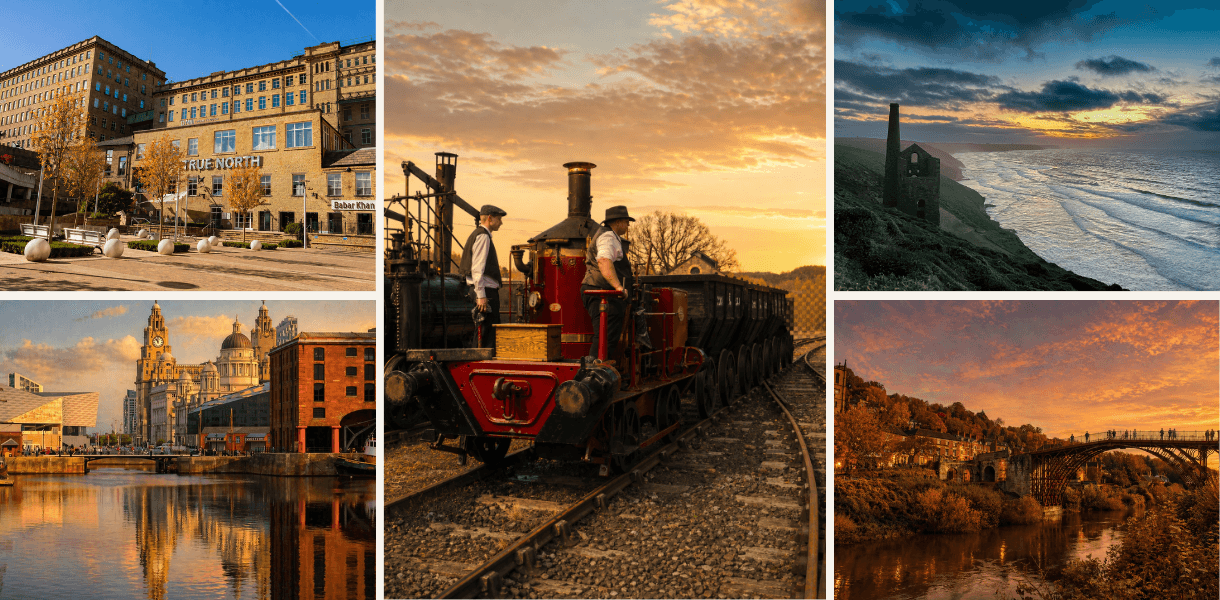
The best regions to explore industrial heritage
Britain’s industrial past is not tucked away politely in a display case. It is still there in railway arches, canal basins, old mills, dock warehouses, pit villages, engine houses, bridges, workshops and grand civic buildings that seem to say, with some justification, that quite a lot of the modern world was once knocked together here with smoke, stubbornness and a suspicious amount of tea.
The best industrial heritage regions are fascinating because they are not simply about the past. They are about what happened next. A mill becomes a gallery. A dock becomes a waterfront. A coalfield becomes a landscape of museums, country parks and memory. A railway workshop becomes a visitor attraction. The story is not just industry, but reinvention.
Quick takeaways
Best for first-time visitors
Greater Manchester, Ironbridge Gorge, West Midlands and the Black Country
Best for coal and community history
South Wales Valleys, North East England, Yorkshire and the Pennines
Best for mills and textiles
Greater Manchester, Yorkshire, Derwent Valley
Best for docks and maritime reinvention
Liverpool and the Mersey, Cardiff Bay, Bristol
Best for dramatic industrial landscapes
Cornwall and west Devon, Glasgow and the Clyde, North East England
Best compact industrial heritage trip
Ironbridge Gorge and Shropshire
Why industrial Britain makes such a good trip
Industrial heritage has a way of giving places texture. It explains why a town has a huge station, a handsome town hall, a canal under a road, or a row of warehouses so confident they look faintly offended by modern architecture. It gives you stories of invention, labour, migration, trade, ambition, hardship and civic pride.
It also makes for excellent visiting. These regions tend to come with proper museums, handsome restored buildings, canalside walks, railway heritage, old engineering sites, lively food scenes and cities that have learned to turn former working districts into some of their most interesting neighbourhoods.
There is romance here, but not the soft-focus kind. This is romance with soot on its boots.
1. North East England
North East England feels industrial in the best possible sense. Not drab, but purposeful. This is a region of coalfields, railways, shipyards, bridges, ports, glassmaking, iron, steel and engineering, all tied together by a fierce sense of local identity.
Newcastle and Gateshead give the story its grand urban stage. The Tyne bridges are not just crossings, but declarations. The Quayside, once built around trade and industry, now mixes culture, food, nightlife and riverside swagger. Downriver, the story turns towards shipbuilding and maritime work, while inland County Durham carries the memory of coal mining communities that shaped generations of working life.
Beamish is the great anchor attraction, giving visitors one of Britain’s best living-history introductions to industrial and social life. But the wider region rewards slower exploration too. Durham’s old mining landscapes, Sunderland’s glass and shipbuilding heritage, and the Tees Valley’s ongoing reinvention all add depth.
Getting here
Newcastle is the best rail gateway, with strong links from London, Edinburgh, York and Leeds.
Best places to base yourself
Newcastle, Durham, Sunderland or Middlesbrough, depending on whether you want city culture, mining heritage or Tees-side regeneration.
Industrial highlights
Beamish, Newcastle Quayside, the Tyne bridges, Durham coalfield heritage, Sunderland glassmaking heritage, Tees Valley industrial landscapes.
Best for
Coal, railways, bridges, shipbuilding, civic pride and post-industrial reinvention.
Time needed
Two to four days.
Don’t miss
Walking Newcastle and Gateshead’s Quayside at dusk, when the bridges and river make the whole place feel unexpectedly grand.
2. South Wales Valleys and Cardiff Bay
Few regions tell the industrial story as powerfully as South Wales. The valleys were shaped by coal and iron, by hard labour, close communities, chapels, rugby clubs, railways and the astonishing movement of material from hillside seams to global markets.
This is industrial heritage at landscape scale. Towns and villages sit in folds of green hills, often with the past visible in terraces, old workings, memorials and museums. Big Pit is the essential starting point, not because it tidies the story up, but because it takes you into the physical reality of mining life.
Cardiff Bay adds the reinvention chapter. The old docks that once sent coal across the world now form one of Britain’s most striking waterfront transformations. It is not the same story as the valleys, but it belongs to the same industrial system. Together they show both the power and the aftermath of coal.
Getting here
Cardiff is the main rail gateway, with onward routes into the valleys by train and road.
Best places to base yourself
Cardiff for the bay and easy day trips, or Blaenavon and the surrounding valleys for a deeper heritage focus.
Industrial highlights
Big Pit, Blaenavon, Cardiff Bay, former coalfield towns, valley rail routes, ironworks heritage.
Best for
Coal, iron, working communities, landscape history and waterfront reinvention.
Time needed
Two to three days.
Don’t miss
Pairing Big Pit with Cardiff Bay, because the contrast says more than either place can on its own.
3. West Midlands and the Black Country
The West Midlands does not merely have industrial heritage. It practically has it under the fingernails. This is a region of canals, foundries, metalworking, glass, locks, workshops, factories and the sort of practical genius that helped make modern Britain look, move, cook, build and occasionally clang.
The Black Country is the heart of the story. Its name alone has a satisfying weight to it, and the Black Country Living Museum gives a vivid, human sense of the region’s working past. Dudley, Wolverhampton, Walsall and surrounding towns still carry the traces of industry in their layout, buildings and waterways.
Birmingham adds scale and reinvention. Its canal network, Jewellery Quarter, old manufacturing districts and revived city centre make it one of Britain’s most rewarding industrial cities to explore. It is a place that has spent years being underestimated, which is often when British cities become most interesting.
Getting here
Birmingham is the main rail hub, with excellent national connections.
Best places to base yourself
Birmingham for city culture and transport links, or Dudley for Black Country heritage.
Industrial highlights
Black Country Living Museum, Birmingham canals, Jewellery Quarter, Dudley Canal and Tunnel Trust, historic metalworking areas.
Best for
Canals, foundries, metalwork, workshops and industrial urban character.
Time needed
Two to three days.
Don’t miss
The Black Country Living Museum, especially if you want industrial history with streets, voices, shops and proper atmosphere rather than just labels on walls.
4. Greater Manchester
Manchester did not so much participate in the Industrial Revolution as stride into the room, rearrange the furniture and start exporting the modern age by the yard. Cotton, canals, railways, warehouses, mills, engineering and commerce made it one of the defining industrial cities of the world.
The centre still carries that confidence. Red-brick warehouses, canal basins, railway viaducts and old commercial buildings give Manchester a texture that is hard to fake. Nearby towns add more layers. Stockport, Bolton, Wigan, Oldham, Rochdale and Salford all bring their own mill, canal and working-class histories.
What makes Greater Manchester especially compelling is the reinvention. Old industrial spaces now hold galleries, studios, bars, flats, music venues, media spaces and food halls. The place has not forgotten its past. It has simply found new uses for the buildings and then added better coffee.
Getting here
Manchester Piccadilly and Victoria are the main rail gateways, with strong national connections.
Best places to base yourself
Manchester city centre, Salford Quays, Stockport or Castlefield.
Industrial highlights
Science and Industry Museum, Castlefield, Ancoats, Salford Quays, canals, mills and warehouse districts.
Best for
Cotton, canals, railways, warehouses and urban reinvention.
Time needed
Two to four days.
Don’t miss
Castlefield and Ancoats, where old infrastructure and new city life sit unusually well together.
5. Liverpool and the Mersey
Liverpool’s industrial and maritime heritage has a different flavour. It is not just about manufacturing, but movement. Goods, people, ships, money, music, ideas and difficult histories all passed through here, leaving a city with extraordinary architecture and a waterfront that still feels built for big entrances.
The docks are central. Warehouses, quays, basins and grand commercial buildings tell the story of trade on a global scale. The Royal Albert Dock is now one of Britain’s best-known examples of heritage-led regeneration, but the wider Mersey story reaches beyond the polished waterfront into shipbuilding, engineering, working docks and port communities.
Liverpool’s reinvention has not smoothed away its character. That is part of the appeal. The city still has grit, humour, confidence and theatrical timing. It is industrial heritage with a maritime breeze and a soundtrack.
Getting here
Liverpool Lime Street is the main rail gateway.
Best places to base yourself
Liverpool city centre, the waterfront, Baltic Triangle or Wirral for views back across the Mersey.
Industrial highlights
Royal Albert Dock, Pier Head, Merseyside Maritime Museum, dockland warehouses, Wirral waterfront, port heritage.
Best for
Docks, shipping, trade, warehouses, maritime history and cultural reinvention.
Time needed
Two to three days.
Don’t miss
The waterfront walk from the Royal Albert Dock to Pier Head, one of Britain’s great urban heritage strolls.
6. Yorkshire mill towns and the Pennines
Yorkshire’s industrial heritage is not confined to one city. It climbs valleys, fills towns, follows canals and sits handsomely in stone against the Pennine weather. This is a region of wool, textiles, mills, engineering, model villages, warehouses, civic pride and railway arches.
Saltaire is the obvious jewel, and rightly so. It is one of the clearest places in Britain to understand the scale, ambition and social order of textile industry. But the wider story is richer than a single site. Bradford, Halifax, Leeds, Huddersfield, Keighley, Hebden Bridge and the Aire and Calder waterways all offer different versions of the mill-town story.
The reinvention is equally interesting. Former mills now hold galleries, offices, markets, apartments, independent shops and cultural spaces. In places like Hebden Bridge and Saltaire, the industrial past has become part of a new visitor identity, with canals, hills and handsome old buildings doing much of the heavy lifting.
Getting here
Leeds, Bradford, Halifax and Huddersfield all have useful rail links.
Best places to base yourself
Leeds for a city base, Saltaire for heritage, Halifax for architecture, or Hebden Bridge for valley atmosphere.
Industrial highlights
Saltaire, Piece Hall in Halifax, Leeds waterfront, Bradford’s textile heritage, Huddersfield mills, Rochdale Canal, Keighley and Worth Valley Railway.
Best for
Textiles, mills, canals, model villages and Pennine townscapes.
Time needed
Three to five days.
Don’t miss
Saltaire and Halifax together, a pairing that gives you both planned industrial order and grand civic drama.
7. Glasgow and the Clyde
Glasgow’s industrial heritage has scale, muscle and style. The Clyde was once synonymous with shipbuilding and engineering, while the city itself grew into one of Britain’s great urban powerhouses. It has the architecture to prove it too, from warehouses and tenements to civic buildings that seem to have been designed by people with no intention of whispering.
The river is the main thread. Shipyards, docks and engineering works shaped the city’s identity, while museums and waterfront regeneration now help visitors understand the scale of what once happened here. The Riverside Museum is an excellent introduction, but the wider reward is wandering the city itself, reading the industrial past in stone, iron, bridges and street patterns.
Glasgow’s reinvention has real energy. It is cultural, architectural, musical and food-led, but it has not become bland in the process. The city still feels like itself, which is the best kind of renewal.
Getting here
Glasgow Central and Queen Street are the main rail gateways.
Best places to base yourself
Glasgow city centre, Finnieston, Merchant City or the West End.
Industrial highlights
Riverside Museum, Clyde waterfront, shipbuilding heritage, historic warehouses, bridges, engineering districts.
Best for
Shipbuilding, engineering, urban architecture and cultural reinvention.
Time needed
Two to four days.
Don’t miss
A riverside walk paired with the Riverside Museum, then an evening in Finnieston for a neat summary of Glasgow old and new.
8. Cornwall and west Devon mining landscape
Cornwall and west Devon offer one of Britain’s most atmospheric industrial landscapes. Here the industrial past does not sit in brick warehouses or city streets, but in engine houses, mine stacks, ruined workings, tramways and harbours, often set against cliffs, moors and Atlantic weather.
The result is dramatic and strangely beautiful. Tin and copper mining shaped communities, fortunes, migration and the landscape itself. Around places such as St Just, Redruth, Camborne, St Agnes, Tavistock and the Tamar Valley, the remains of industry feel inseparable from the scenery.
This is heritage with salt in the air and gorse on the slopes. It is also a reminder that industrial Britain was never just urban. Some of its most powerful stories happened in remote, rugged places where the ground itself was the workplace.
Getting here
Mainline rail routes serve Plymouth, Truro, Redruth, Camborne and Penzance, though many mining sites are easiest by car.
Best places to base yourself
St Just, St Agnes, Redruth, Tavistock or Plymouth for wider access.
Industrial highlights
Levant Mine, Geevor Tin Mine, Botallack, Heartlands, Tamar Valley, Tavistock, mining engine houses and coastal paths.
Best for
Mining, engine houses, rugged landscapes and industrial archaeology.
Time needed
Three to five days.
Don’t miss
The engine houses around Botallack and Levant, where the industrial past meets the coast in spectacular fashion.
9. Ironbridge Gorge and Shropshire
Ironbridge Gorge in Shropshire is the compact classic. It is one of those places where the phrase “birthplace of the Industrial Revolution” could easily sound overblown, except here it feels entirely reasonable. The gorge, the bridge, the river, the museums and the old industrial settlements together make a clear, readable story.
What makes Ironbridge so good for visitors is its scale. You do not need to decode a whole city or chase fragments across a region. The industrial story is concentrated, scenic and exceptionally well served by museums. Blists Hill Victorian Town, Coalbrookdale, Coalport and Jackfield all add different chapters.
It is also a very attractive place, which feels almost unfair. You arrive for iron, industry and invention, and find wooded slopes, riverside views and handsome villages behaving as though they are on a quiet weekend away.
Getting here
Telford is the nearest main rail gateway, with bus or taxi connections to Ironbridge.
Best places to base yourself
Ironbridge, Coalbrookdale, Much Wenlock or Shrewsbury.
Industrial highlights
The Iron Bridge, Blists Hill Victorian Town, Coalbrookdale Museum of Iron, Coalport China Museum, Jackfield Tile Museum.
Best for
Early industry, iron, ceramics, museums and a compact heritage break.
Time needed
Two days.
Don’t miss
Standing on the Iron Bridge itself, which remains quietly thrilling even if you are not normally moved by eighteenth-century engineering.
10. Derwent Valley and the East Midlands
The Derwent Valley is where industrial history becomes almost deceptively calm. The river, mills, villages and wooded valley scenery make it easy to forget how radical this landscape once was. Yet this was one of the places where the modern factory system took shape.
Cromford is the key stop, with its links to Richard Arkwright and the development of water-powered textile production. Belper, Darley Abbey and Derby add further layers, showing how mills, housing, water power, transport and communities formed a new kind of industrial landscape.
It is a quieter trip than Manchester or the Black Country, but that is part of its appeal. The Derwent Valley allows you to understand industrial change at a human scale, with stone buildings, river paths and small towns rather than metropolitan roar.
Getting here
Derby is the main gateway, with rail links to Belper, Matlock Bath and nearby towns.
Best places to base yourself
Derby, Belper, Cromford or Matlock.
Industrial highlights
Cromford Mills, Masson Mills, Belper mills, Darley Abbey, Derby Silk Mill, Derwent Valley Mills landscape.
Best for
Early factories, water power, textile production and compact industrial villages.
Time needed
Two to three days.
Don’t miss
Cromford Mills, then a walk through the village and along the valley to see how industry, water and landscape fit together.
Final verdict
Britain’s industrial heritage is not one story, but many. It is coal in the valleys, cotton in Manchester, wool in Yorkshire, ships on the Clyde, docks on the Mersey, iron in Shropshire, tin in Cornwall, metalwork in the Black Country and early factories along the Derwent.
What makes these regions so rewarding is that they show both sides of the national character. The restless urge to invent, build, dig, forge, move and manufacture, and the equally persistent habit of taking old places and making something new from them.
For a first trip, choose Greater Manchester, the West Midlands and the Black Country, or Ironbridge Gorge. For atmosphere, go to South Wales, Yorkshire, Glasgow or Cornwall. For the richest sense of past and present rubbing shoulders, head for North East England, Liverpool or the Clyde.
Industrial Britain may have lost much of its smoke, but it has not lost its power.