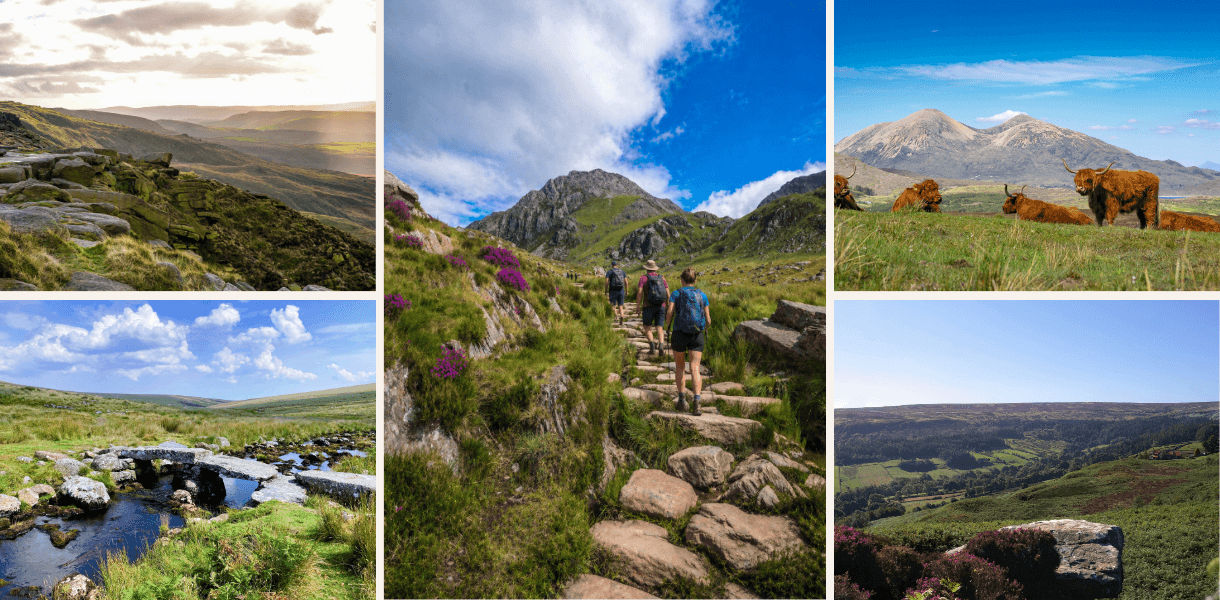
Britain does hills and moorland with real flair. Not always gently, and rarely without wind getting involved, but with a wonderful sense of space, drama and slightly muddy satisfaction. These are the UK regions where ridges, tors, heather, high moors and big views give the landscape its proper character.
Quick takeaways
Best for classic moorland
Dartmoor, North York Moors, Peak District
Best for big views and hill walking
Yorkshire Dales, Bannau Brycheiniog, Scottish Highlands
Best for solitude
Northumberland, Scottish Borders, Exmoor
Best first hill and moorland trip
Peak District or Yorkshire Dales
Best for wild atmosphere
Dartmoor, Rannoch Moor, Cairngorms
Why hills and moorland make such good trips
There is something deeply satisfying about a landscape that refuses to lie flat. Hills give a trip shape. Moorland gives it mood. Together they create the sort of places where a walk feels properly earned, the weather becomes part of the story, and a flask of tea takes on the emotional importance of a small inheritance.
Britain’s upland regions are not all dramatic in the same way. Some are rugged and stony, some are soft and sheep-nibbled, some are purple with heather in late summer, and some appear to have been assembled from wind, peat and ancient suspicion. What unites them is that wonderful sense of openness. You can breathe differently in these places. You can see further. You can also, if you are not paying attention, step confidently into a bog and learn something about humility.
These are the regions where hills and moorland feel central to the whole experience.
1. Yorkshire Dales
The Yorkshire Dales do not shout about themselves. They simply roll out valley after valley, wall after wall, fell after fell, until you realise you have been quietly impressed for several hours.
This is hill country at its most approachable and handsome. The landscape has a wonderful balance of openness and human detail. There are high moors and broad views, but also stone barns, dry-stone walls, small villages, old lanes and market towns that appear just when you begin thinking lunch would be a civilised idea.
Swaledale, Wensleydale and Wharfedale all have their own personality. Malham brings limestone drama. Ingleborough and Pen-y-ghent offer classic hill days. The moorland tops feel spacious without tipping too far into severity. It is a region that suits walkers, photographers, village wanderers and anyone who likes their scenery with a good pub at the end.
Best for
Classic hill country with villages and valleys
What it feels like
Open, green, stone-built and quietly magnificent
Don’t miss
Malham Cove, Swaledale, Ingleborough, Pen-y-ghent, the high road views above Wensleydale
Good base options
Settle, Grassington, Hawes, Reeth, Kirkby Lonsdale
2. North York Moors
The North York Moors are one of Britain’s great mood landscapes. In summer, the heather can turn the high ground an almost theatrical purple. In winter, the same hills become darker, quieter and wonderfully brooding, as if the whole place has decided to write a novel.
What makes the region special is the scale of its open moorland. The villages tucked into the valleys are charming, but the real character lies up high, where roads cross wide empty ridges and the horizon seems to keep moving away from you.
It is also a region of lovely contrasts. You can walk heather moor in the morning, drop into a wooded dale by lunch, and reach the coast by late afternoon. Few places combine such big skies with such a strong sense of old rural life.
Best for
Heather moorland and wide skies
What it feels like
Spacious, atmospheric and slightly mysterious
Don’t miss
Rosedale, Farndale, Blakey Ridge, Danby, the Cleveland Way escarpment
Good base options
Helmsley, Pickering, Hutton-le-Hole, Goathland, Danby, Whitby
3. Peak District
The Peak District is a brilliant first upland region because it gives you so much variety in a relatively compact area. It has gritstone edges, peat plateaus, limestone dales, handsome villages and enough dramatic walking to make you feel heroic without requiring an expedition team.
The Dark Peak is the place for moorland atmosphere. Kinder Scout, Bleaklow and the edges above the Hope Valley have that raw, open quality that makes a day feel properly outdoors. The White Peak softens things with limestone valleys, green fields and pretty villages, but even here the hills are never far away.
It is also one of the easiest upland regions to reach from major cities, which gives it a democratic charm. You can leave urban life behind remarkably quickly and find yourself on a ridge with wind in your ears and gritstone underfoot.
Best for
Accessible hill walking and varied moorland
What it feels like
Rugged, practical, atmospheric and full of good walking days
Don’t miss
Kinder Scout, Stanage Edge, Mam Tor, Edale, Dovedale, Curbar Edge
Good base options
Bakewell, Castleton, Edale, Hathersage, Buxton, Hope
4. Dartmoor
Dartmoor is moorland with a story-telling instinct. Granite tors rise from the high ground like weathered monuments. Ponies appear with complete confidence. Mist drifts in at inconveniently dramatic moments. Even the stones seem to know something.
This is one of Britain’s most distinctive upland landscapes. It feels ancient, open and elemental, with a character quite unlike the green hill country of the north. The walking can be easy around the edges and more serious in the interior, where bog, weather and distance require a little respect.
Dartmoor is especially good for visitors who like atmosphere as much as views. Yes, there are big panoramas, but the real pleasure is the feeling of the place. It has Bronze Age remains, old tracks, granite villages, river valleys and tors that make even a short walk feel like a small adventure.
Best for
Classic moorland atmosphere and granite tors
What it feels like
Ancient, rugged, strange and deeply memorable
Don’t miss
Haytor, Hound Tor, Bellever Forest, Wistman’s Wood, Widecombe-in-the-Moor, High Willhays
Good base options
Tavistock, Moretonhampstead, Chagford, Ashburton, Princetown
5. Exmoor
Exmoor is often quieter than it deserves to be, which is one of the reasons it works so well. It has rolling moor, wooded valleys, rivers, high viewpoints and a coastline that suddenly drops away in spectacular fashion.
The great joy of Exmoor is its mix of upland and sea. One moment you are crossing open moorland with ponies grazing in the distance. The next, you are looking down towards the Bristol Channel from cliffs that feel far grander than England’s southwest edge has any right to produce.
It is not as stark as Dartmoor and not as busy as some better-known hill regions. Instead, it offers a softer, more secretive kind of moorland beauty, full of wooded combes, hidden lanes and high open ground.
Best for
Moorland with coastal drama
What it feels like
Quiet, varied, gently wild and slightly under the radar
Don’t miss
Dunkery Beacon, Valley of Rocks, Porlock Hill, Tarr Steps, Lynmouth, Doone Valley
Good base options
Dulverton, Porlock, Lynmouth, Lynton, Dunster
6. Northumberland
Northumberland’s hills do not always announce themselves with great theatrical gestures. They roll, rise and spread out with a quiet confidence that becomes more impressive the longer you spend with them.
The Cheviots are the heart of the hill country here, straddling the border and offering some of the best walking for anyone who likes space, solitude and a feeling of being properly away from things. Simonside adds a more compact ridge experience, while Hadrian’s Wall country gives the landscape historical muscle.
This is a superb region for people who want fewer crowds and bigger silences. The hills are not the highest in Britain, but they have a rare emptiness. The views feel spacious, the skies feel enormous, and the whole place seems to have politely declined the idea of fuss.
Best for
Solitude and wide open hill country
What it feels like
Quiet, spacious, honest and beautifully unhurried
Don’t miss
The Cheviots, College Valley, Simonside, Hadrian’s Wall, Breamish Valley
Good base options
Rothbury, Wooler, Haltwhistle, Bellingham, Hexham
7. Bannau Brycheiniog
Bannau Brycheiniog, still widely known as the Brecon Beacons, is one of the best regions in Britain for big, satisfying hill walks. The ridges are broad, the views are generous, and the scenery has a strong, open quality that makes you want to keep going.
Pen y Fan is the headline act, but the wider region is far richer than one summit. The Black Mountains, Fforest Fawr and the western Beacons all offer different moods, from grand ridge walks to quieter uplands and hidden valleys. It is a landscape that rewards both first-timers and more experienced walkers.
The hills here feel bold without being remote in a forbidding way. You can have a proper day out on high ground, then return to a market town, canal-side pub or village base with the pleasing sense that you have done something worthwhile.
Best for
Ridge walks and big upland views
What it feels like
Open, walking-friendly, dramatic but welcoming
Don’t miss
Pen y Fan, Corn Du, Llyn y Fan Fach, the Black Mountains, Waterfall Country
Good base options
Brecon, Crickhowell, Abergavenny, Hay-on-Wye, Llandovery
8. Eryri
Eryri is famous for mountains, but its moorland and lower upland landscapes are just as important to its character. Between the great peaks are wide valleys, rough hillsides, quieter plateaus and open spaces where the drama eases just enough to let you breathe.
This is the region for visitors who want hills with real scale. Yr Wyddfa draws the crowds, but there are countless other corners where the landscape feels wilder and more spacious. Around Cadair Idris, the Rhinogydd and the uplands away from the busiest routes, Eryri has a wonderful rough-edged quality.
It is not gentle country, and it does not pretend to be. But for sheer variety of hill and moorland scenery, few places in Britain can match it.
Best for
Mountain drama with moorland edges
What it feels like
Big, rugged, varied and full of weather
Don’t miss
Cadair Idris, the Ogwen Valley, the Rhinogydd, Beddgelert, the quieter uplands around Trawsfynydd
Good base options
Betws-y-Coed, Beddgelert, Dolgellau, Llanberis, Bala
9. Scottish Borders
The Scottish Borders are hill country in a gentler key. This is not the Highland drama of sharp ridges and vast glens, but a rolling, lyrical landscape of rounded hills, river valleys, abbeys, small towns and roads that seem designed for meandering.
For walkers, the Borders offer a lovely balance. The hills are generous rather than severe, and the distances can be shaped into satisfying days without needing to commit to anything too brutal. The Eildon Hills, the Cheviot fringes and the Southern Upland Way all give the region real walking credentials.
What makes the Borders especially appealing is the way the hills sit alongside history. Abbey towns, old routes, castles, battlefields and river valleys give the landscape texture. It feels lived-in, storied and quietly addictive.
Best for
Gentle hill country with history
What it feels like
Rolling, peaceful, old and quietly romantic
Don’t miss
Eildon Hills, Tweed Valley, St Cuthbert’s Way, Southern Upland Way, the hills around Yetholm
Good base options
Melrose, Peebles, Kelso, Jedburgh, Innerleithen
10. Scottish Highlands
The Scottish Highlands are what happens when hills and moorland are allowed to stop being polite. Everything is bigger, emptier, wetter, wilder and more dramatic. The moors stretch on. The mountains rise suddenly. The glens pull you deeper in. The sky behaves like a theatre curtain with opinions.
For moorland, Rannoch Moor is one of the great British landscapes. Vast, boggy, open and haunting, it has the sort of beauty that makes you go quiet without quite knowing why. The Cairngorms add high plateau country and immense upland scale, while the west Highlands bring rough moor, lochs, glens and mountain backdrops that feel almost excessive.
This is not always easy countryside. Distances are greater, weather matters, and planning is important. But for visitors who want hills and moorland at their most powerful, the Highlands are in a category of their own.
Best for
Scale, wildness and unforgettable upland drama
What it feels like
Vast, elemental, remote and occasionally overwhelming
Don’t miss
Rannoch Moor, Glen Coe, Cairngorms, Assynt, Torridon, the road to Skye
Good base options
Aviemore, Fort William, Pitlochry, Kingussie, Ullapool, Torridon
Also worth considering
The Shropshire Hills
A beautiful, accessible region of ridges, valleys and market towns. The Long Mynd and Stiperstones give it a strong upland character without the scale of the bigger national parks.
The North Pennines
Wild, quiet, high and wonderfully underappreciated. Excellent for moorland, waterfalls, big skies and a proper sense of remoteness.
The Isle of Man
Compact but surprisingly dramatic, with moorland hills, sea views and a strong sense of place.
The Mourne Mountains
One of Northern Ireland’s finest upland landscapes, where granite peaks, moorland slopes and sea views come together beautifully.
Final verdict
For a first trip into Britain’s hill and moorland landscapes, the Peak District and Yorkshire Dales are hard to beat. They are accessible, varied and full of rewarding walks that do not require heroic levels of planning.
For classic moorland atmosphere, Dartmoor and the North York Moors are the standouts. Dartmoor is stranger and more elemental. The North York Moors are broader, softer and glorious when the heather is out.
For scale and drama, go to Eryri, Bannau Brycheiniog or the Scottish Highlands. For quiet, soul-restoring space, choose Northumberland, Exmoor or the Scottish Borders.
The real joy of these regions is that they remind you how much variety Britain manages to squeeze into its uplands. Some hills are friendly. Some are stern. Some are basically just weather with contours. All of them make the country feel bigger, older and far more interesting than it has any practical right to be.